
Home › Blog › Top 3 most beautiful mosques in Malaysia
Ranking · 8 min read · 2026-03-02
Top 3 most beautiful mosques in Malaysia
A hard choice, since Malaysia has multiplied its mosque-manifestos since independence. Here nonetheless is our selection of the three most spectacular, from the floating glass of Terengganu to the pink granite of Putrajaya, with the history, figures and details that justify each one's place on this podium.
#1 : Crystal Mosque, the floating glass mosque
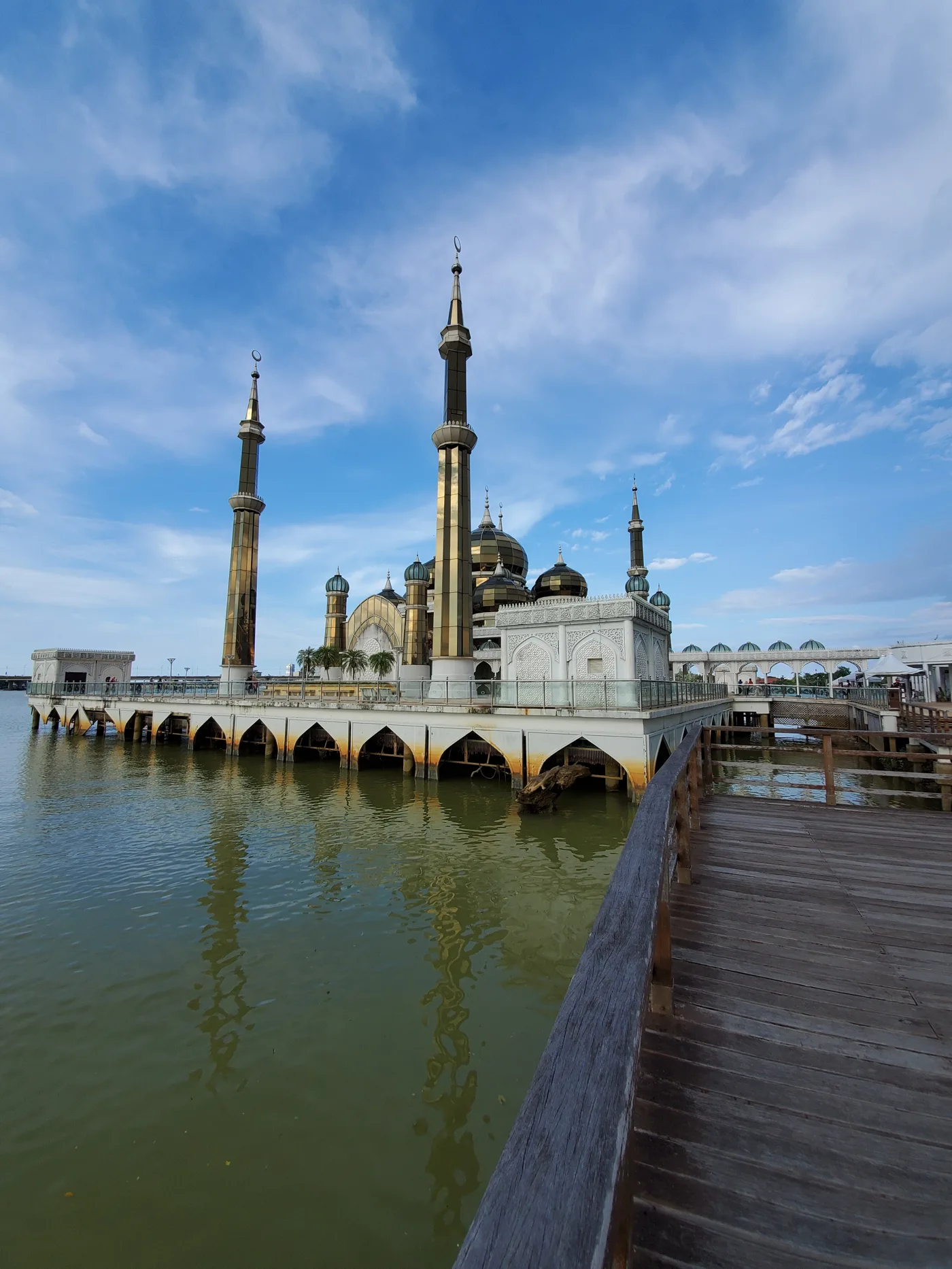
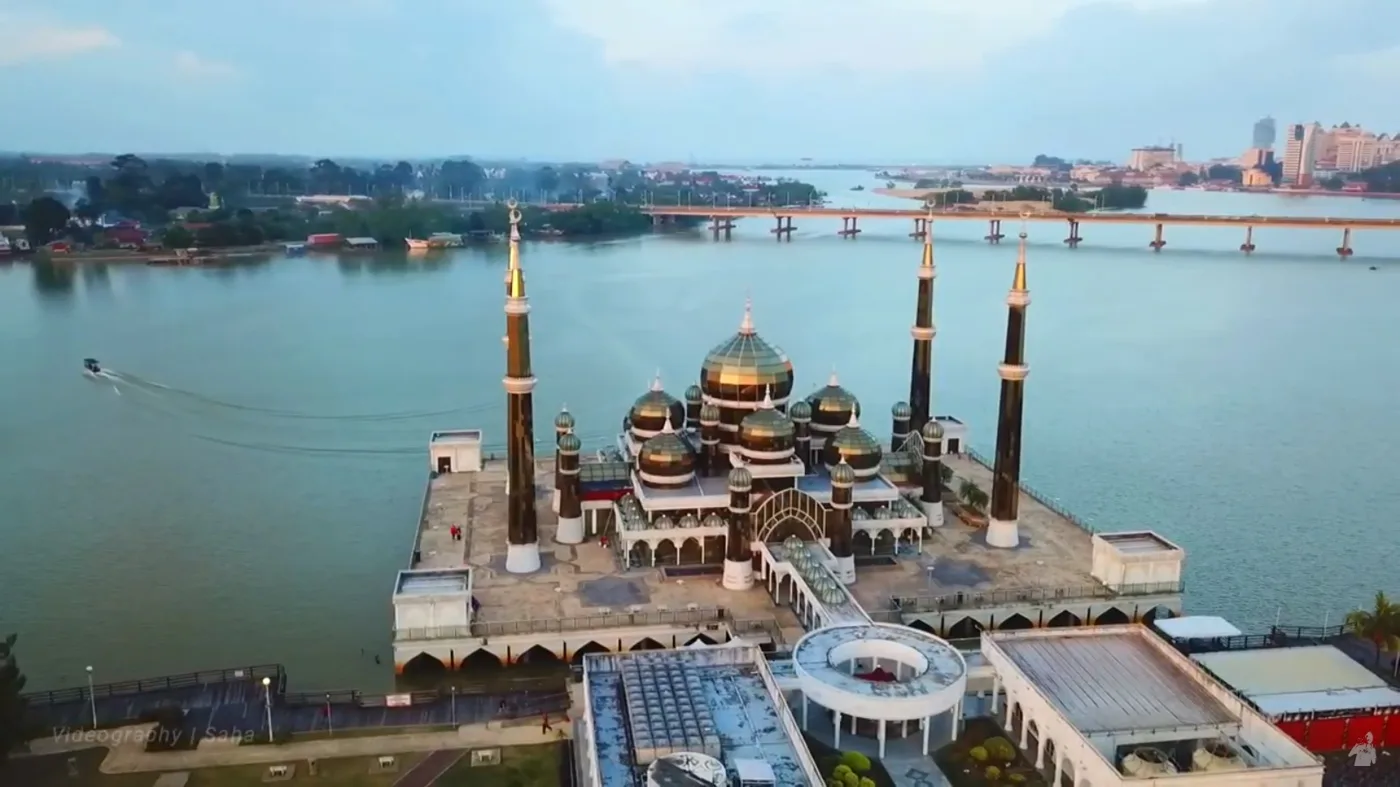
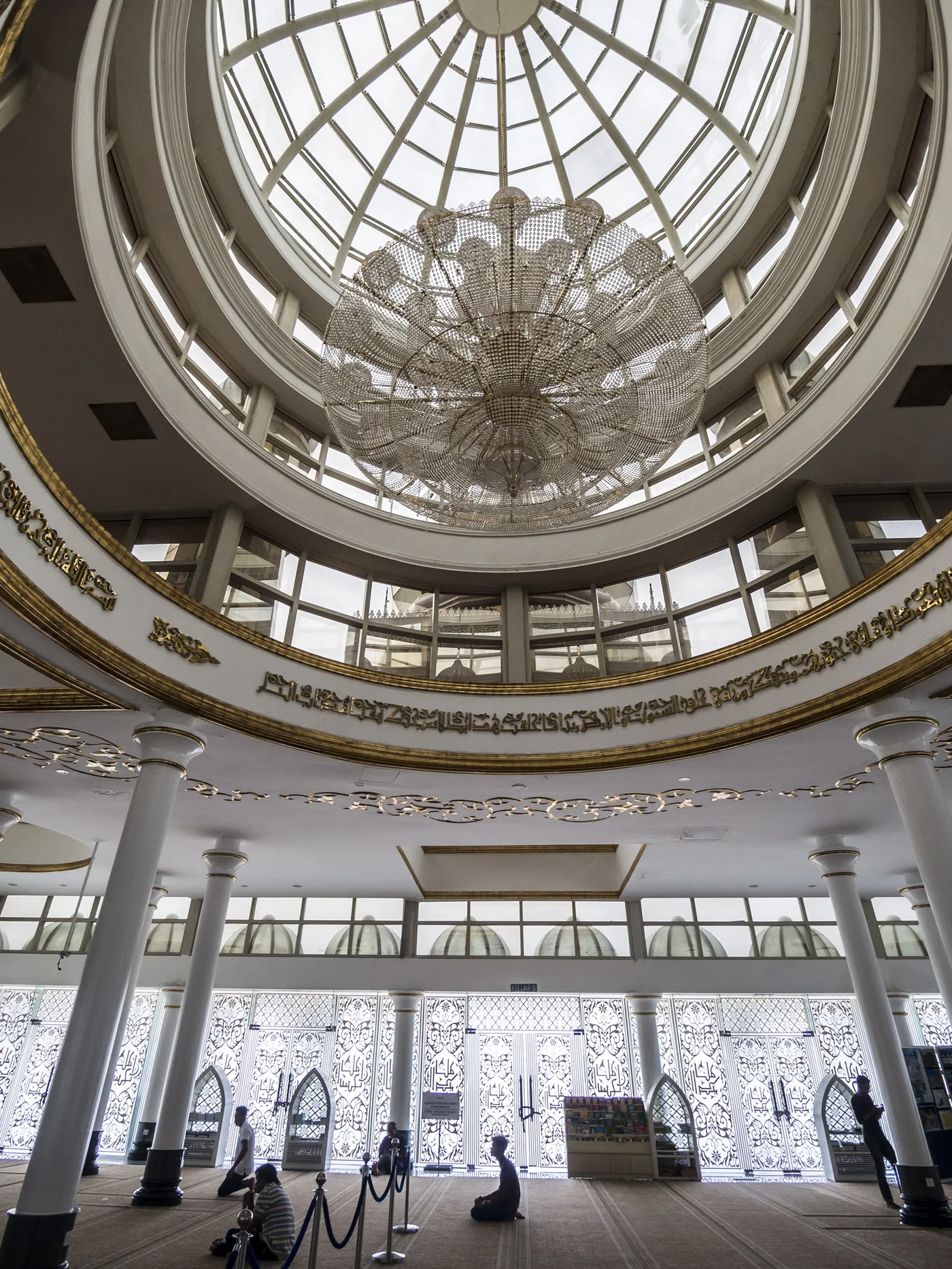
In Kuala Terengganu, capital of Terengganu state on the east coast of the Malay peninsula, the Crystal Mosque takes first place for a simple reason: it is one of the only mosques in the world built almost entirely of glass, steel and aluminium, set on a platform that seems to float at the confluence of the Terengganu river and the South China Sea. Built on Wan Man Island and inaugurated in February 2008 by the state's sultan, it forms the centrepiece of the Islamic Civilisation Park (Taman Tamadun Islam), a vast complex that presents, on the same island, scaled-down replicas of some twenty famous Islamic monuments from around the world, from the Kaaba to the Taj Mahal. Its steel and laminated-glass structure, rather than traditional masonry, allows a feat that neither stone nor concrete could offer: literally changing appearance with the hour and the weather. Golden and coppery at sunrise and sunset, it turns silvery under the midday sun and, once night falls, dons a display of programmable LED lights that colour its domes and minarets in turn. Its position, almost entirely surrounded by water, adds an almost permanent mirror effect that no other great mosque in Southeast Asia reproduces at this scale. It can hold about 1,500 worshippers, a modest size compared with the next two mosques on this list, offset by a visual identity no other mosque in the country claims.
#2 : Putra Mosque, pink granite on the lake
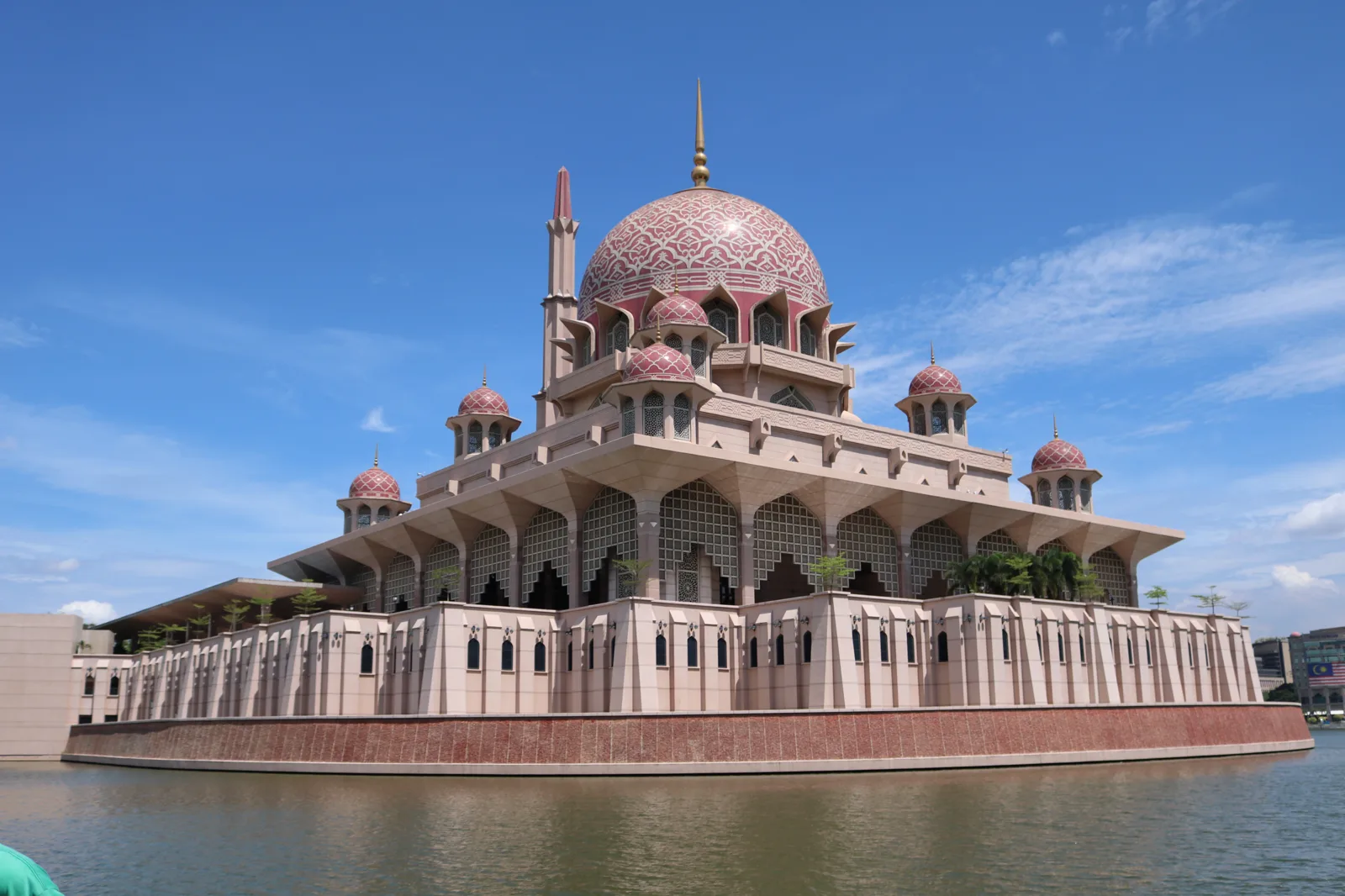
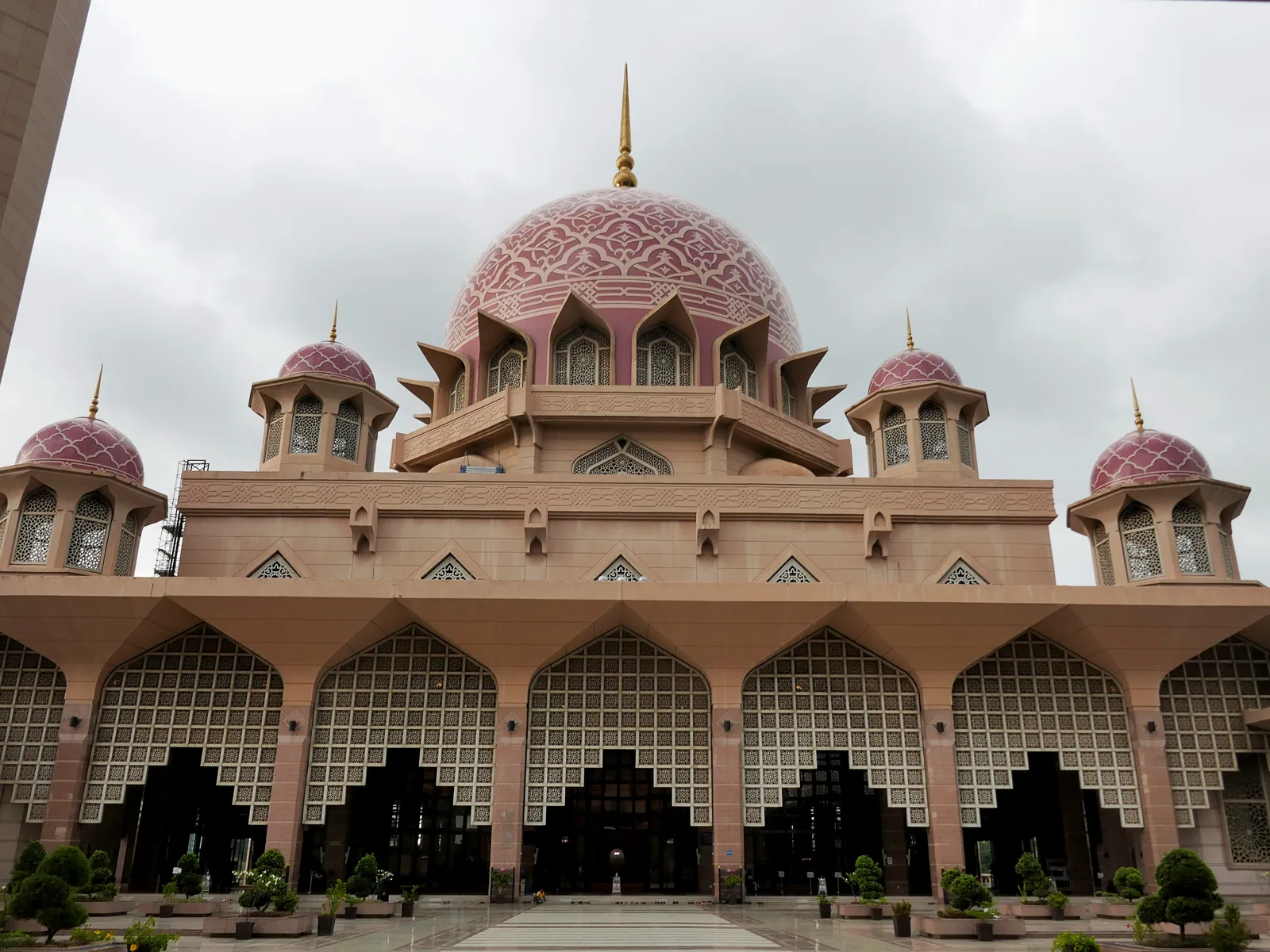
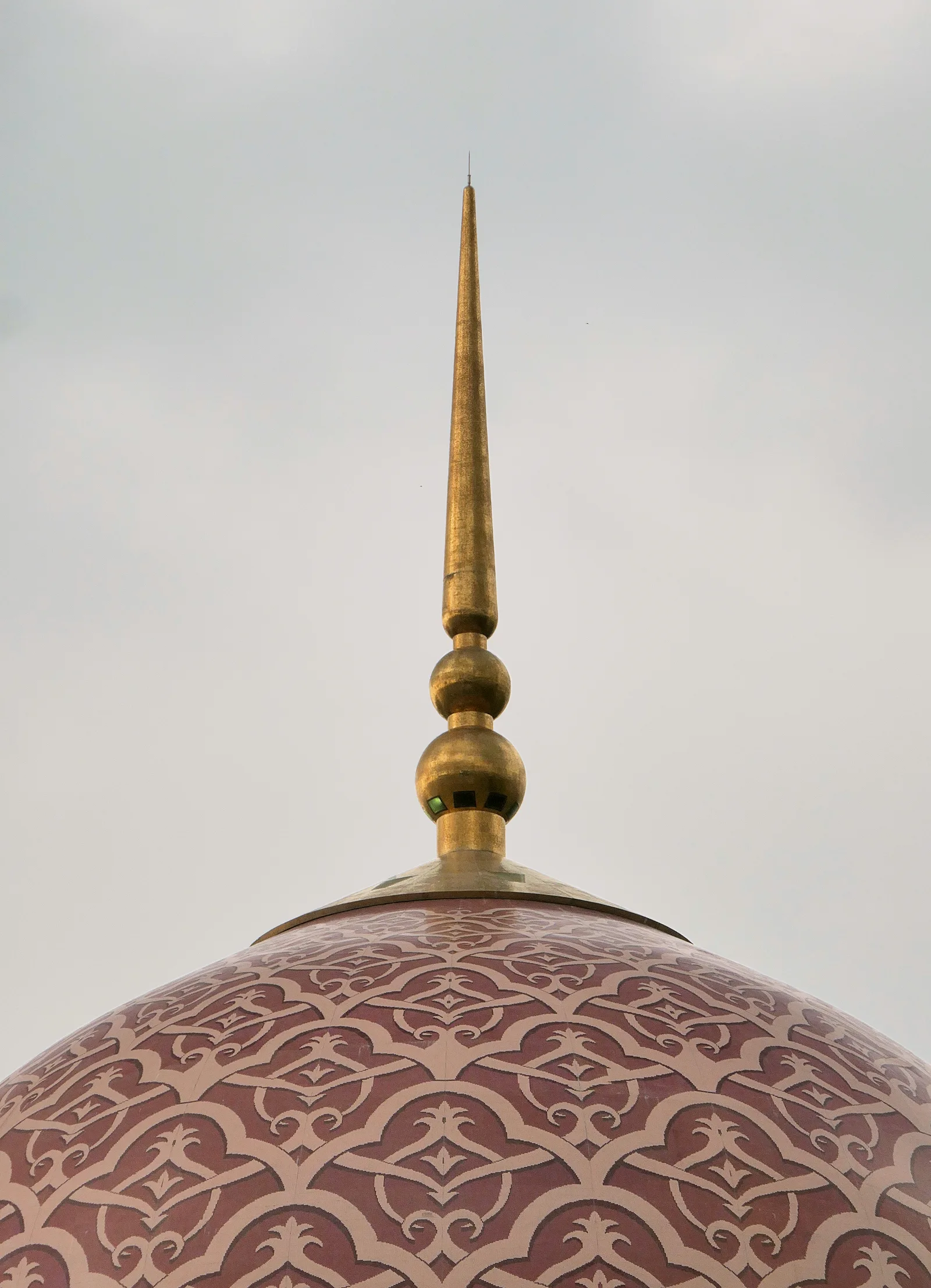
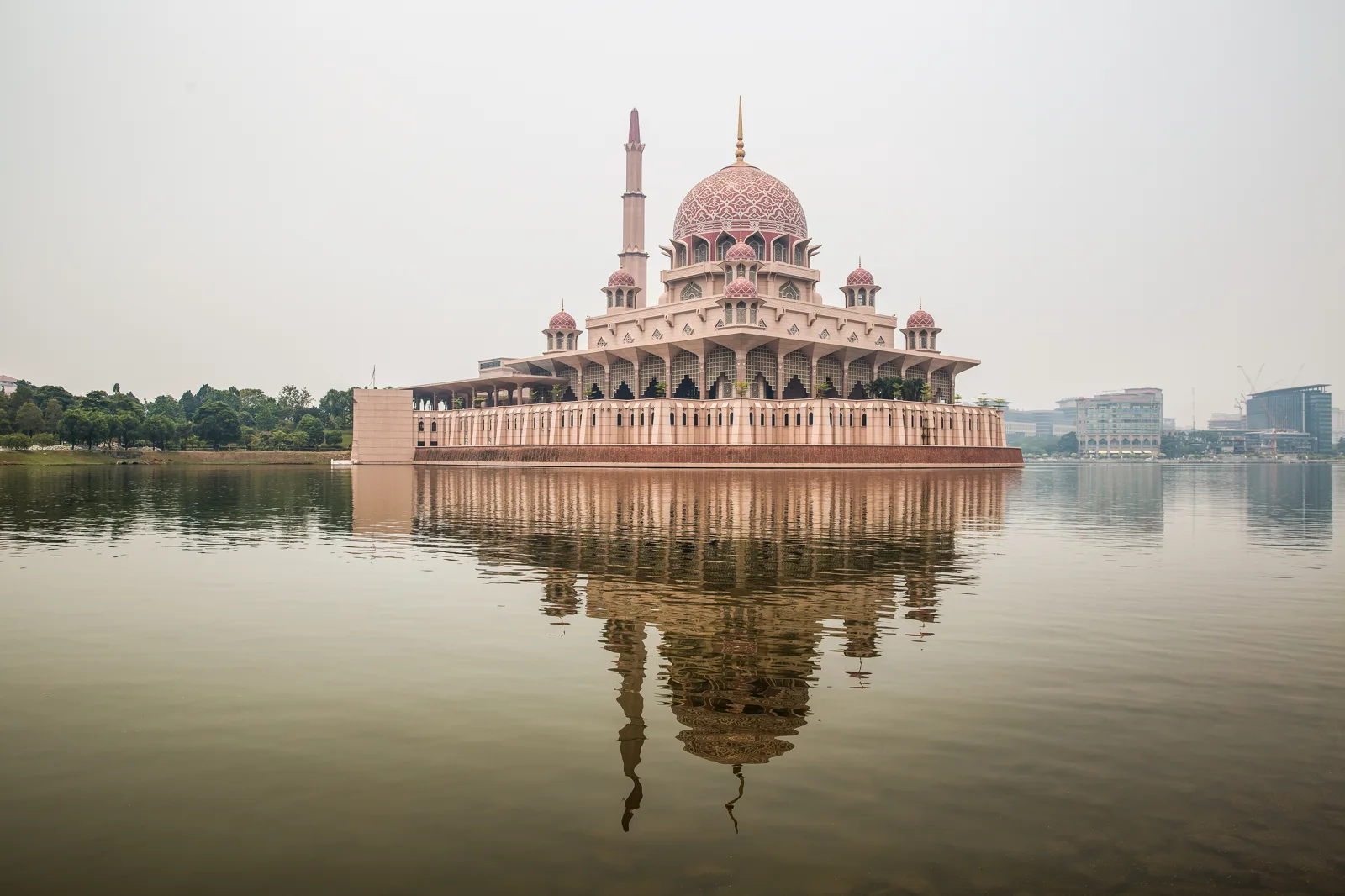
In Putrajaya, a federal administrative city built from scratch in the late 1990s to relieve Kuala Lumpur, the Putra Mosque owes its place on this podium to a material choice as simple as it is radical: a dome and walls of pink granite, a hue found in no other great mosque in Southeast Asia, directly inspired by the pink tones of the Sheikh Lotfollah Mosque and other Safavid Persian buildings. Completed in 1999, it can hold about 15,000 worshippers between the prayer hall and the esplanade, and stands three-quarters above Putrajaya's artificial lake, dug specifically to give the new administrative capital a monumental face. Its minaret, rising to 116 metres, one of the tallest in Southeast Asia, is structured in five distinct sections, a division symbolising the five pillars of Islam; the whole complex, with its great arcaded courtyard and carved doors, embraces a deliberate blend of Middle Eastern influences (Persian, for the decorative vocabulary) and Malay ones (in the overall proportions and certain roof details). It is today one of the country's most visited mosques, not least because of its proximity to the Prime Minister's complex and the federal administration buildings around it.
#3 : Masjid Negara, the manifesto of independence
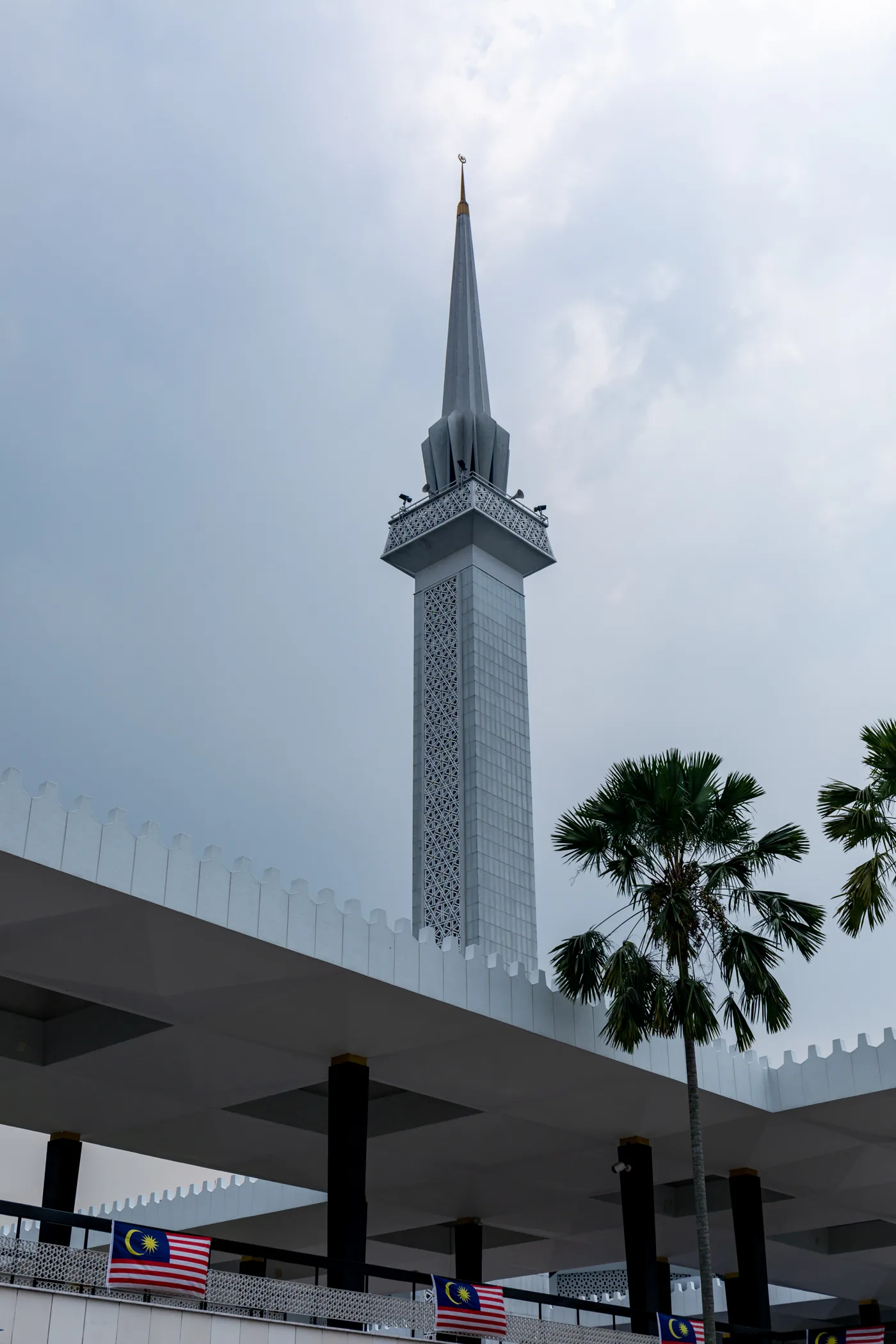
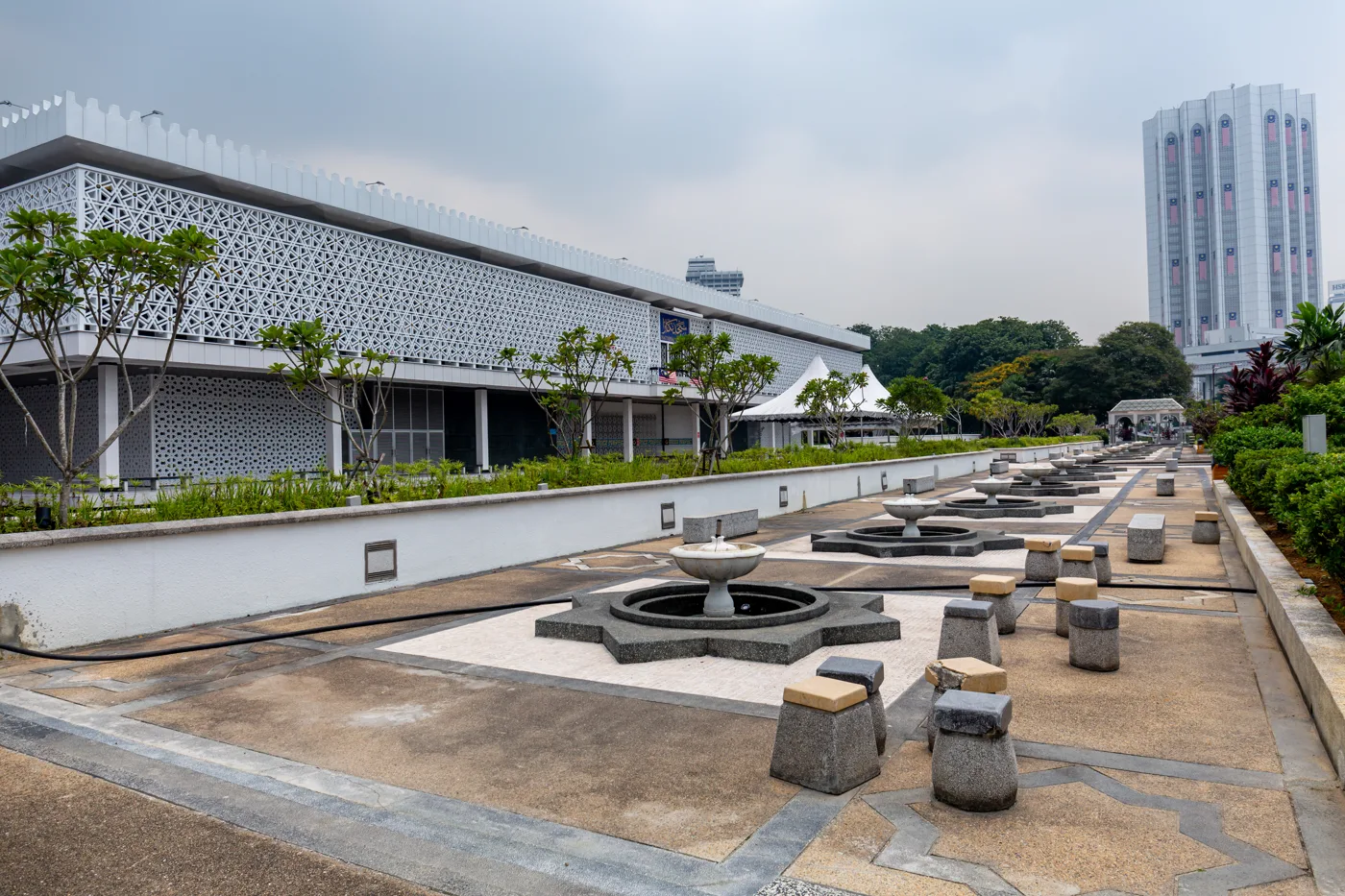
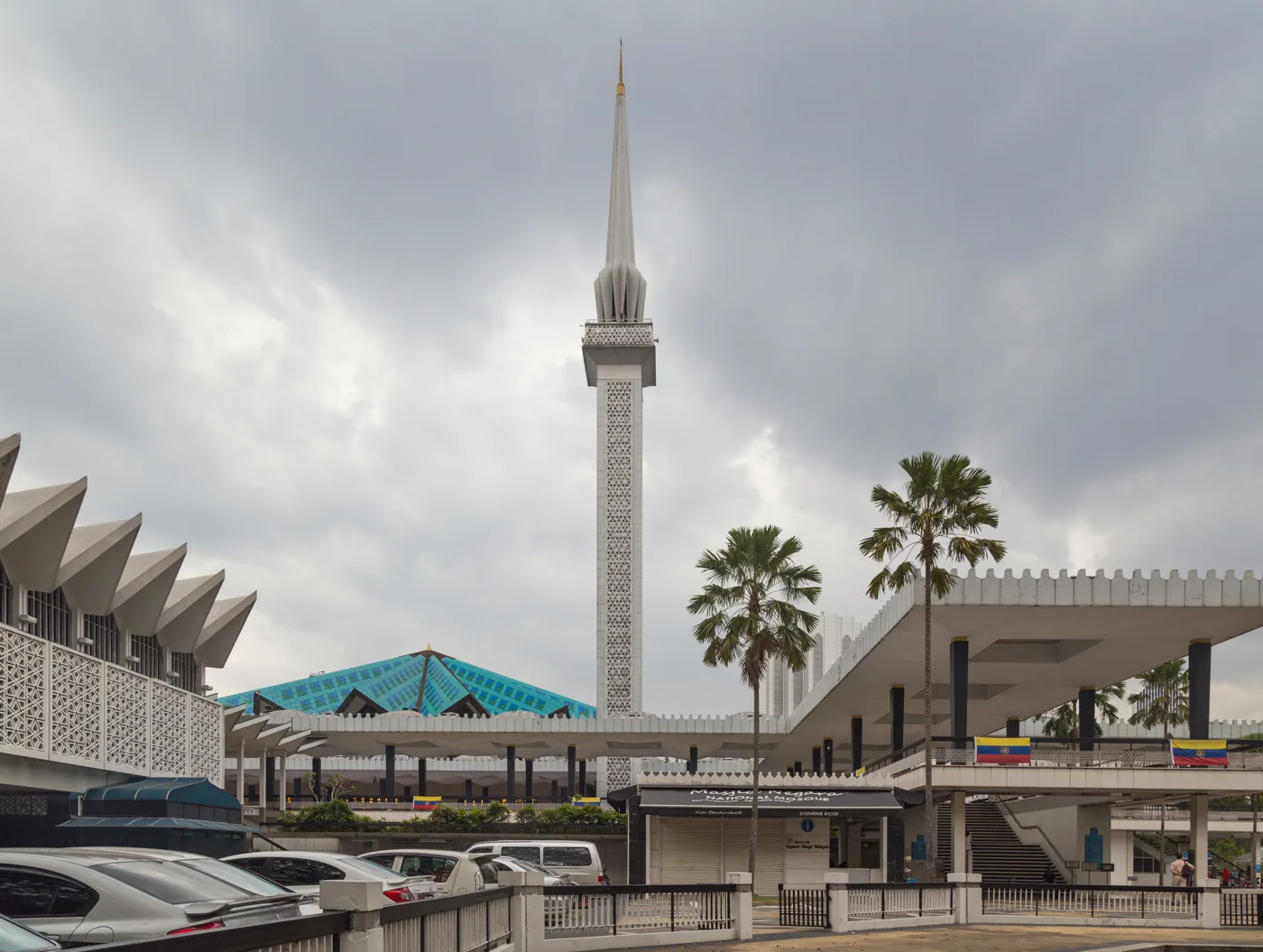
The National Mosque of Kuala Lumpur closes this podium, not for its age in absolute terms, it dates from 1965, while several mosques on this list go back centuries, but for its formal radicalism. Inaugurated on 27 August 1965, less than ten years after Malaysia's independence (1957), it was conceived from the outset as a national symbol rather than a simple neighbourhood mosque: its main roof, a sixteen-pointed pleated concrete umbrella, deliberately breaks with the traditional hemispherical dome of the Ottoman or Mughal world, and its finned rocket-shaped minaret, 73 metres tall, remains, sixty years after its inauguration, one of the most recognisable silhouettes in all 20th-century mosque architecture. It is very often described as having eighteen points, thirteen for the states of the federation and five for the pillars of Islam. That reading was denied by Ikmal Hisham Albakri, a member of the design team, in an interview with Badan Warisan Malaysia. The complex, which can hold about 15,000 worshippers, spreads over nearly 5 hectares of gardens and reflecting pools, on the site of the former Selangor Turf Club polo ground right in the heart of the capital. The project, led by a team of British and Malaysian architects brought together for the occasion, deliberately sought to break free of the Ottoman or Mughal references then dominant in the world's imagery of the mosque, in order to propose a vocabulary of its own : an approach later echoed, decades on, in the Putra Mosque and then the Crystal Mosque.
Inevitably subjective criteria
This ranking is of course a matter of taste : the "Blue Mosque" of Shah Alam (Sultan Salahuddin Abdul Aziz Mosque), with one of the largest domes in the world and a capacity sometimes exceeding 24,000 worshippers, or the venerable Masjid Kampung Kling in Malacca, a rare example of a Malaysian mosque with a tiered roof in Chinese pagoda style dating from the 18th century, would have deserved a place just as well. But the Crystal Mosque, Putra and Negara share the fact that each, in its own way and a generation apart (1965, 1999, 2008), illustrates the same steady ambition since independence: to make the Malaysian mosque an architectural manifesto and an assertion of national identity, rather than a mere reproduction of models imported from the Middle East.
Discover
Mosques mentioned in this article
About this page's content: this site offers editorial and cultural content written with care and respect for the religious traditions concerned; it does not constitute a theological opinion or a source of religious authority. Despite our checks, errors, inaccuracies or approximations may remain. If you spot one, please let us know via the Contact page or by email at qibla.mosk@gmail.com, and we will correct it gratefully.