History
History
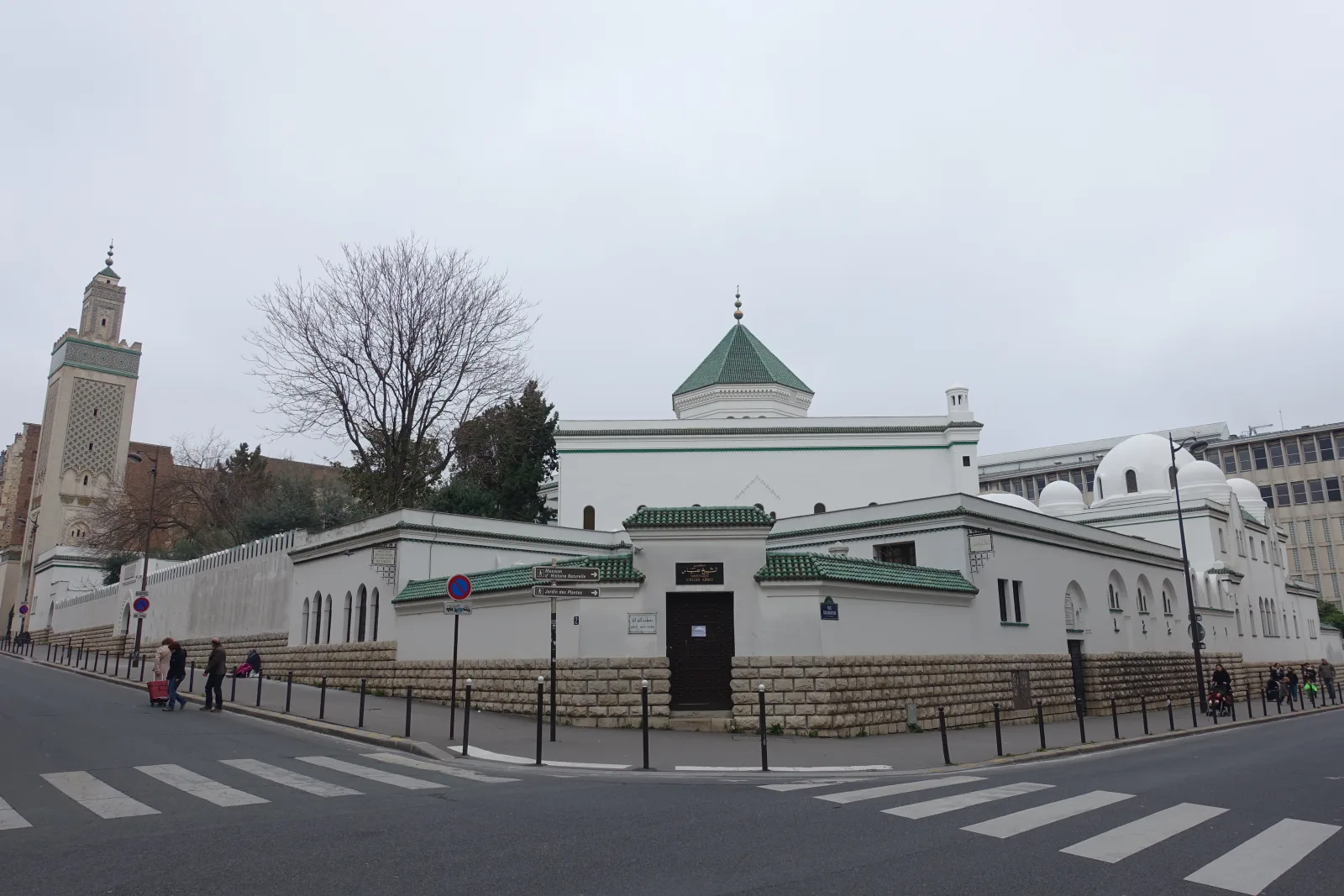
Inaugurated in 1926 on Place du Puits-de-l'Ermite, in the 5th arrondissement of Paris, the Great Mosque of Paris was funded by the French state as a tribute to the tens of thousands of Muslim soldiers, in particular North African tirailleurs, who died for France during the First World War (1914-1918). The project was entrusted to architects Maurice Mantout, Charles Heubès and Robert Fournez, working with Moroccan craftsmen and architects. The result, in the Hispano-Moorish style, draws directly on the Bou Inania madrasa in Fez, Morocco: an Andalusian patio planted with orange trees, polychrome zellige tilework, carved stucco and a minaret roughly 33 metres tall.
The mosque houses the Paris Muslim Institute, still active today and the reference institution for Islam in the French capital. Rather unusually for a great mosque, it also includes a hammam and a restaurant-tea room open to the public, beyond worshippers alone. Its first rector, Si Kaddour Benghabrit, was the central figure behind its founding, a personality who remains historically controversial regarding other aspects of his role during that period.
Anecdotes & highlights
- The Andalusian patio and its zellige decoration are directly inspired by the Bou Inania madrasa in Fez, Morocco, one of the masterpieces of Marinid architecture.
- The mosque includes a hammam and a restaurant-tea room open to the public, a fairly rare feature for a great mosque.
- According to some accounts, widely popularised but now historically debated (notably by the work of historian Ethan Katz), the mosque is said to have sheltered and helped resistance members and Jewish people during the Occupation by providing refuge or false certificates of Muslim faith; the true extent of this role is not established with certainty by historians.