History
History
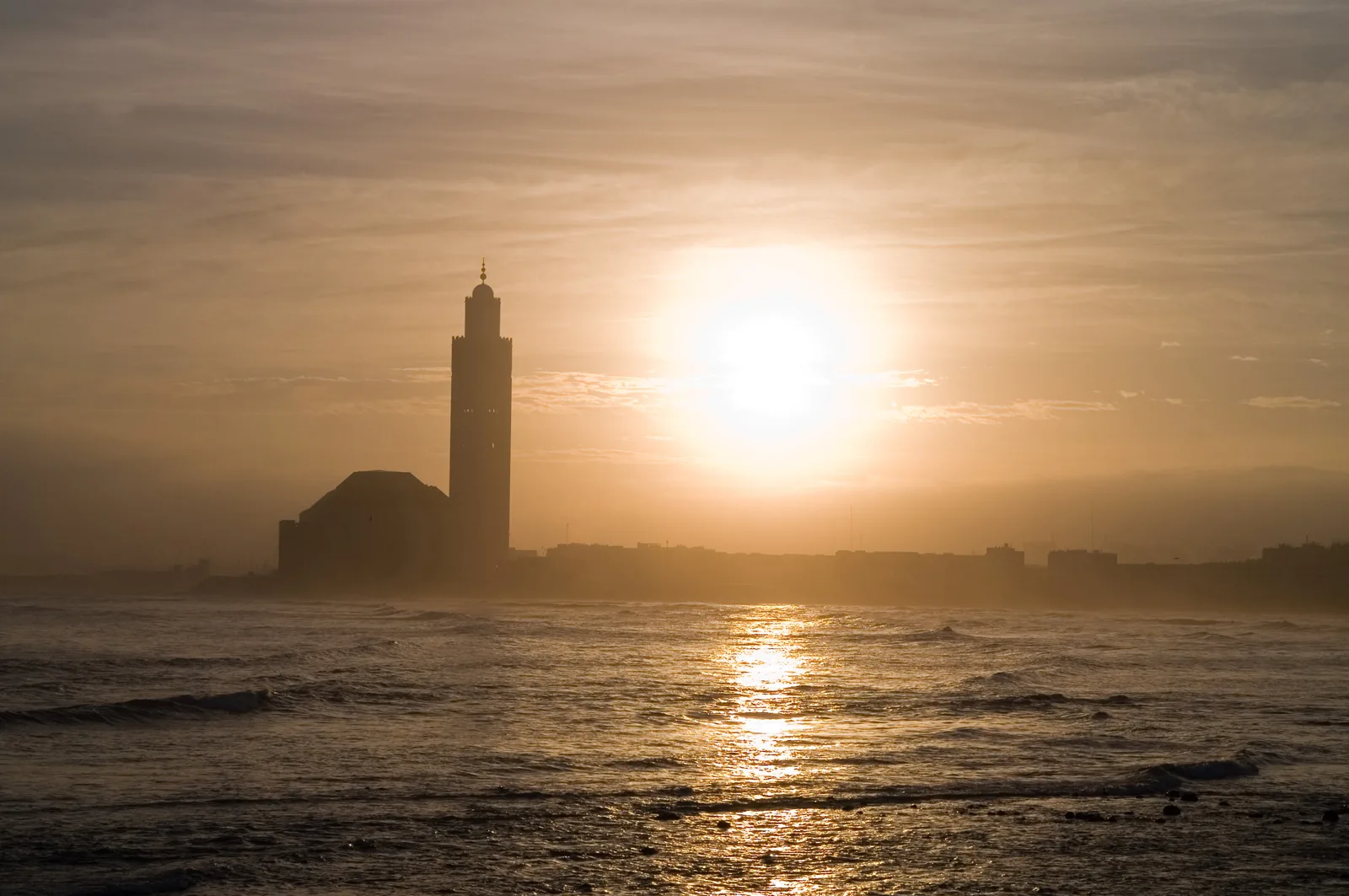
Commissioned by King Hassan II and inaugurated in 1993, the Casablanca mosque is built partly over the Atlantic Ocean, echoing the verse describing God's throne "upon the water". Construction began in 1986 and mobilised up to forty thousand workers and craftsmen, sometimes working through the night, funded by a national public subscription. French architect Michel Pinseau orchestrated the work of tens of thousands of Moroccan craftsmen: zellige tilework, carved plasterwork, painted Atlas cedar and marble all display the full repertoire of Moorish art here.
Its 210-metre minaret, for a long time the tallest in the world, is crowned by a laser beam pointed towards Mecca, visible on a clear night up to thirty kilometres away. The prayer hall stretches 200 metres long, with a central nave rising 40 metres, and is fitted with a retractable cedar roof weighing roughly 1,100 tonnes across 3,400 square metres: driven by electric motors, it slides open in five minutes, turning the hall into an open-air courtyard for major occasions and exceptionally crowded nights. The mechanism, its rollers, its rail and the place those eleven hundred tonnes park are detailed in our article on the retractable roof of the Hassan II Mosque. Beneath the building, a vast ablutions hall, lit by its own columns and fountains, can hold up to fourteen hundred worshippers at once.
Anecdotes & highlights
- A laser mounted atop the minaret sweeps some thirty kilometres at night in the direction of Mecca.
- A section of the royal area's floor is said to be glass, allowing prayer directly above the Atlantic Ocean; this section is reserved for the royal family and is not accessible during public visits.
- The prayer hall's retractable roof weighs about 1,100 tonnes and slides fully open in five minutes via electric motors.
- It is one of the few great Moroccan mosques open to non-Muslim visitors.