History
History
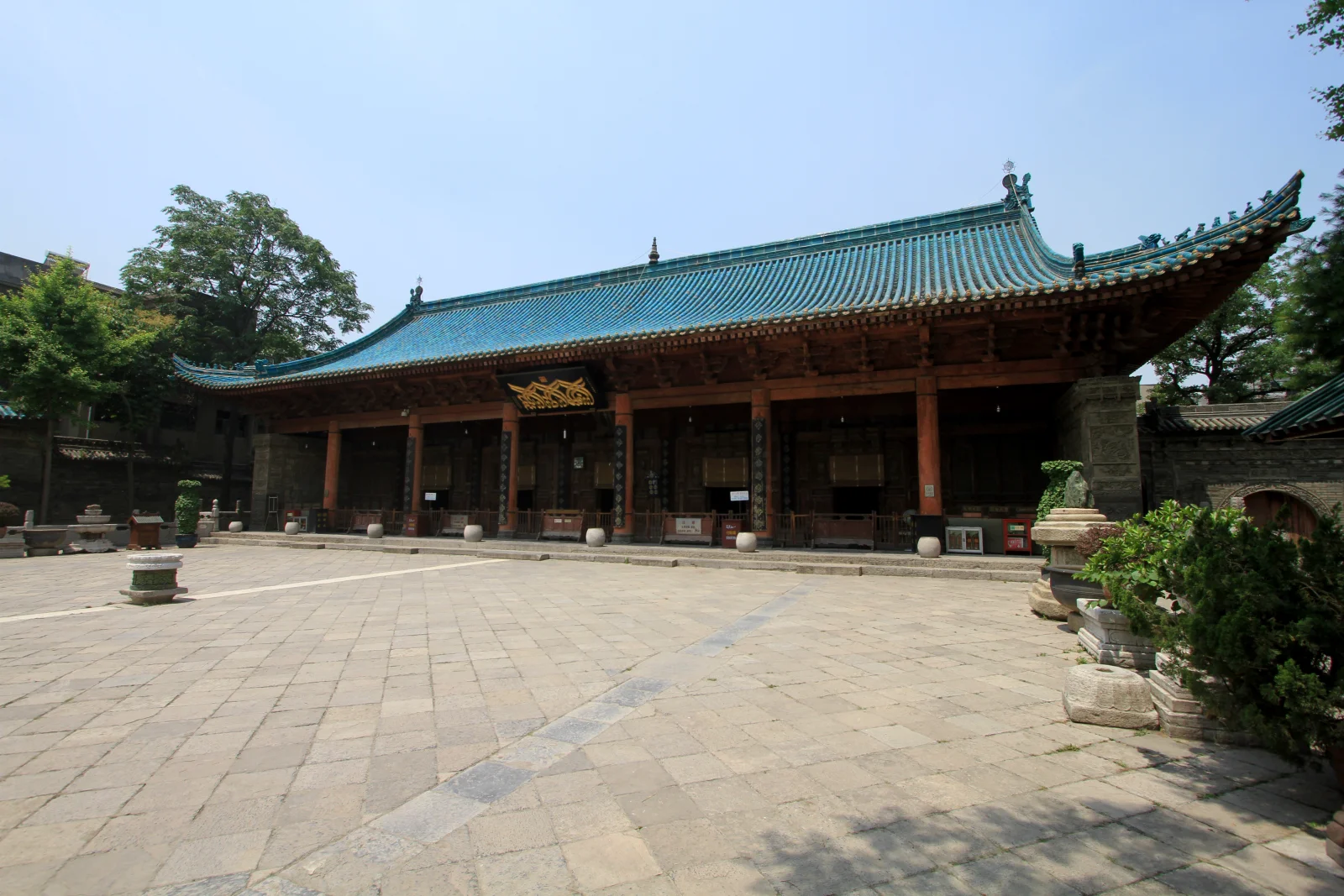
Seen from the outside, the Great Mosque of Xi'an looks more like a Chinese Buddhist temple than a mosque: entirely Chinese architecture, wooden pavilions, upturned eaves, a succession of garden courtyards planted with old trees. No dome, arch or minaret gives away its religious function at first glance. Founded according to tradition in 742 under the Tang dynasty, in the days of the Silk Road, it owes most of its current appearance to reconstructions and extensions under the Ming and Qing dynasties, which never sought to give it the classical Islamic architecture of the Arab or Persian world.
The minaret here is replaced by a three-storey octagonal pagoda, the Tower of Introspection (Xingxin Lou), which also served as a moon-watching post, useful for calculating the lunar calendar. The prayer hall, a vast Chinese timber-framed hall, nonetheless carries one discreet clue to its function: its axis is oriented east-west, towards Mecca, the exact opposite of the north-south orientation of traditional Chinese temples. Arabic and Chinese calligraphy converse on the same steles.
According to Chinese tradition, Islam arrived in Xi'an (then Chang'an, the imperial capital) peacefully. Around 650-651, a diplomatic embassy sent by the caliph and led by Sa'd ibn Abi Waqqas, a companion of the Prophet Muhammad (peace and blessings of Allah be upon him), was received by Emperor Tang Gaozong, who granted its members freedom to preach their faith. The religion then spread gradually through trade along the Silk Road, giving rise to a Chinese Muslim community, the Hui, today over a thousand years old. The current mosque, founded in 742, stands on an earlier religious site linked to this episode.
Anecdotes & highlights
- The mosque's axis is oriented east-west, towards Mecca, unlike Chinese temples oriented north-south.
- The Tower of Introspection, the octagonal pagoda standing in for a minaret, also served to watch the moon for the Islamic lunar calendar.
- Some steles bear the same text engraved in Arabic and classical Chinese.
- The mosque is still active, at the heart of the Hui Muslim quarter and its famous street market.