
Home › Blog › Djamaâ El Djazaïr vs. Hassan II: North Africa's clash of giants
Maghreb · 8 min read · 2026-07-27
Djamaâ El Djazaïr vs. Hassan II: North Africa's clash of giants
For twenty-six years, the Hassan II Mosque in Casablanca reigned unchallenged over Africa: the continent's largest mosque, with the tallest minaret in the world after those of the two holy sites. In 2019, a newcomer from Algiers, Djamaâ El Djazaïr, stripped it of every record at once. Two mosques, two neighboring countries, two radically different ways of building a national symbol.
Hassan II, a king's ambition facing the Atlantic
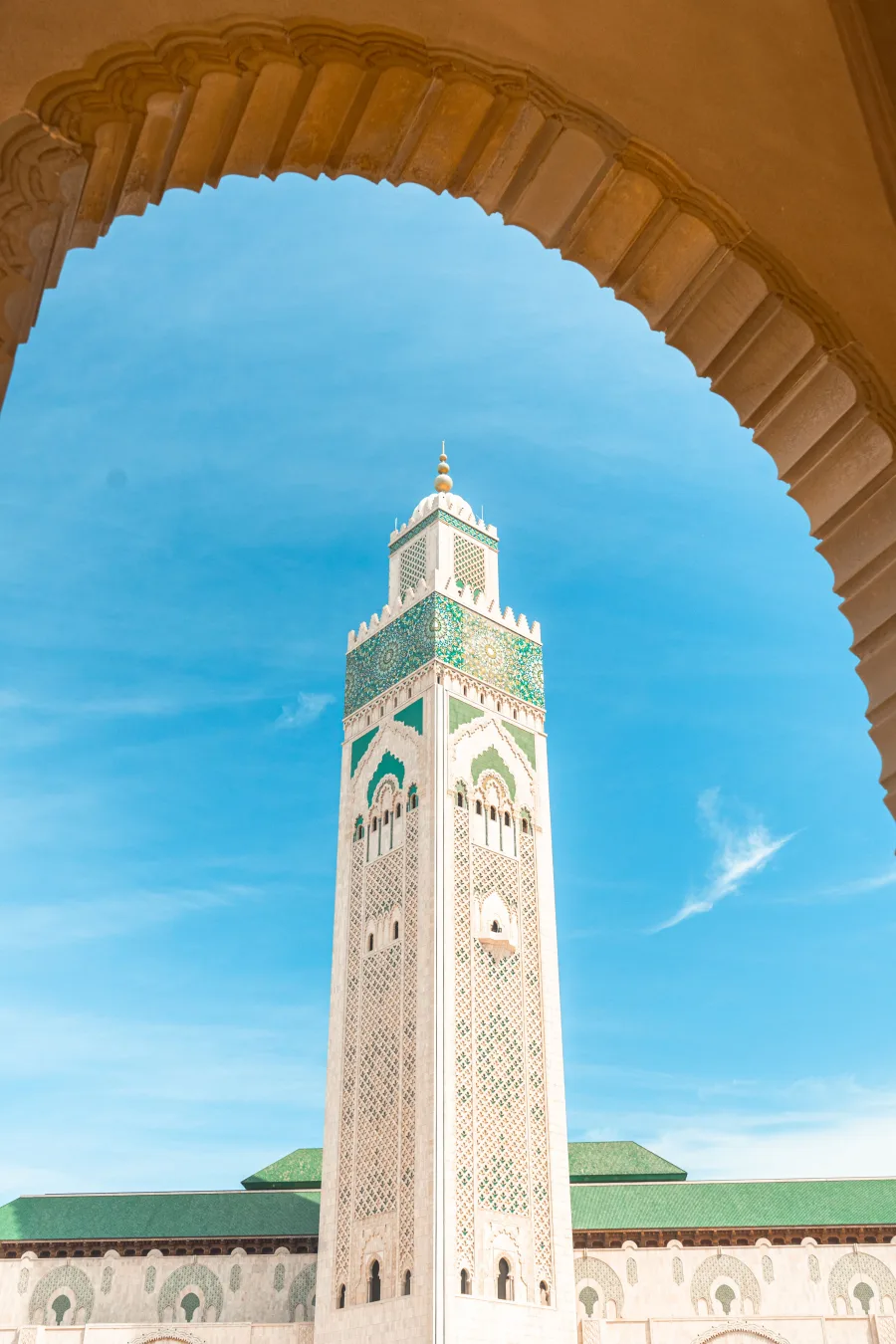
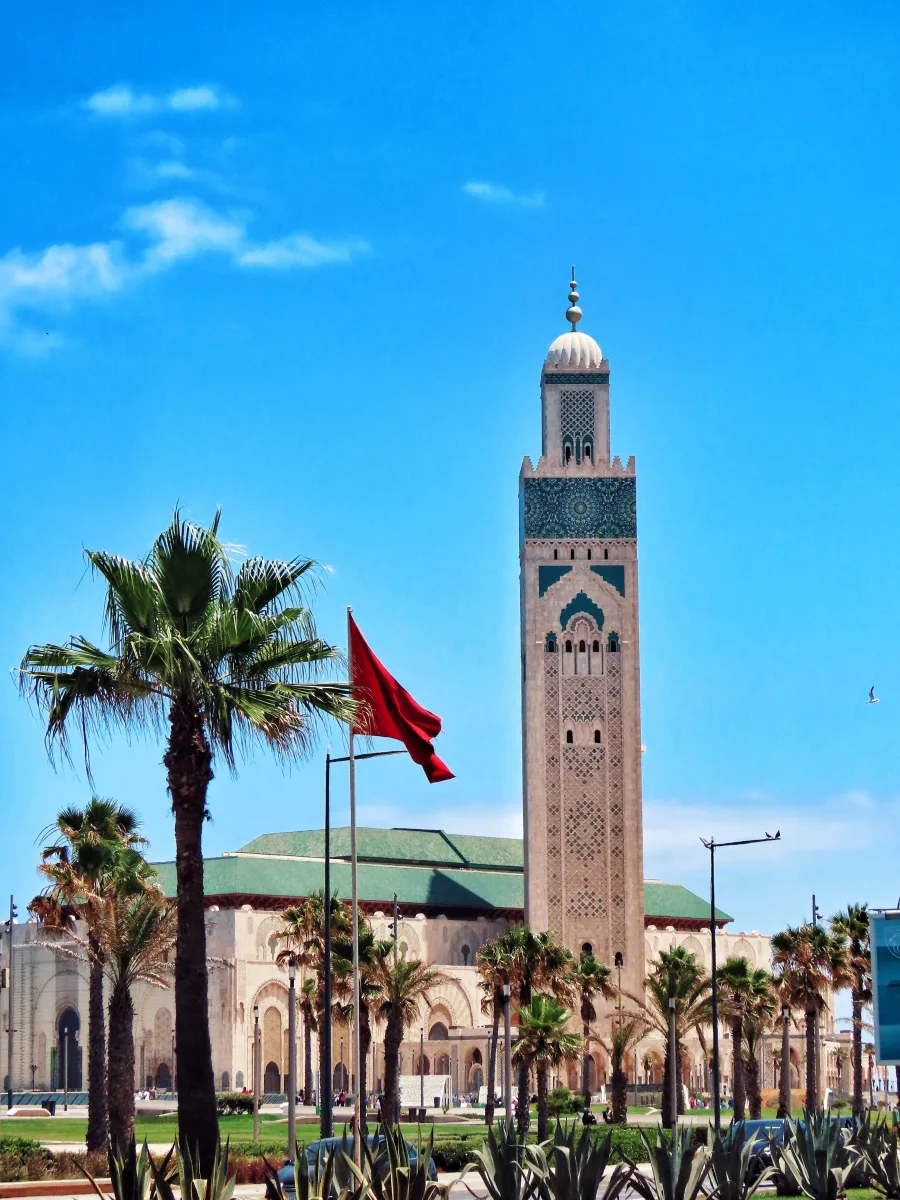
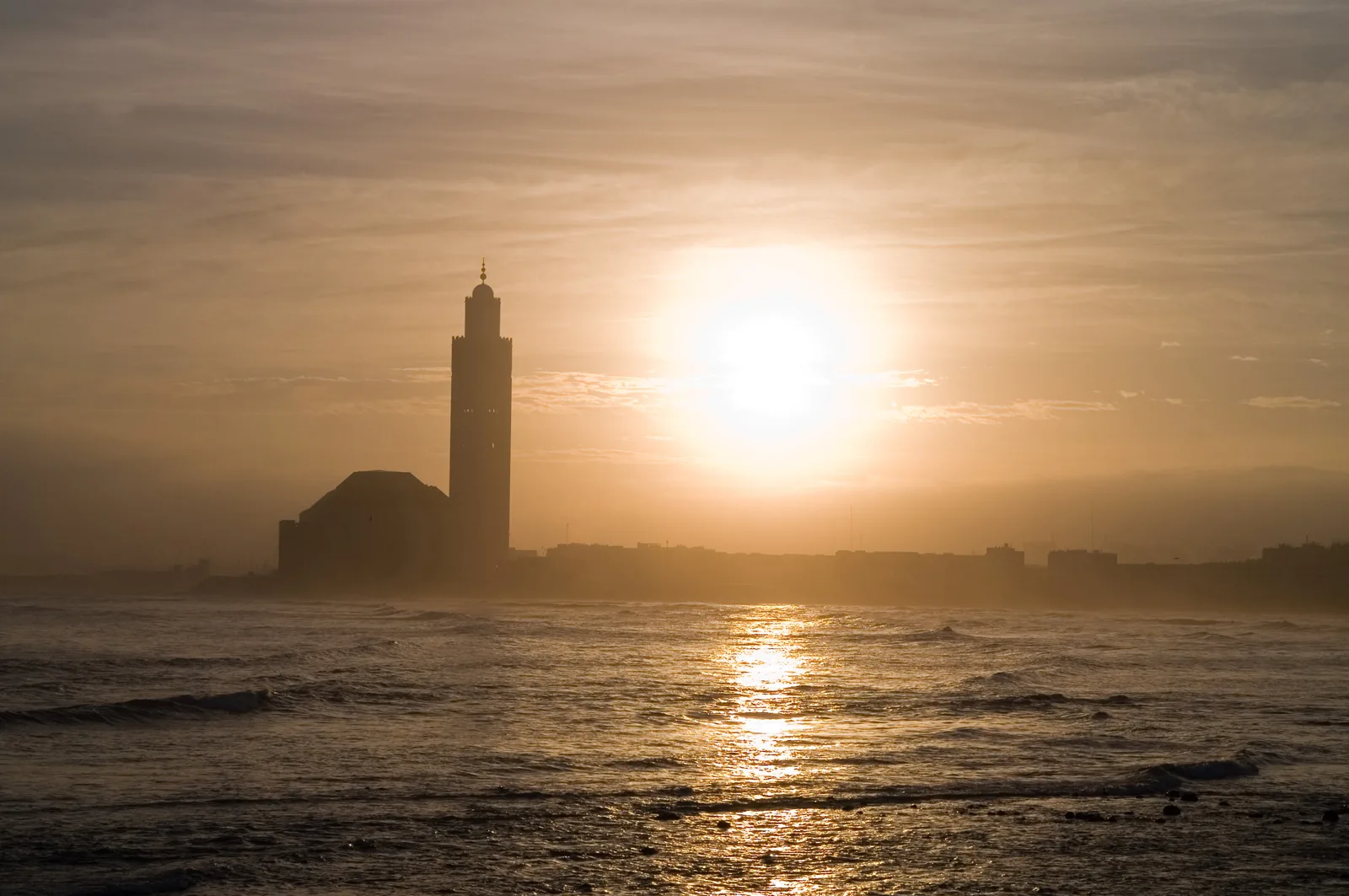
It was in 1980 that King Hassan II of Morocco launched the project for a great national mosque in Casablanca, built partly on a rocky spur jutting into the Atlantic Ocean, in reference to the Quranic verse describing God's throne as resting upon water. The first stone was laid on 11 July 1986, and the building, designed by the French architect Michel Pinseau, was inaugurated in 1993, funded entirely through a national public subscription: about a third of the budget, estimated at 800 million dollars, came from royal funds, with the rest raised from nearly 12 million Moroccan citizens, each receiving a printed receipt acknowledging their contribution. Its minaret rises to 210 meters, topped with a powerful green laser that, at night, symbolically points toward Mecca and remains visible from more than 30 kilometers away. Inside, marble, Atlas cedar, and zellige tilework were crafted by thousands of Moroccan artisans using Andalusian techniques inherited from Fez and Marrakech; the 60-meter-high roof of the prayer hall is fully retractable and opens within minutes, while a section of glass flooring lets worshippers pray above the waves.
Djamaâ El Djazaïr, 21st-century engineering
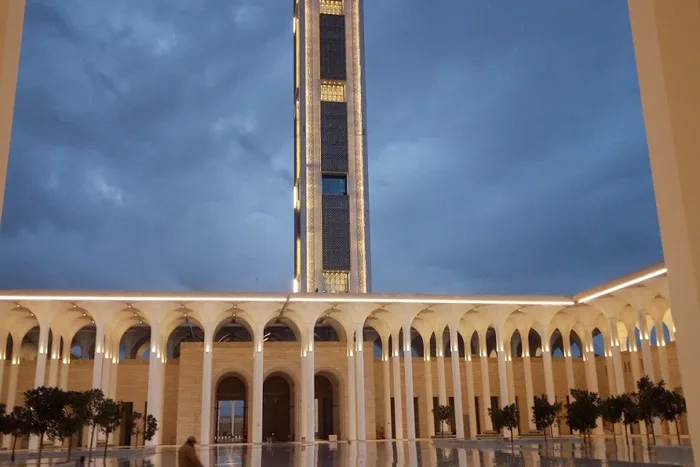
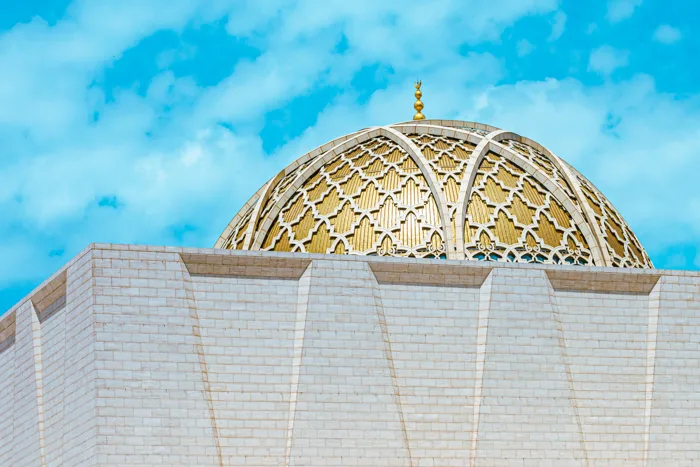
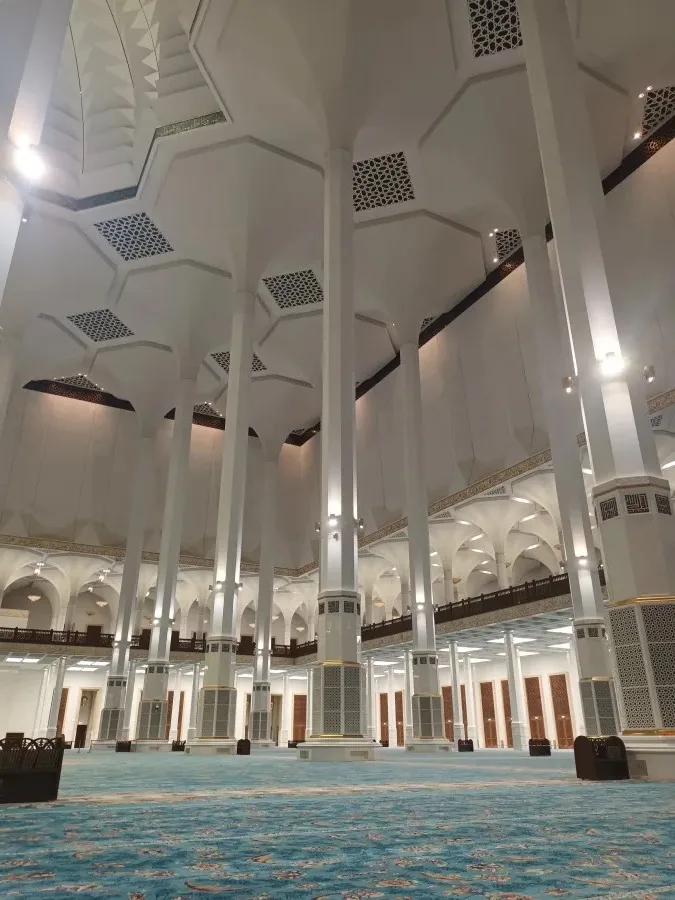
Twenty-six years later, Algeria answered with Djamaâ El Djazaïr, on the Algiers waterfront. In 2008, an international architecture competition was launched to select the project's design team; it was won by the German firms KSP Jürgen Engel Architekten, for the architectural design, and Krebs und Kiefer, for structural engineering, while construction was entrusted to the Chinese state-owned company China State Construction Engineering Corporation (CSCEC). Work began in 2012; the structure was completed in 2019, but the official inauguration, repeatedly postponed for political and budgetary reasons, only took place in February 2024, on the eve of Ramadan. The result: a 265-meter minaret, the tallest in the world, a prayer hall of about 20,000 m² able to hold nearly 37,000 worshippers, a 50-meter-diameter dome supported by 618 octagonal columns, and a full complex, esplanades, gardens and annexes included, able to receive up to 120,000 people on major occasions.
The minaret, a singular structural challenge
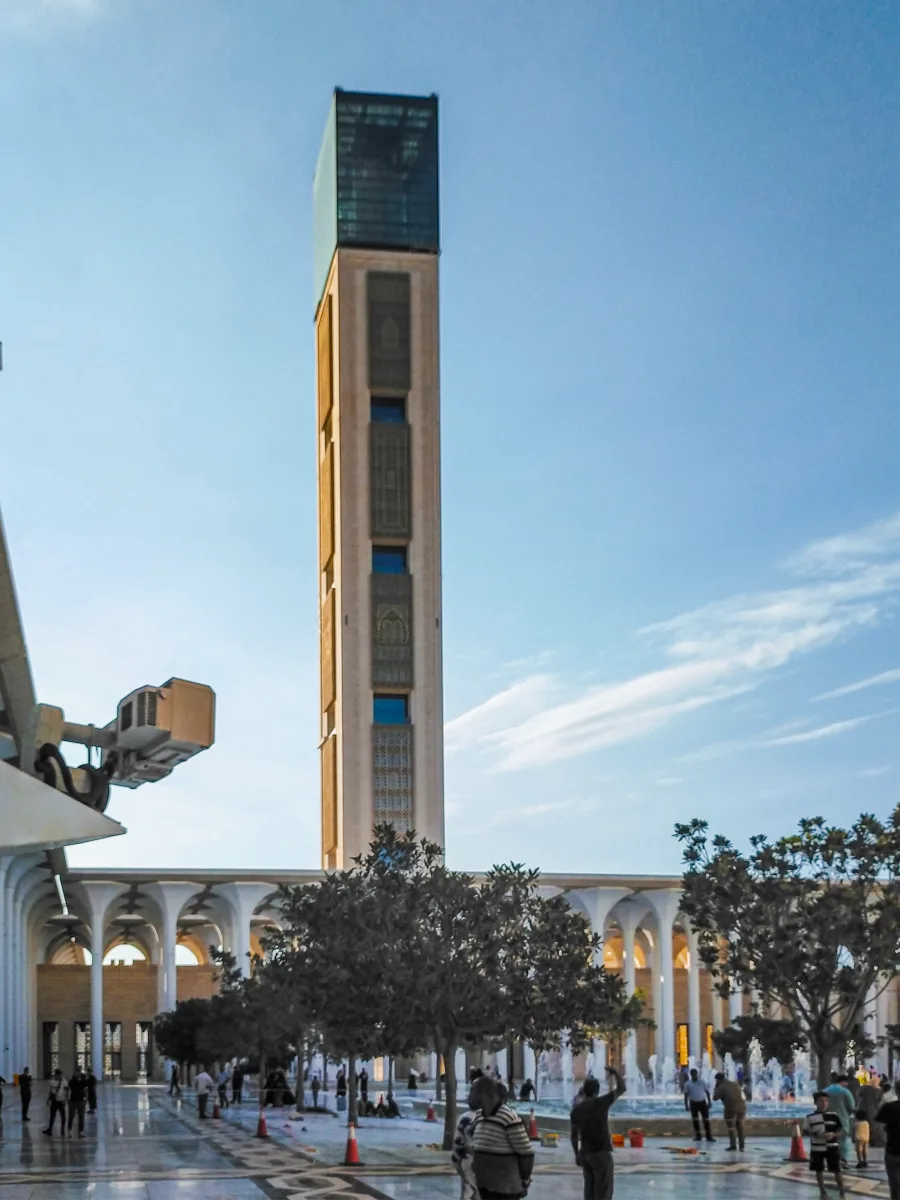
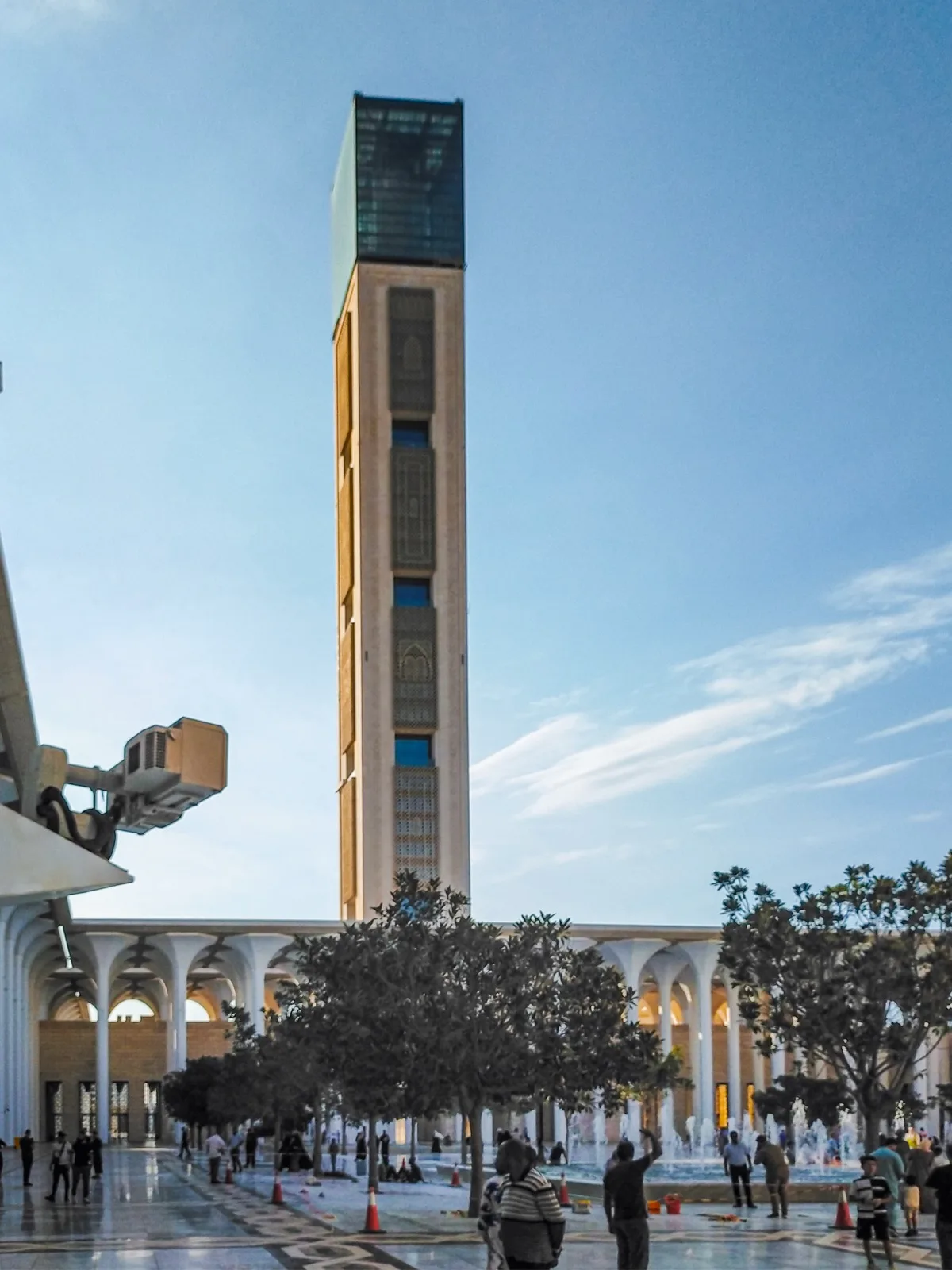
Rising to 265 meters, the minaret of Djamaâ El Djazaïr sits on a 26.5-meter square base and comprises 43 floors served by panoramic elevators. Its structure, remarkably slender for a building of this height, combines reinforced-concrete cores with integrated steel members, linked at the façade by a system of dissipative bracing designed to absorb lateral loads from wind and earthquakes. The foundations, distinct from those of the prayer hall given the seismic strategy chosen for the tower, rest on a three-meter-thick raft and 60 rectangular piles driven down to 60 meters. At the top, an observation platform with glass walls offers panoramic views over Algiers Bay and houses a museum devoted to Islamic culture; the minaret's façade is visually divided into five segments, a symbolic reference to the five pillars of Islam.
Withstanding earthquakes: a feat of engineering
Algiers sits close to the boundary between the African and Eurasian tectonic plates, an area of high seismic risk. To protect the prayer hall, engineers designed a seismic isolation system unprecedented on the African continent: about 250 curved-surface sliding isolators (246 according to specialized engineering literature), combined with around 80 hydraulic dampers, decouple the structure from the ground during an earthquake. This system gives the building an isolation period of about 3.1 seconds and limits maximum horizontal displacement to 500 millimeters, while absorbing up to 70% of seismic force. It was designed for a major earthquake of up to magnitude 9, with the aim of protecting the building for roughly 500 years. It is the first time seismic isolation on this scale, comparable to systems used in Japan or the United States, has been applied to a religious building in Africa.
The battle of the numbers
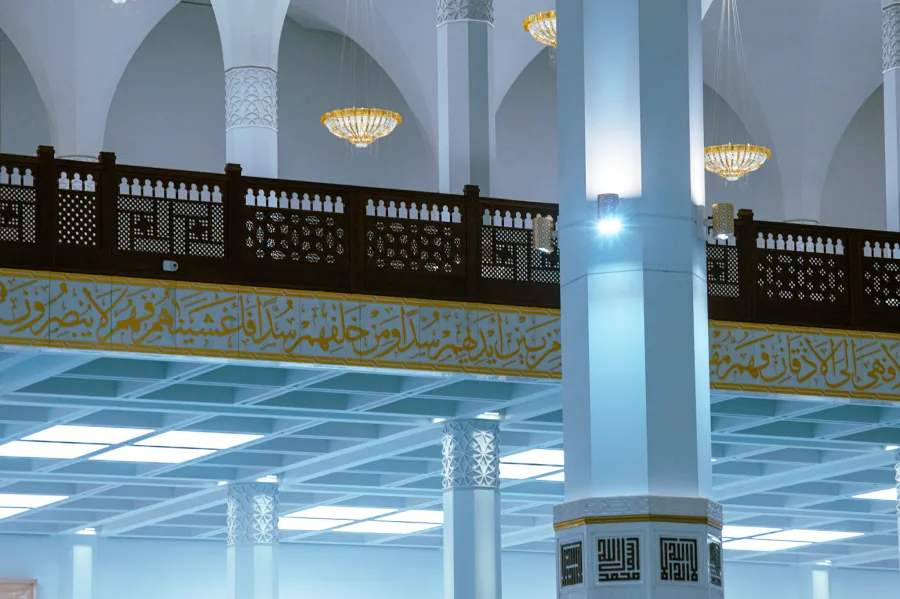
On paper, the comparison leaves no doubt: a 265-meter minaret versus 210, a complex able to receive up to 120,000 people versus 105,000, a final budget of around 900 million dollars (898 million according to the most commonly cited figure) versus 800 million. Djamaâ El Djazaïr is now considered the third-largest mosque in the world by capacity, after the two holy sites of Mecca and Medina, and the largest in Africa, dethroning Hassan II across all its former continental records.
Two national narratives, one shared ambition
Beyond the numbers, the two buildings tell different stories. Hassan II is a manifesto of craftsmanship: more than 6,000 master Moroccan artisans, woodcarvers from Fez, stonecutters from Taroudant, and mosaic artists from across the kingdom lived on site for years to clad the building in marble, cedar, and zellige. The mosque was funded entirely through a national public subscription to which nearly 12 million Moroccans contributed, topped up by a third from royal funds. Djamaâ El Djazaïr, meanwhile, is a manifesto of engineering and diplomacy, the fruit of German-Chinese cooperation and a project spanning more than a decade: launched under President Abdelaziz Bouteflika, it saw its inauguration postponed several times, first amid the political upheaval of 2019 and later for budgetary reasons, before finally opening in February 2024. Two ways of answering the same question: how can a single mosque embody the image of an entire country?
Discover more
Mosques mentioned in this article
Read more
Related articles
Algerian mosques: from Ottoman heritage to Africa's tallest minaret
From the Ketchaoua Mosque in Algiers, shaped by three successive regimes, to Djamaâ El Djazaïr and its record-breaking minaret, an overview of mosque architecture in Algeria.
Moroccan mosques: from Fez's ancient to Casablanca's marvels
From the Qarawiyyin in Fez, the oldest continuously operating university in the world, to the Hassan II Mosque built on the Atlantic, an overview of mosque architecture in Morocco.
About this page's content: this site offers editorial and cultural content written with care and respect for the religious traditions concerned; it does not constitute theological advice or an authoritative religious source. Despite our checks, errors, inaccuracies, or approximations may remain. If you spot one, please let us know via the Contact page or by email at qibla.mosk@gmail.com, we will gladly correct it.