
Home › Blog › From the Cave of Hira to the Mosque of Quba: the founding sites of Islam
History · 7 min read · 2026-03-30
From the Cave of Hira to the Mosque of Quba: the founding sites of Islam
According to Muslim tradition, the story of Islam begins in a mountain cave, before continuing on to the founding of its very first mosque. From the Cave of Hira to the Mosque of Quba, by way of Masjid al-Qiblatayn, four sites trace the gradual birth of a new religion and its architecture.
The Cave of Hira, a place of retreat before the revelation
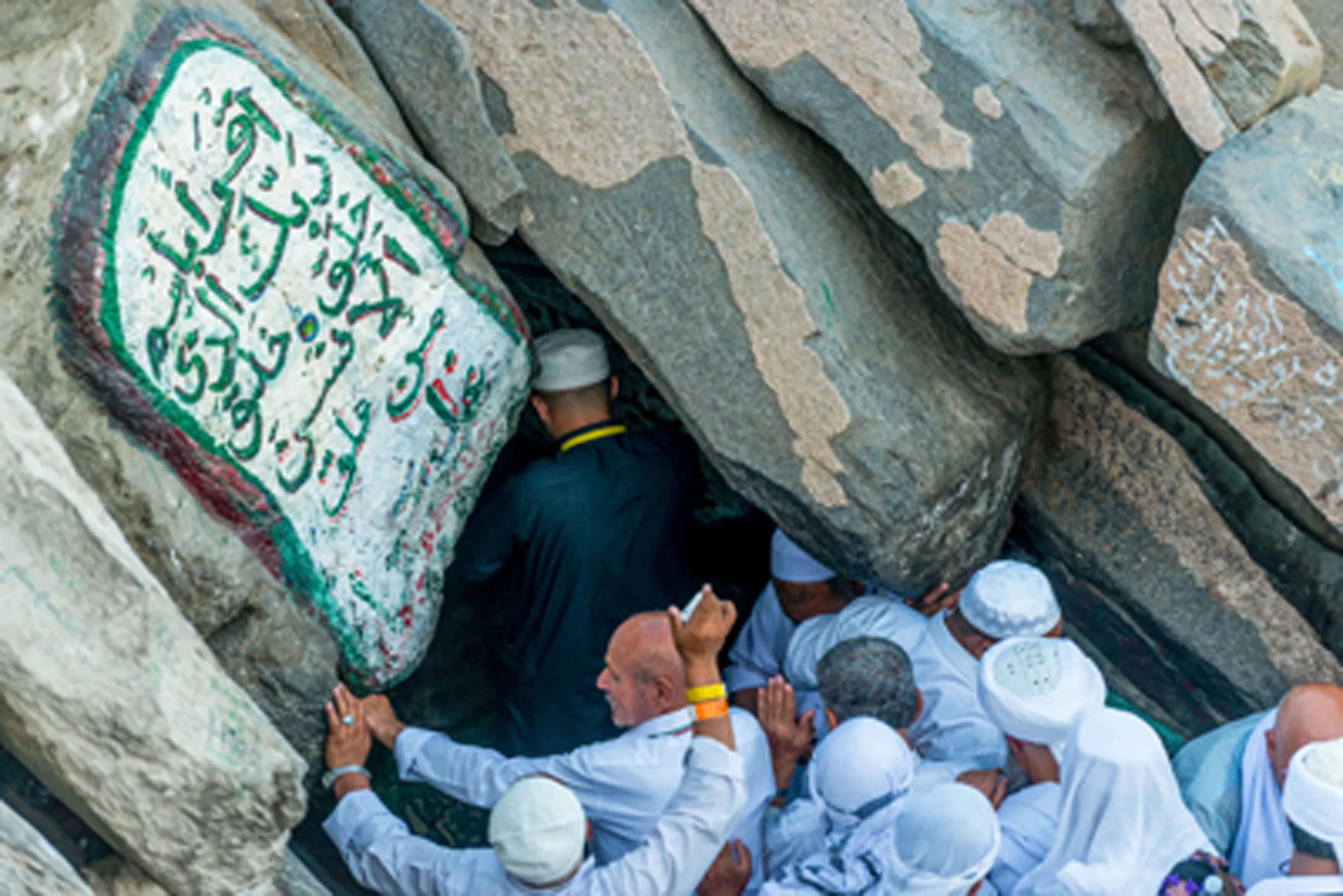
On Jabal al-Nour, near Mecca, a small cave hosted, according to tradition, Muhammad's annual spiritual retreats even before he became a prophet: he was in the habit of withdrawing there in meditation (tahannuth) for a month at a time. Tradition places the very first revelation in this cave, around the year 610, dated to the Night of Decree (Laylat al-Qadr). The first verses revealed there are those of Surah Al-Alaq, whose opening word, "Iqra" ("Read" or "Recite"), traditionally marks the starting point of Islam.
From revelation to the Hijra
After this first revelation, Muhammad's preaching in Mecca met with hostility from part of his tribe, the Quraysh. In 622, he left the city with his companions to reach Medina: this migration, the Hijra, marks the starting point of the Muslim calendar. It was along the way, during a stop in the village of Quba, on the outskirts of Medina, that a founding episode for the religious architecture of Islam took place.
Quba, the first mosque of Islam
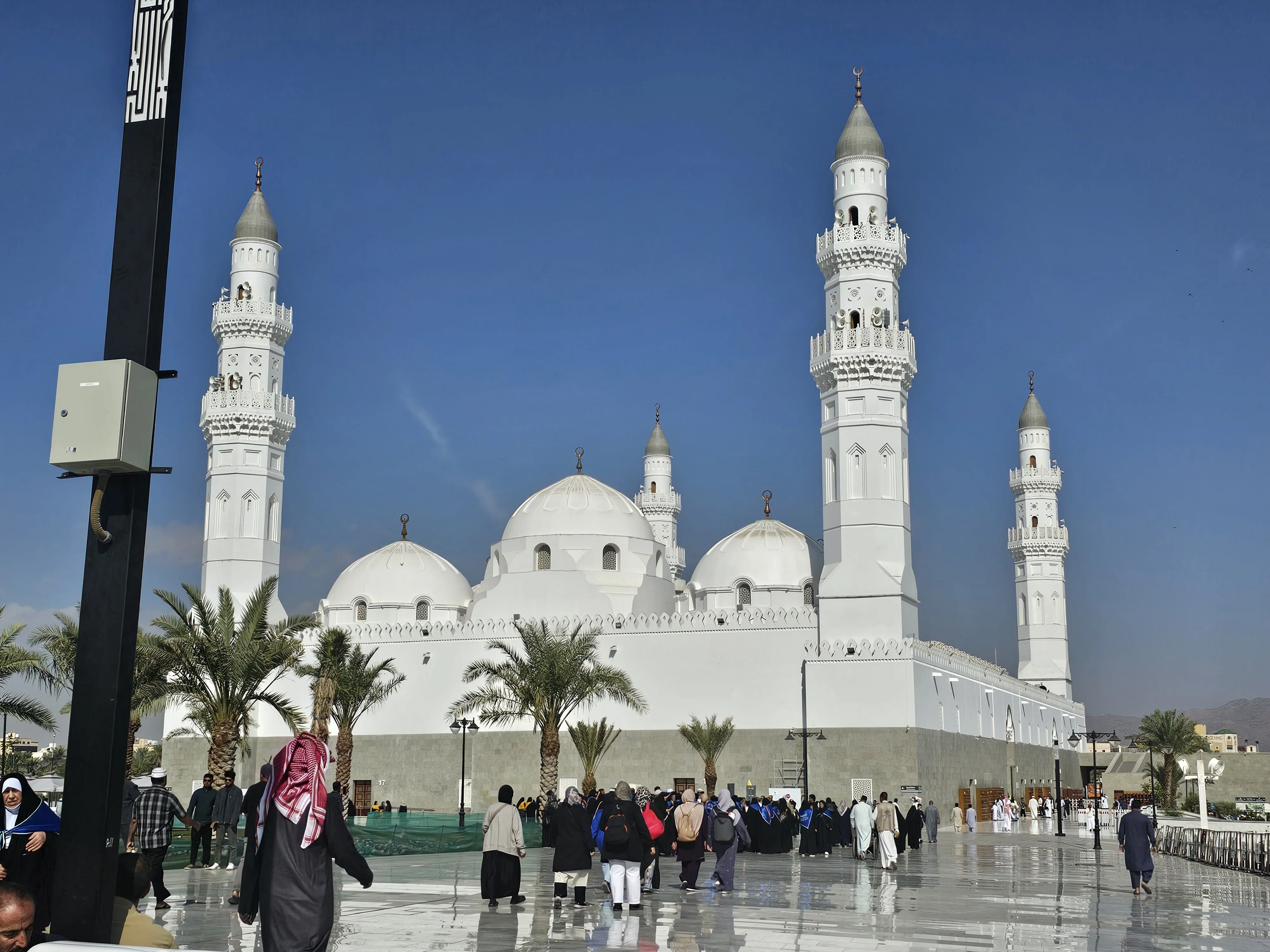
The Mosque of Quba is traditionally presented as the very first mosque built in the history of Islam. Accounts vary on the details of its founding: some report that the Prophet (peace and blessings of Allah be upon him) himself laid its first stone upon arriving at Quba, others that it had already been built by the earliest emigrants before his arrival. Muhammad's stay at Quba, before his official entry into Medina, is said to have lasted anywhere from three to about twenty days depending on the source. The building has been rebuilt and expanded many times over the centuries, up to a complete reconstruction in the 1980s that gave it its current appearance, with its characteristic white domes.
What we do not know about the first mosque
This has to be said plainly, because many pages on the subject slide past it: we do not know what the mosque of Quba originally looked like. The archaeology of first-century-AH mosques is almost non-existent. The materials used were perishable, the sites were rebuilt without survey drawings, and no excavation has produced a plan for Quba. The Saudi state encyclopaedia, which documents building campaign after building campaign, gives neither materials nor an initial plan.
One description circulates everywhere all the same: mud brick, palm trunks carrying the roof, palm fronds covering it, a rectangular hall and an open courtyard. That description is attested, but for a different building: the Prophet's Mosque in Medina. It has been copied from one building to the other until it passed for a fact about Quba.
As for the idea that courtyard plus hall is the origin of the mosque plan everywhere, that is a historian's thesis, put forward by K. A. C. Creswell, and recent scholarship judges it harshly. A contested thesis is not a fact, and we do not present it as one.
Fourteen centuries of building work
What is documented, by contrast, is documented very precisely: the list of building campaigns. It is referenced in the mosque's own record and corroborated by the Saudi state encyclopaedia, which gives the same dates. It tells you what this place actually is better than any description could.
| Date | What was done |
|---|---|
| 622 | Foundation, on arrival near Medina, before entering the city |
| 644-656 | Enlargement under Caliph Uthman (may Allah be pleased with him) |
| 684 | Enlargement under Abd al-Malik |
| 705-715 | Rebuilding under al-Walid I |
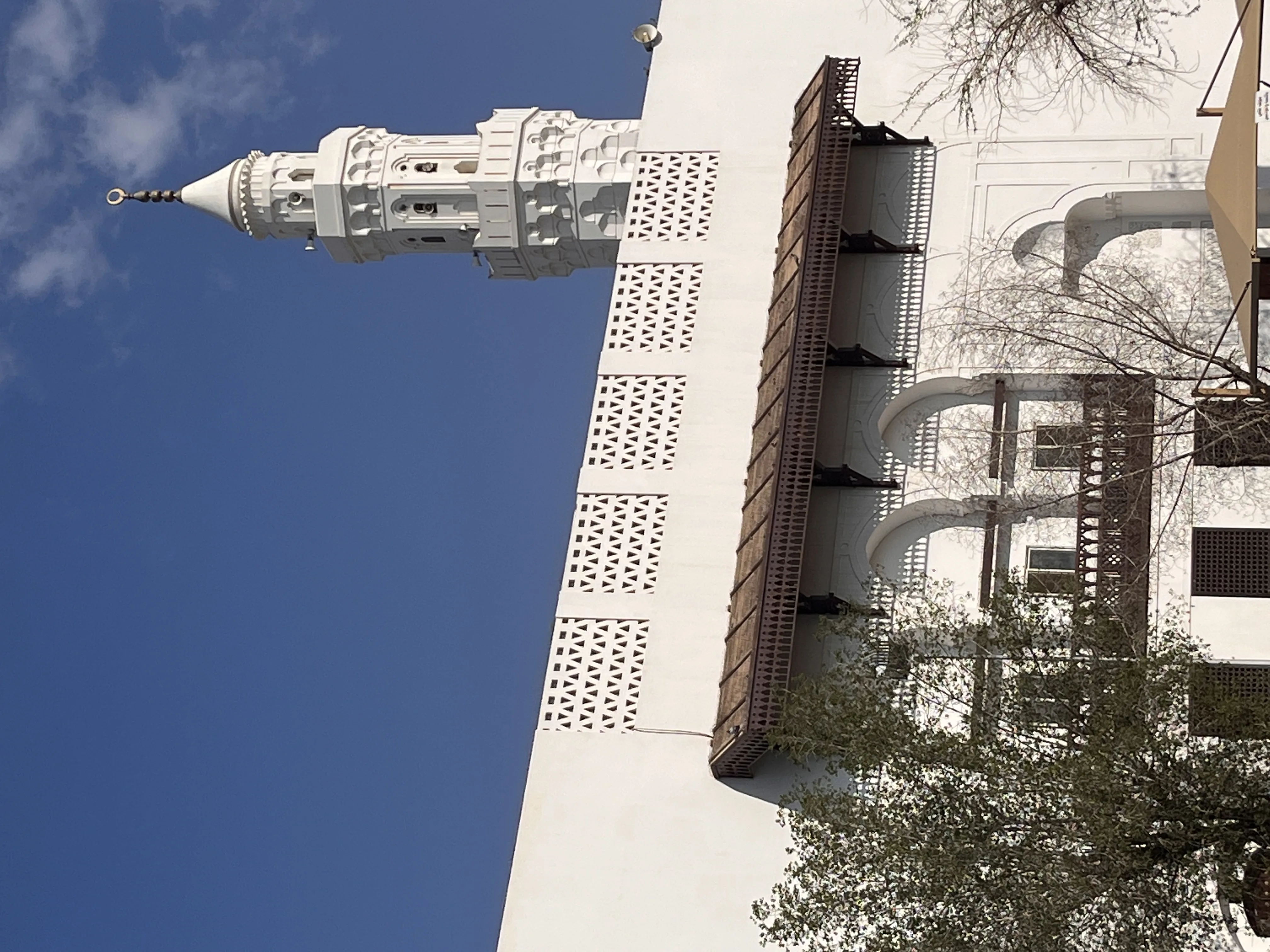
| 717-720 | First minaret, under Umar ibn Abd al-Aziz |
| 1044 | Mihrab |
| 1160 | Renovation |
| 1333 | Rebuilding |
| 1436 | Ceiling |
| 1476 | Renovation |
| 1543 | Minaret and ceiling, under Suleiman |
| 1699 | Minaret and ceiling |
| 1829 | Major renovations |
| 1968 | External refurbishment |
| 1984-1986 | Complete demolition and rebuilding |
Fifteen campaigns in fourteen centuries. The first minaret arrives only at the start of the eighth century: there was none in the lifetime of the Prophet (peace and blessings of Allah be upon him), none under the rightly guided caliphs, and the call to prayer was given from the roof of the tallest house.
Today's face, and the one before it
Before the 1980s the mosque kept an overall form inherited from the Umayyad period: a covered prayer hall and an inner courtyard ringed by arcaded galleries. Nineteenth-century travellers describe it as a square roughly forty metres on a side, under a ceiling about six metres high. Then, between 1984 and 1986, the building was demolished outright and rebuilt. Today's mosque has four minarets, fifty-six domes and a footprint of 13,500 square metres. Materially, it has nothing in common with the building of 622.
Surat At-Tawba, verse 108, which speaks of a mosque founded on piety from the first day, is traditionally referred to Quba. That is an identification of tradition, widely received, and we give it as such.
What lasted, and what did not
Of the first mosque of the Muslim world, not one stone survives. That is neither neglect nor accident: it is the result of fourteen centuries of upkeep, enlargement and rebuilding in a place that never stopped being in use. A building people use gets remade; a building people abandon is preserved, and becomes a ruin.
What lasted at Quba was therefore not the material. It was the place, and what was decided there. The list of fifteen building campaigns is, in its own way, the real monument.
Masjid al-Qiblatayn, the mosque of the two qiblas
In Medina stands a second founding site, distinct from Quba: Masjid al-Qiblatayn, "the mosque of the two qiblas". Tradition reports that in the middle of a prayer, on 15 Sha'ban of year 2 of the Hijra (623), Muhammad received the order to change the direction of prayer there: until then facing Jerusalem and the Al-Aqsa Mosque, it turned from that point on, and forever, toward Mecca and the Kaaba. It is the only place where the Prophet (peace and blessings of Allah be upon him) is said to have prayed toward two different qiblas within a single prayer, which gives the mosque its name. The building originally had two mihrabs facing different directions; during a more recent reconstruction, the mihrab facing Jerusalem was removed and replaced with a simple commemorative marker, under a secondary dome.
Four sites, one trajectory
From the Cave of Hira to Masjid al-Qiblatayn, these sites trace the founding trajectory of nascent Islam: a place of retreat and revelation, a founding migration, a first mosque, and the architectural and spiritual gesture that permanently fixed the direction of prayer toward Mecca : the very direction that gives the Qibla project its name.
Discover more
Mosques mentioned in this article
About this page's content: this site offers editorial and cultural content written with care and respect for the religious traditions concerned; it does not constitute theological advice or an authoritative religious source. Despite our checks, errors, inaccuracies, or approximations may remain. If you spot one, please let us know via the Contact page or by email at qibla.mosk@gmail.com, we will gladly correct it.