
Home › Blog › The Kalyan minaret
Bukhara, Uzbekistan · 9 min read
This minaret is four centuries older than its own mosque
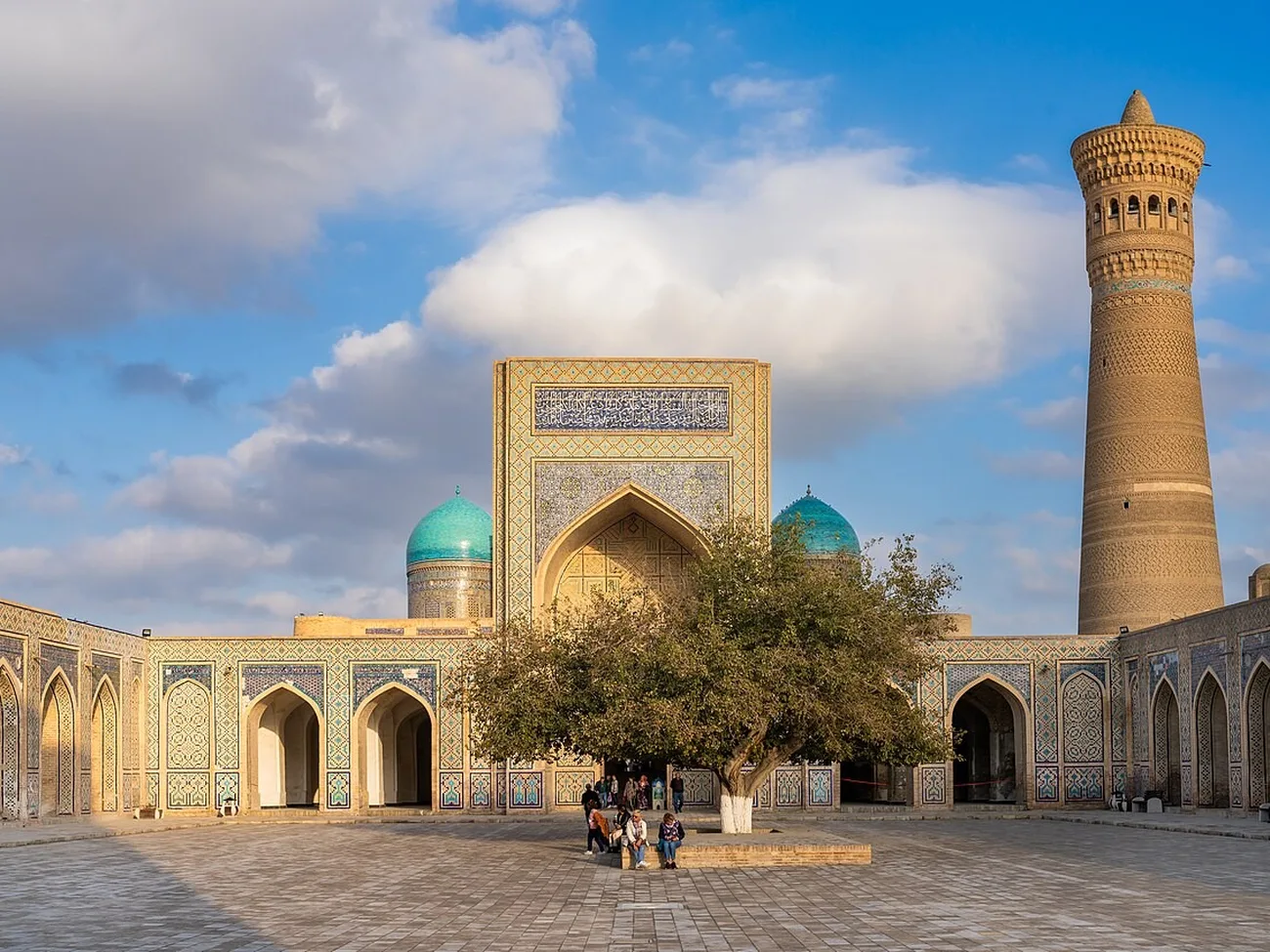
On the Po-i-Kalyan square in Bukhara, a minaret stands beside a mosque. We look at them as one ensemble. They are not of the same period: four centuries separate them. And the surprising part is that the minaret says so itself, in writing.
A building that carries its own date
Most medieval monuments are dated by triangulation: style, techniques, mentions in chronicles, sometimes analysis of materials. You arrive at a bracket, rarely at a year.
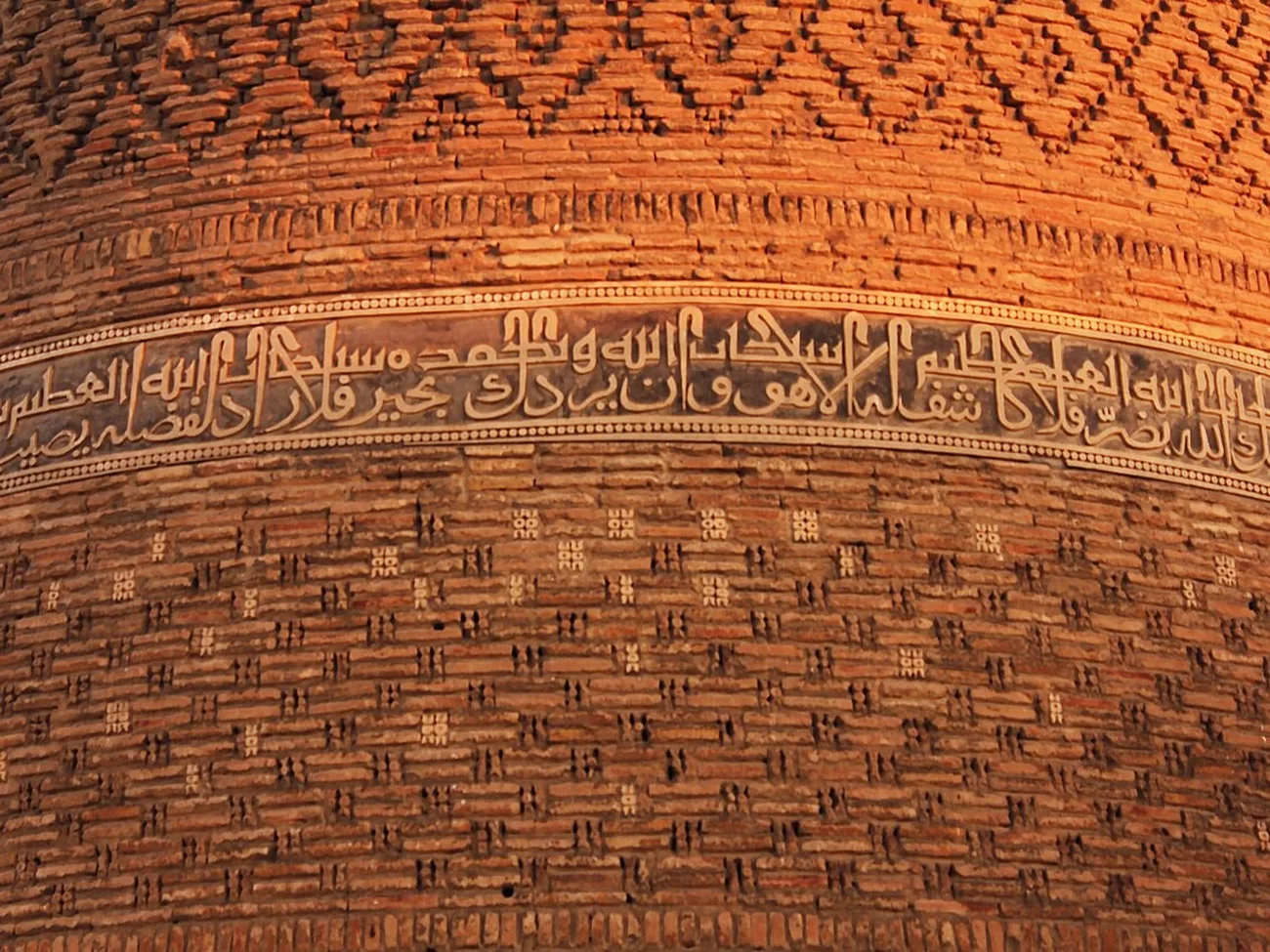
Not here. An inscription runs along the cornice of the minaret, and it gives two things: the year, 1127, and the name of the architect, Bako.
That is unusual. Names of twelfth-century architects are rare, and a date carried on the work itself is rarer still. This building does not have to be dated. It dates itself.
What it is
The Kalyan minaret, or Minorai Kalon, was raised for the Qarakhanid ruler Arslan Khan.
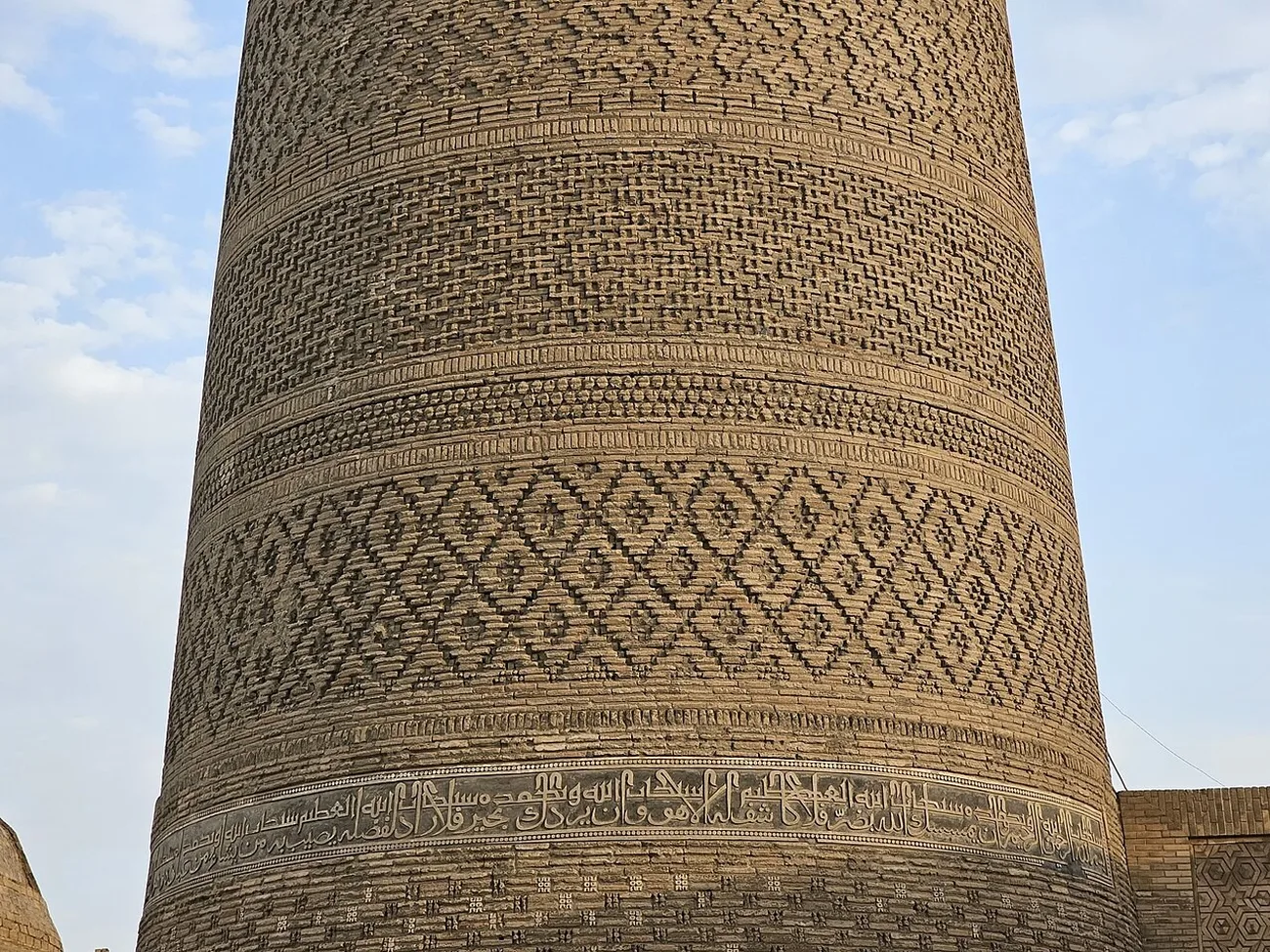
Its dimensions are these: 45.6 metres high, nine metres in diameter at the base and six at the top, which gives it that slightly conical profile. Its foundation goes down some ten metres, which partly explains what follows.
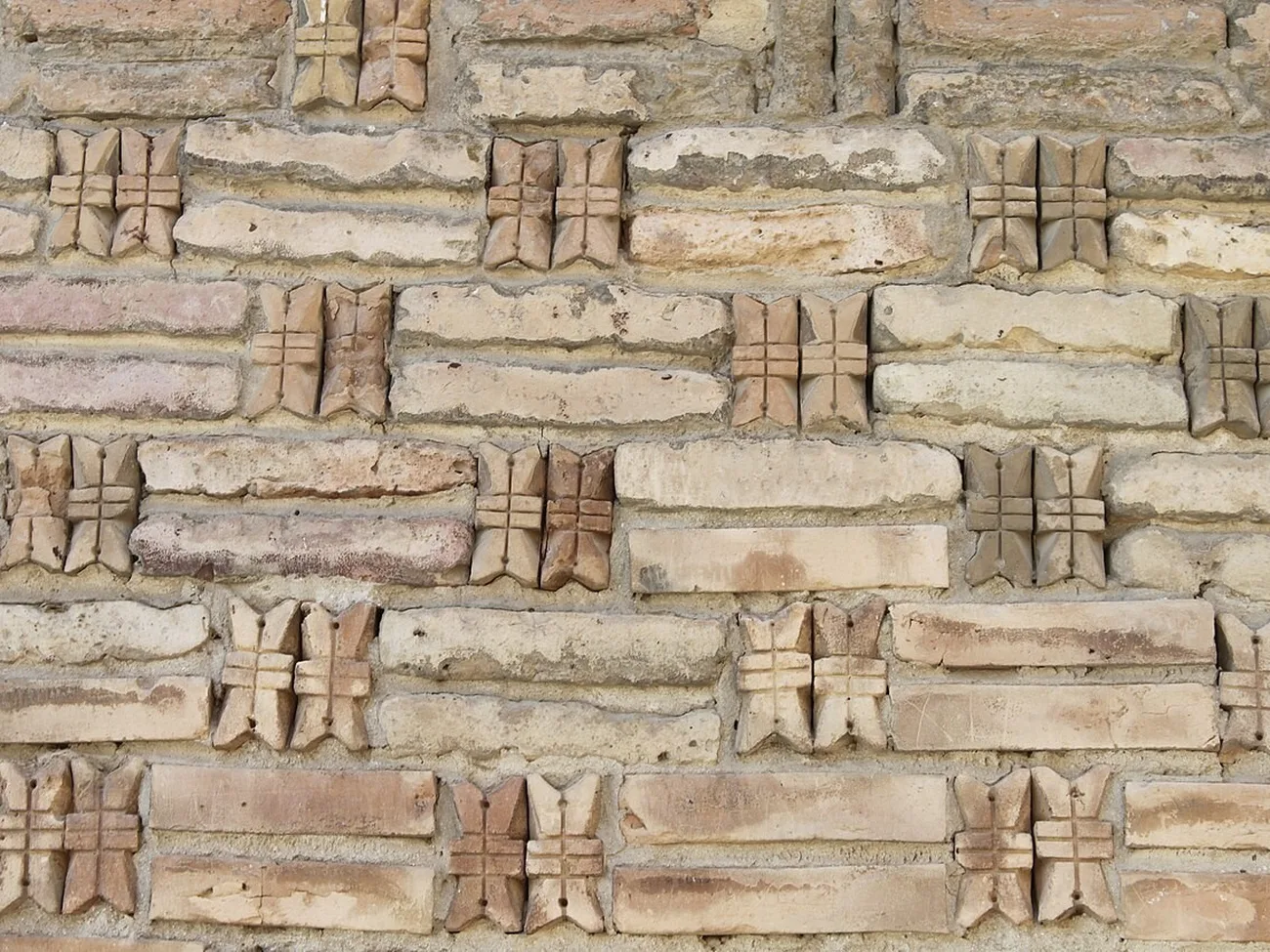
But the detail that strikes you on looking up is elsewhere. The tower is entirely covered in bands of brick, set in rings from bottom to top. There are twelve of them, and each carries a different geometric pattern. No two are alike.
This is not applied decoration: the pattern comes from the laying of the bricks themselves, from their orientation and their setback. The ornament is the masonry.
One square, three buildings, three periods
The ensemble is worth looking at as a whole, because the square itself tells this story of mismatch.
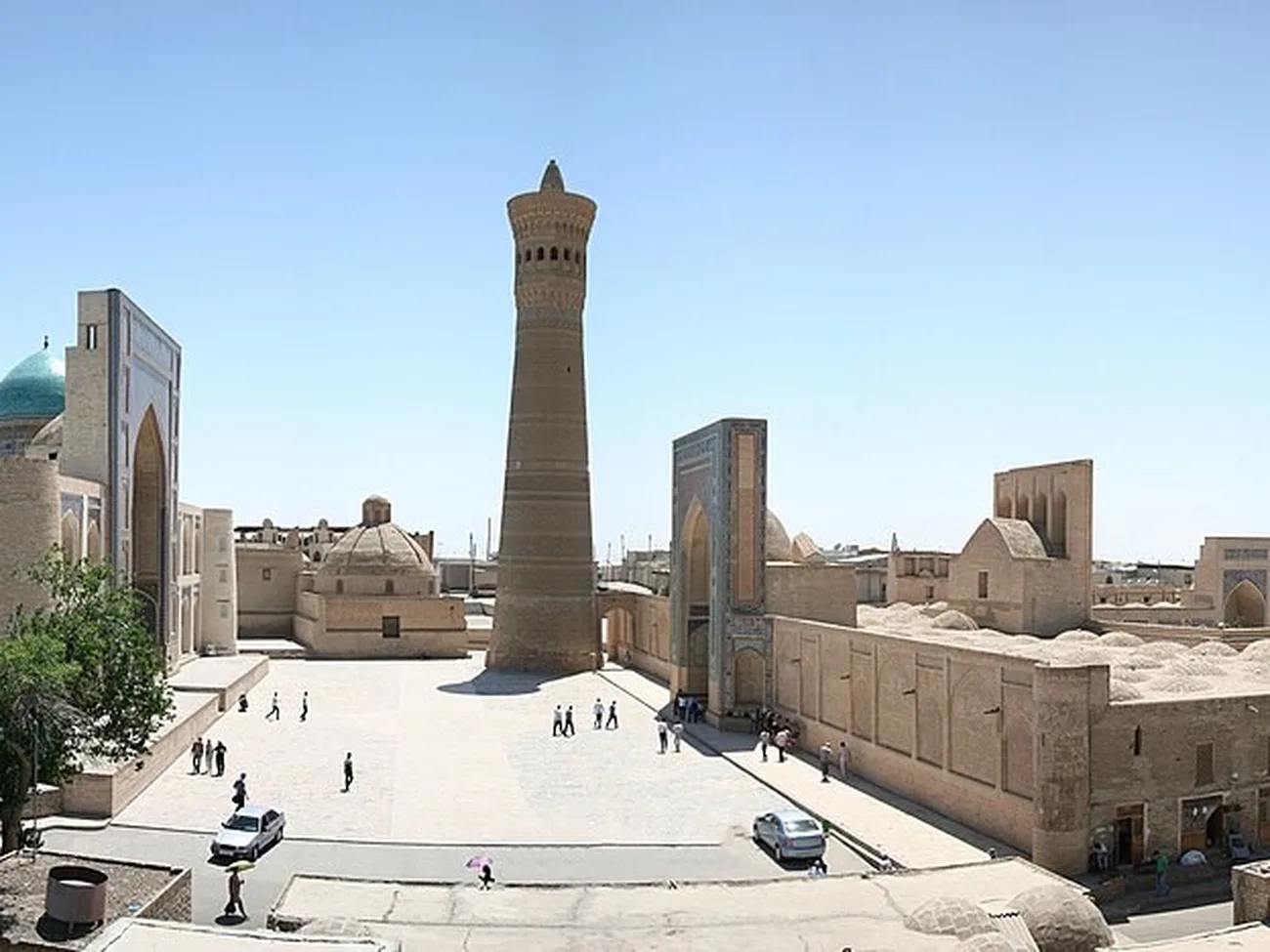
The complex is called Po-i-Kalyan, which means "at the foot of the Great One", the Great One being the minaret. The name already states the order of precedence: it is not the mosque that names the square, it is the tower, and the other buildings are positioned in relation to it.
Three elements face one another there. The minaret, of 1127. The Kalyan mosque, rebuilt in the early sixteenth century. And, opposite, a madrasa of the same sixteenth century. Two of the three are therefore contemporaries, and the third precedes them by four hundred years.
When you photograph the square, you photograph two periods answering each other without ever having met.
February 1220
The armies of Genghis Khan reached Bukhara early in 1220. The city was taken and devastated. Almost nothing that stood remained standing.
The minaret did.
The mosque it is associated with today, the Kalyan mosque, did not: the one you visit was rebuilt in 1514-1515. What we look at as a coherent ensemble is therefore a juxtaposition of two periods, nearly four hundred years apart.
The legend, and why we do not settle it
The story you will be told on site needs addressing, because it is a fine one and it is everywhere.
It is said that Genghis Khan, entering the city, looked up at the minaret and that his helmet fell. Bending to pick it up, he is said to have declared that he had never bowed to anyone, but that such a work deserved a bow. And he had it spared.
The story is told in every local source. It is presented there as a narrative, never as a fact documented by a contemporary chronicle.
We can therefore neither confirm nor deny it, and we will do neither. Selling it as history would be dishonest. Passing over it would be foolish: it is part of what this monument has become, and it is a fact in itself that a brick tower produced such a story.
What we refuse is to use it as proof. That the minaret survived is established. That it survived because someone ordered it is not.
A more prosaic explanation, which does not exclude the other
In fairness it should be added that the survival of such a structure is not in the least inexplicable.
A solid cylindrical brick tower, nine metres across at the base, on a deep foundation, offers very little purchase. It does not burn, it has no timber frame, it has no roof to collapse. A hypostyle prayer hall, with its porticoes and its roofs, is infinitely more vulnerable.
In other words: the difference in fate between minaret and mosque is very well explained by the difference in construction. The legend is not needed. But neither is it contradicted, and the two can coexist.
What we do not say
We do not repeat the accounts of what the top of the tower was used for, which circulate widely and belong to the same category as the helmet story. Nor do we enter the military history of 1220 beyond what places the building.
Finally, a tradition holds that the architect laid the foundations with a mortar mixed with camel's milk, then left the city for two years and came back to find them hard as stone. It is a fine workshop tale, and we give it as such, not as a technical datum.
What the brick establishes
Take up again what holds, and it is more than enough.
The minaret is the original. It carries its date written on it, with the name of the man who designed it. It came through the destruction of the city. And it is today four centuries older than the mosque whose minaret it is.
Legends cannot be checked. Bricks can.
Our sources
- The cornice inscription, giving the date of 1127 and the architect's name, is recorded in Uzbek heritage documentation, notably the national portal: uzbekistan.travel.
- For the dimensions and the description of the Po-i-Kalyan complex, including the rebuilding of the mosque in 1514-1515: Asian Historical Architecture.
Read on
Another building whose name poses a question: the sixty dome mosque of Bangladesh, which has seventy-seven. And for a building rebuilt without anyone knowing what it looked like, Qol Sharif in Kazan.