
Home › Blog › Vietnam's two great mosques were not built by the Cham
Southeast Asia · 9 min read · 2026-08-13
Vietnam's two great mosques were not built by the Cham
In Vietnam, Islam is the faith of a tiny minority: around eighty thousand believers, barely a tenth of a percent of the population. That minority has a name, the Cham, heirs to the ancient kingdom of Champā. Yet the country's two most iconic mosques, one in Hanoi in the north and one in Saigon in the south, were not built by them. They are the work of merchant diasporas from India. And their fates, separated by war and then by the closing of the country, tell two opposite stories.
The Cham, the only Muslims in a Buddhist country
Islam reached Vietnam by sea, very early. As soon as the 9th century, Arab, Persian and Indian traders were stopping along the coast of the kingdom of Champā, on the trade route towards China. The religion spread slowly and peacefully, through commerce rather than conquest. The Cham thus became the only one of Vietnam's fifty-three recognised ethnic minorities to practise Islam.
But Cham Islam is not uniform. Two currents still coexist today. The Cham Bani, settled mainly in the central provinces, practise a deeply syncretic faith in which Quranic teachings blend with ancestral Cham traditions and elements inherited from Hinduism. The Cham Islam, more numerous in the Mekong Delta and around Saigon, follow a classical Sunni Islam much closer to practices elsewhere in the Muslim world. That second branch was reinforced through contact with the Malay and Indian communities present in the southern ports.
Some Cham also left Vietnam over the centuries, fleeing Vietnamese incursions towards Cambodia and Malaysia, where the diaspora merged into orthodox Sunni Islam. The history of Vietnam's Muslims is therefore, from the very start, a story of movement and departure as much as of settlement.
Hanoi, 1885: the mosque of the Bombay merchants
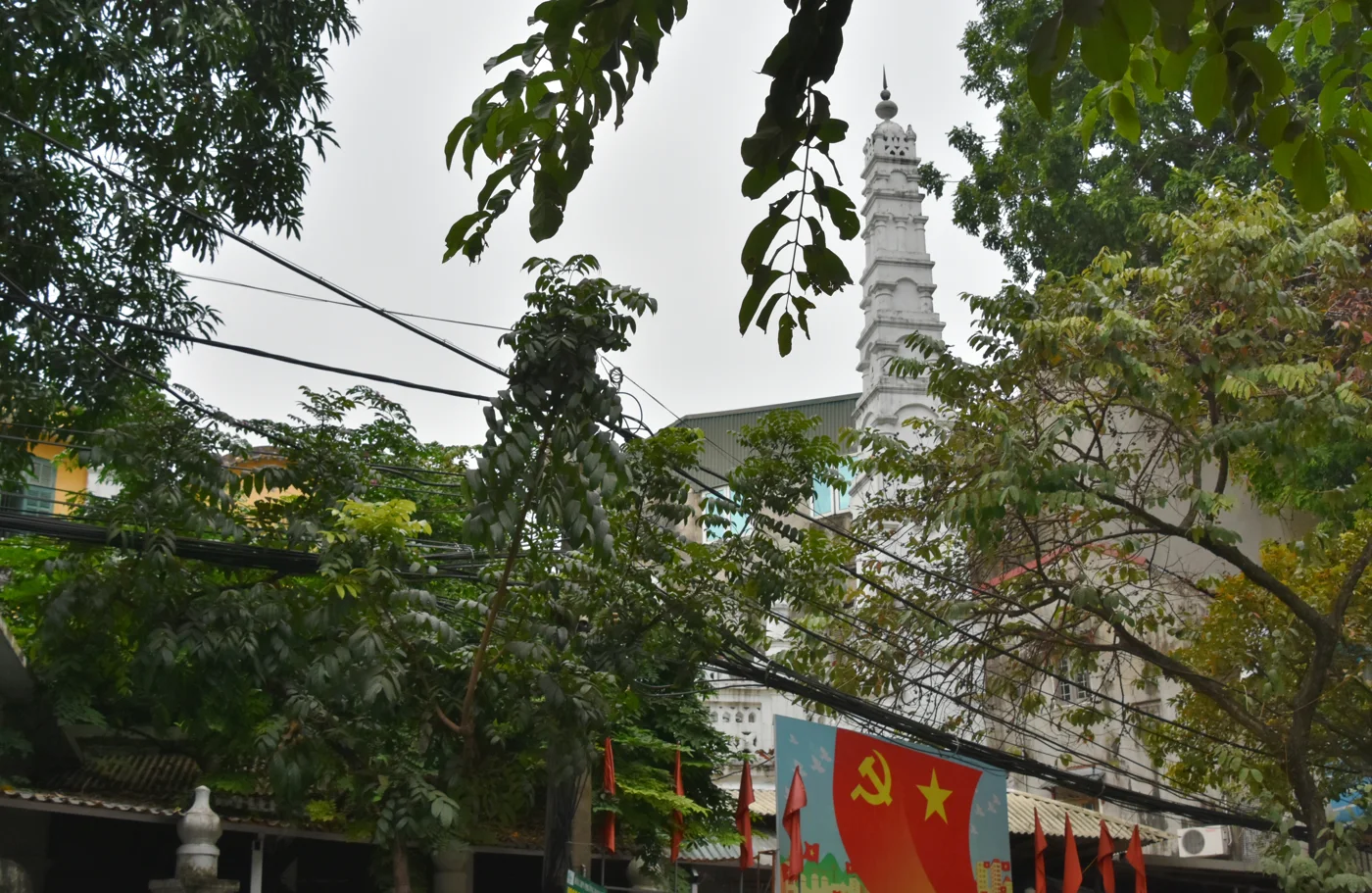
In the 19th century, traders from India and the Middle East settled in northern Vietnam to deal in fabrics and currency exchange. In Hanoi they gathered in the Hang Dao district, the quarter of weavers and silk merchants, at the heart of the old town. There were only a few hundred of them, but prosperous enough to want a permanent place of worship.
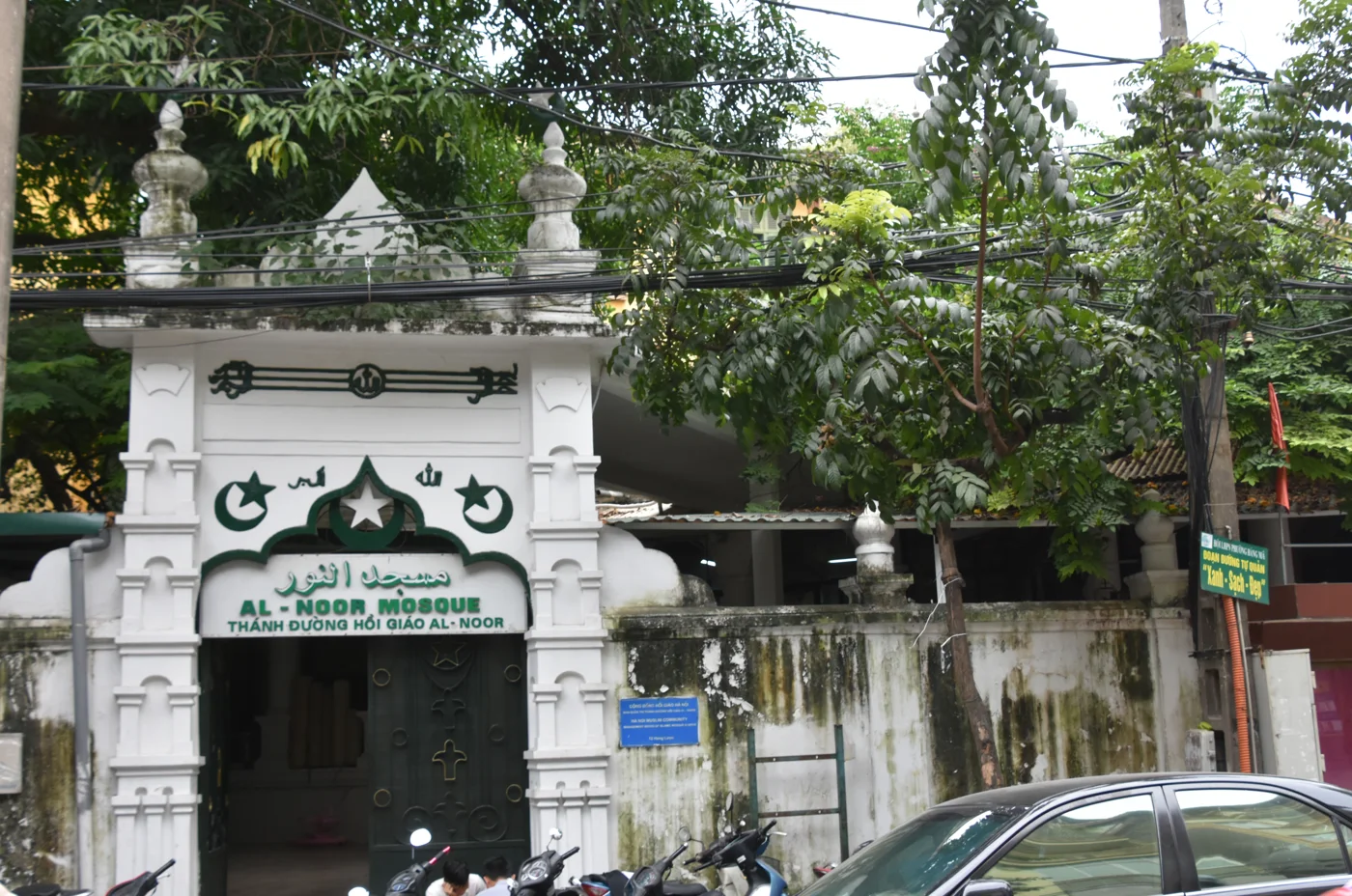
In 1885, a group of Indians from Bombay raised the necessary funds. The Al-Noor Mosque rose on a plot of about seven hundred square metres on Hang Luoc street, and officially opened in 1890. Its architecture blends classical Islamic codes with Indian influences, particularly visible in the treatment of the dome and the minaret. It can hold between two and three hundred worshippers, which was more than enough for the community it served.
This deserves emphasis: the mosque was never designed for the Cham. It was built by expatriates, for expatriates. Northern Vietnam has never had a significant Cham population, and the Muslim community of Hanoi would remain, throughout its history, essentially foreign.
Saigon, 1935: the mosque of the South Indian traders
Fifty years later, at the other end of the country, the scenario repeated itself. Saigon, then capital of French Cochinchina, was home to a cosmopolitan population: Malay, Indonesian, Indian, North African and Yemeni merchants crossed paths in the streets of the centre. Its Muslim community was larger and more diverse than Hanoi's.
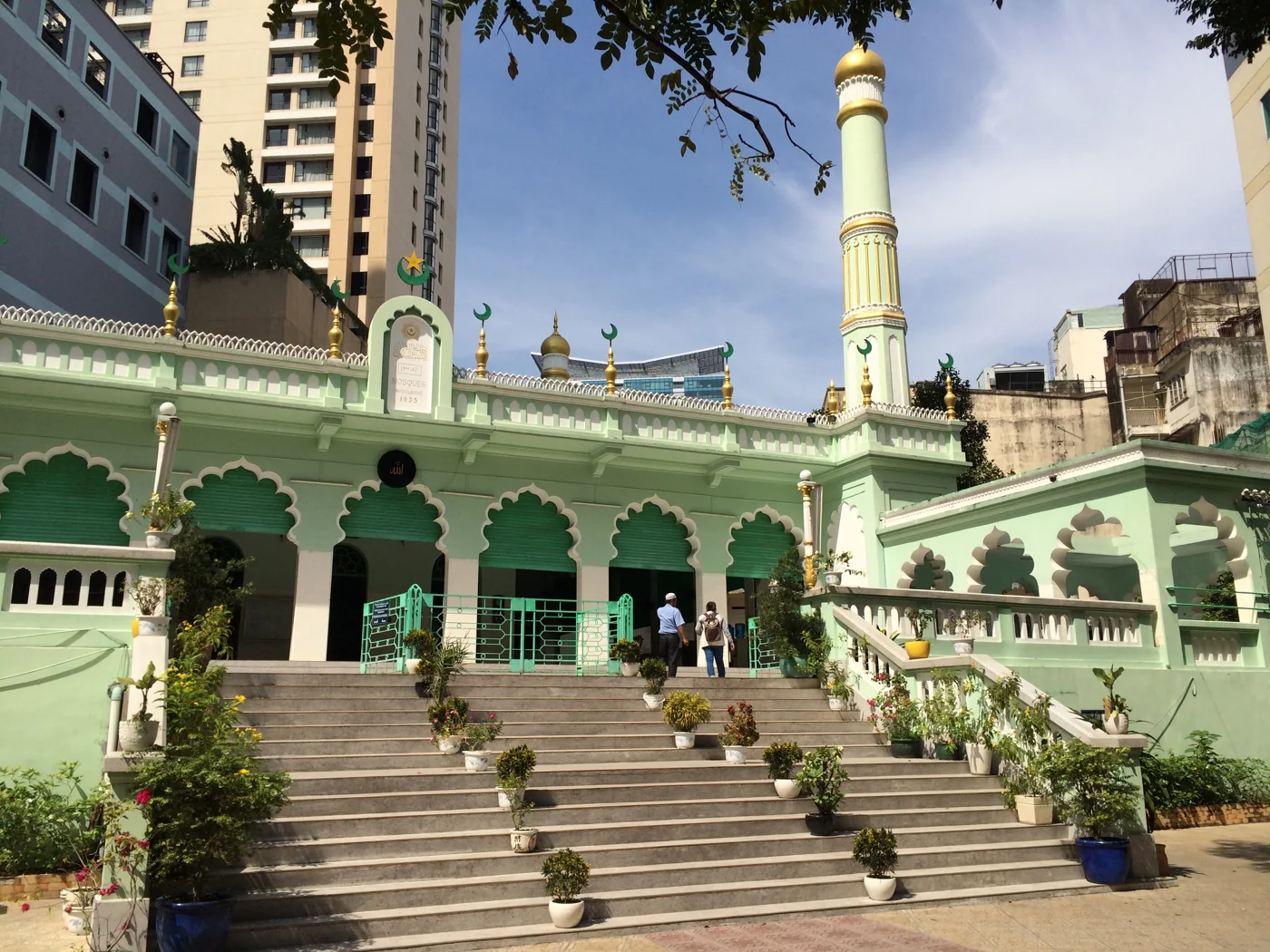
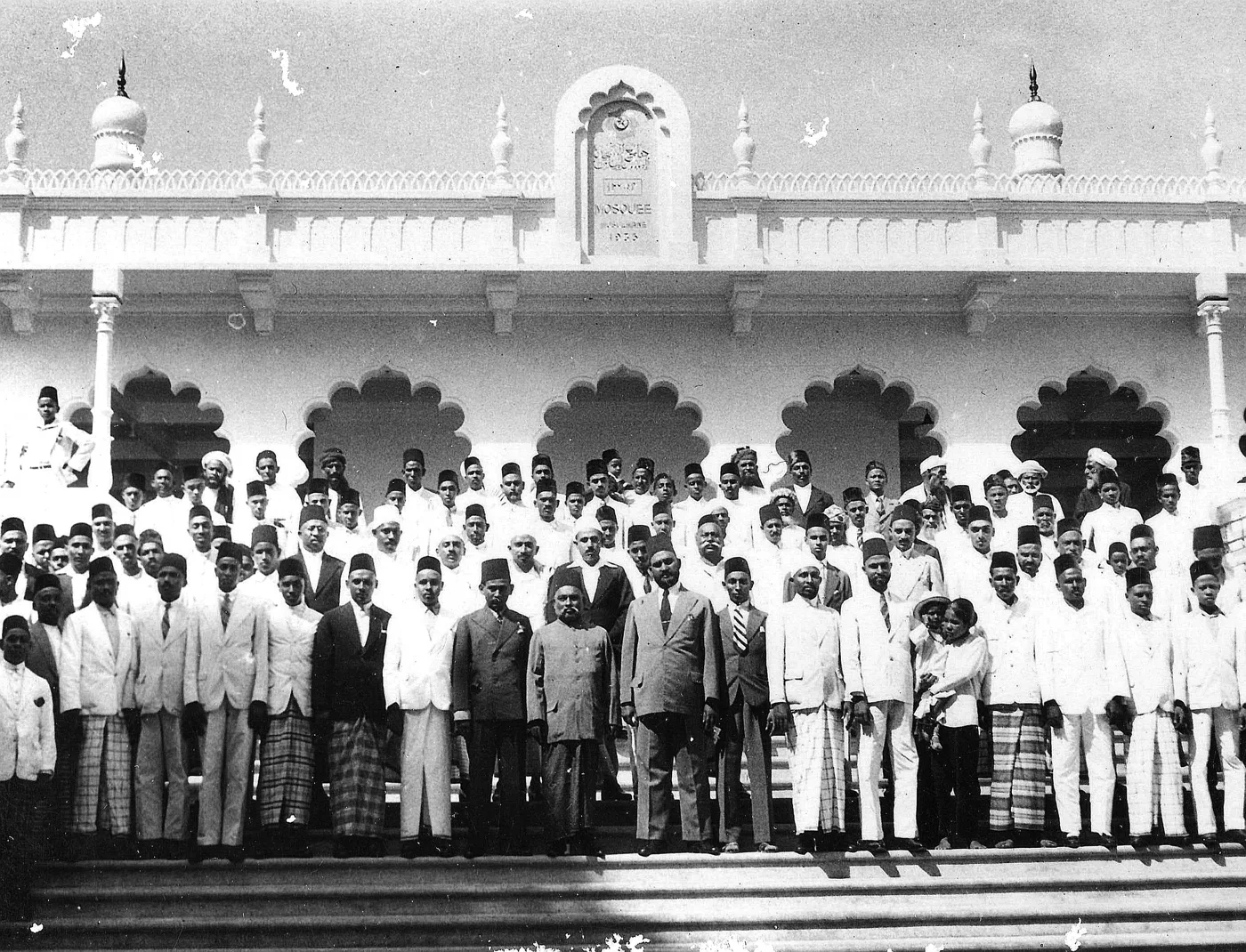
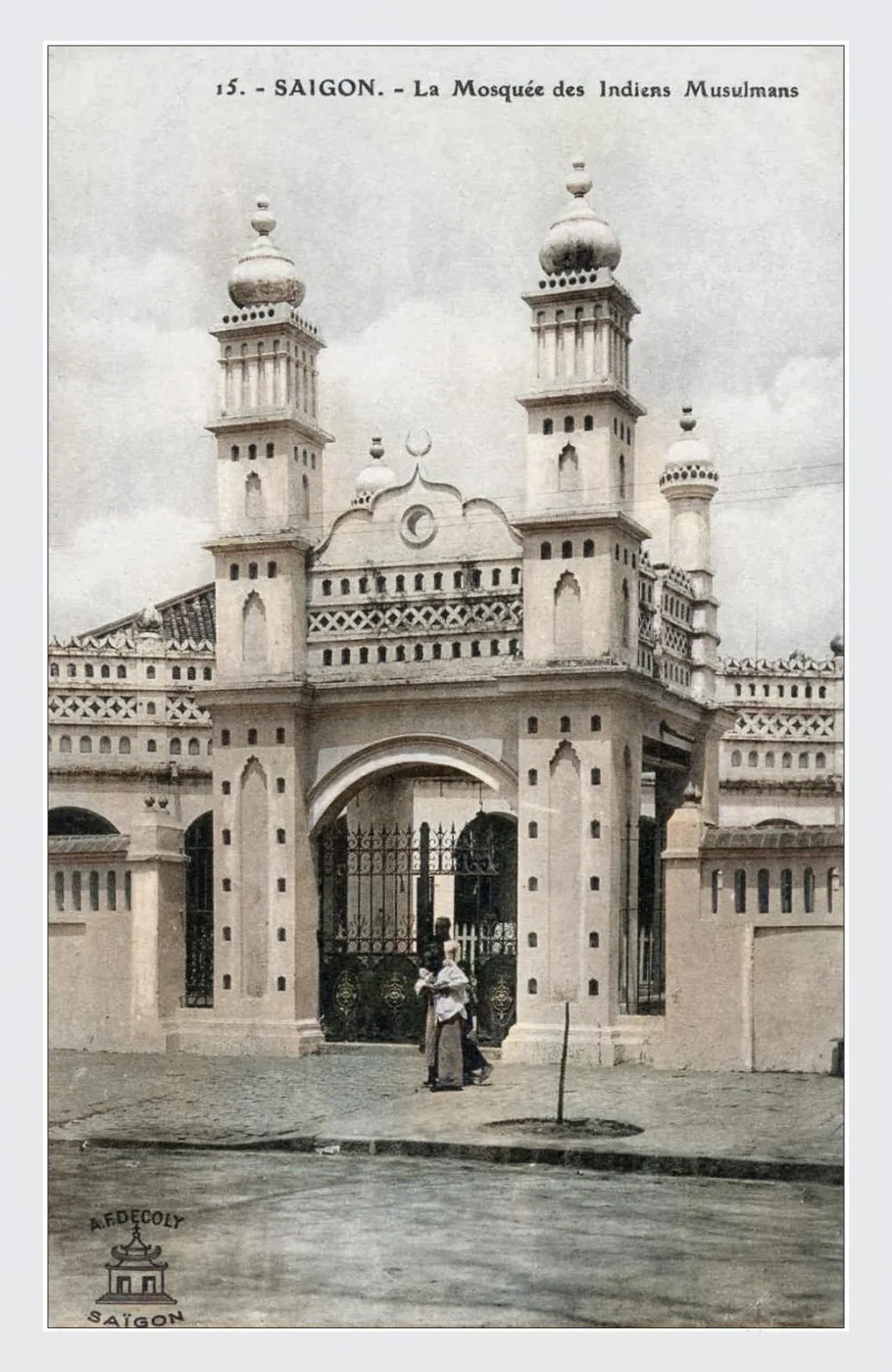
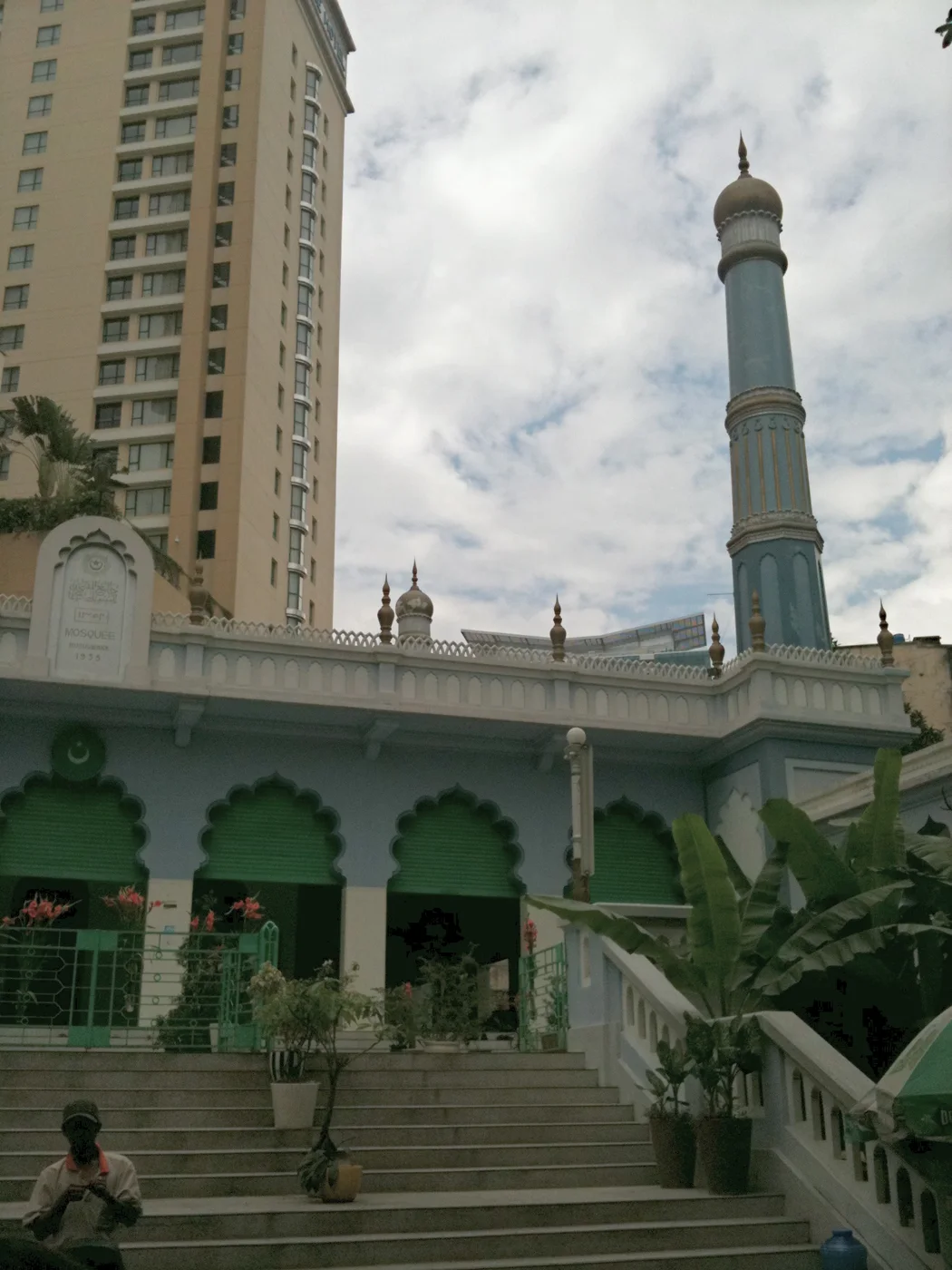
Construction of the Saigon central mosque began on 21 December 1934 and was completed in 1935. It was driven by Muslim traders from southern India, under the leadership of JM Mohamed Ismael, head of the Muslim congregation and a leading figure of the city's British Indian community. The mosque stands at 66 Dong Du street, in the very centre.
Its architecture is a curious assembly. The white facade, the pale blue interior and the four minarets framing the building follow Islamic codes, but the overall structure borrows from the vocabulary of European churches. More surprising still, the arch of the main lintel takes the shape of a lotus, a motif drawn directly from Buddhist and Hindu iconography. Three religious worlds therefore meet in a single facade.
Initially reserved for Indian Muslims, the mosque gradually opened to all the city's faithful, including Cham from the delta who had settled in Saigon. It is today the oldest and best known of the twelve mosques of Ho Chi Minh City, and its four minarets now stand out against the glass towers of the business district.
Two fates separated by war
This is where the two stories diverge. Between 1964 and 1973, the war forced the Al-Noor Mosque in Hanoi to close its doors. Remarkably, the building came through the bombing without being destroyed. But the structure survived better than the community it housed.
After the reunification of 1975, Vietnam adopted a Soviet-style planned economy and closed in on itself. Foreign missionaries were expelled and exchanges with the outside world shrank drastically. For a mosque whose worshippers were overwhelmingly expatriates, the consequence was mechanical: there was simply no one left to pray there. It was not so much the mosque that closed as the entire country, and expatriates could no longer return.
It took the opening reforms launched from 1986, known as the Renewal, for Vietnam to reopen to the world. The Al-Noor Mosque came back to life in 1990. Its reopening hung on very little: a Malaysian businessman, Khalid, then Malaysia Airlines manager in Hanoi, revived the effort, and it was the ambassador of Iran who signed the agreement that secured official approval. A mosque built by foreigners, reopened by foreigners.
In the south, a community that never disappeared
In Saigon, nothing of the kind. The southern Muslim community, older, larger and above all locally rooted thanks to the Cham presence in the Mekong Delta, never ceased to exist. The central mosque never experienced a comparable interruption and has continued to welcome its faithful without a break.
The contrast still holds today. In Hanoi, a good share of the worshippers are diplomats and embassy staff from Muslim countries, alongside a few hundred Vietnamese Muslims. In the south, around Ho Chi Minh City and in the provinces of An Giang and Tay Ninh, Cham communities have preserved their Islamic heritage across centuries, with their own village mosques.
What these two buildings tell us
The story of these two mosques is ultimately less a story of architecture than one of human movement. Twice, fifty years apart, merchants from elsewhere built a place of worship for themselves, and these foreigners' buildings became the most visible Islamic landmarks of a country where Islam is practised by a minority that had nothing to do with either of them.
What the comparison between north and south reveals is the fragility of a community without local roots. In the north, once the diaspora left, the mosque emptied, and it took decades and the intervention of foreigners to revive it. In the south, the graft between merchant diaspora and Cham minority held, and the place of worship crossed the same decades without rupture. Two buildings born of the same impulse, two outcomes explained by nothing more than the presence, or absence, of a rooted community.