History
History
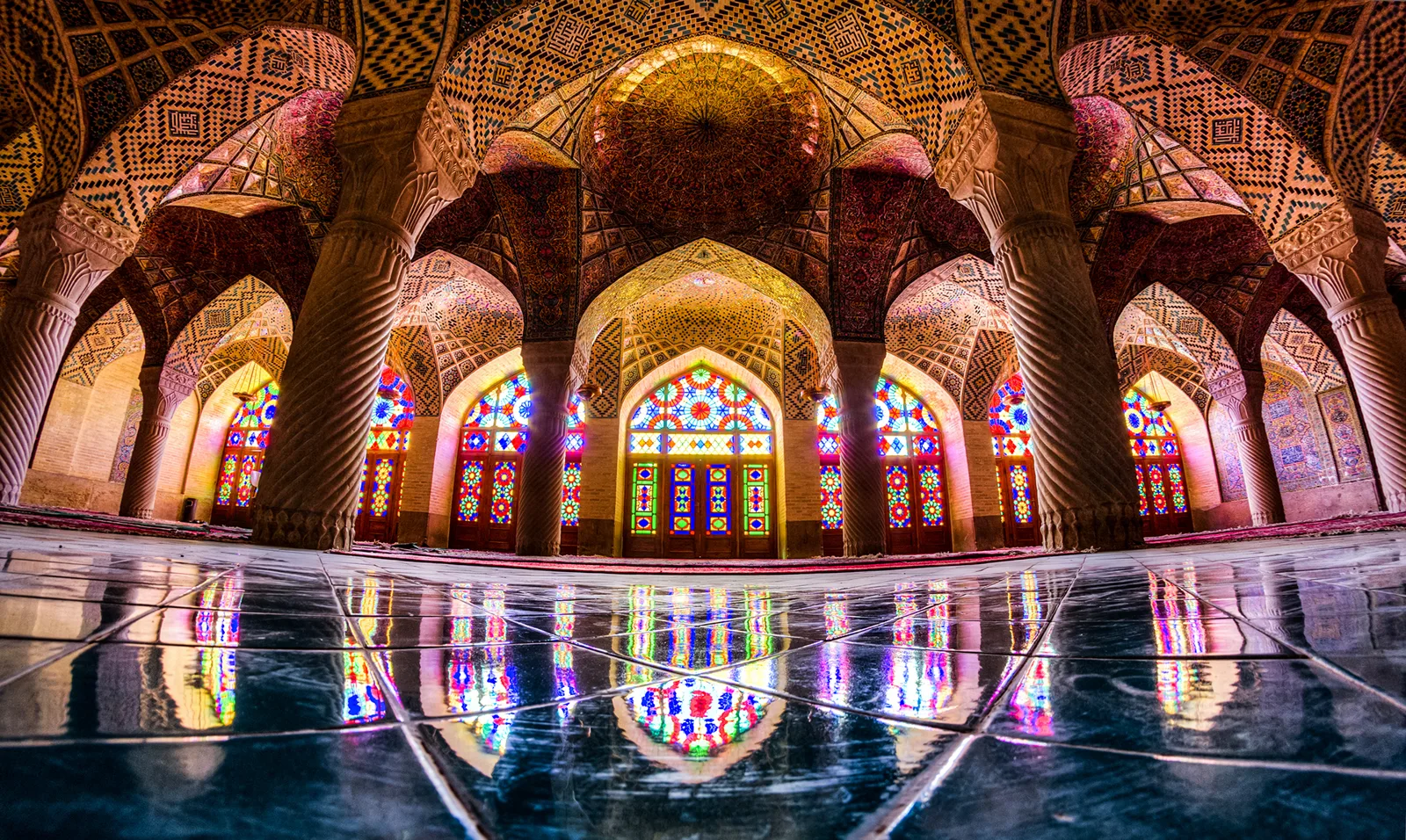
Built between 1876 and 1888 under the Qajar dynasty for the nobleman Mirza Hasan Ali Nasir al-Mulk, this Shiraz mosque is nicknamed the "Pink Mosque" for its tiles dominated by pinks, reds and yellows, a rare palette in Iranian art, traditionally blue. The project, entrusted to the architect Mohammad Hasan-e Memar, took about twelve years for a modest neighbourhood building able to hold only a few hundred worshippers.
Its marvel lies in its winter hall: every morning, sunlight passes through its tall stained-glass windows and casts a shifting kaleidoscope of colours onto the carpets and twisted columns, making light itself the primary architectural material.
A hall designed for the morning sun
Traditional Iranian mosques often separate a summer hall, cool and shaded, from a winter hall oriented to capture the warmth and light of the low sun. It is this second space, the winter shabestan, that made Nasir al-Mulk famous. Its orientation is no accident: the building was conceived to take the morning sun head on.
The consequence is that the spectacle runs on a timetable. Visitors arriving late in the morning miss it: as the sun climbs, the angle of incidence narrows, the patches of colour ride up the walls, fade, and disappear. By the middle of the day the hall returns to almost ordinary light. This is why photographers crowd in from opening time, in the earliest hours.
The season matters as much as the hour. The most favourable window runs from mid-October to early winter, when the sun stays low on the horizon and strikes the glass at an angle, prolonging the effect and intensifying the projected colours. In high summer, a sun that sits too high markedly reduces the phenomenon.
The orsi, a Persian technique
The windows that produce this effect are not stained glass in the European cathedral sense, where coloured glass is set in lead. They are orsi, a type of Persian joinery: a finely pierced wooden frame assembled into geometric networks, into which pieces of tinted glass are fitted. The wood draws the grid, the glass supplies the colour, and together they act as a filter that breaks up daylight.
The technique was used in Iranian domestic and palatial architecture long before being applied here on such a spectacular scale. What Nasir al-Mulk adds is the combination of oversized glazed bays, a low hall whose twisted columns multiply the receiving surfaces, and pale carpets on the floor that act as a screen.
A pink mosque in a blue country
The "Pink Mosque" nickname comes from an unusual choice of colour. Classical Iranian ceramics, those of Isfahan in particular, favour deep blues and turquoises. Here the tiles give unusual prominence to pink, red and yellow, with floral motifs that betray the 19th-century Qajar aesthetic, more decorative and more open to European influence than earlier periods.
The mosque remains a working neighbourhood place of worship, and the foundation that maintains it is still administered by the descendants of the man who commissioned it. Its recent photographic fame, largely driven by social media, contrasts with its original purpose: a modest building, put up for a local community, that became almost by accident one of the most recognisable mosques in the world.
Anecdotes & highlights
- The stained-glass display lasts only a few hours: you need to arrive early in the morning, ideally in winter.
- Its pink tiles make it one of the most photographed mosques in the world.
- The foundation that maintains it is still run by the descendants of the man who commissioned it.