
Home › Blog › Hassan Tower: a minaret stopped halfway since 1199
Rabat · 9 min read · 2026-08-14
Hassan Tower: a minaret stopped halfway since 1199
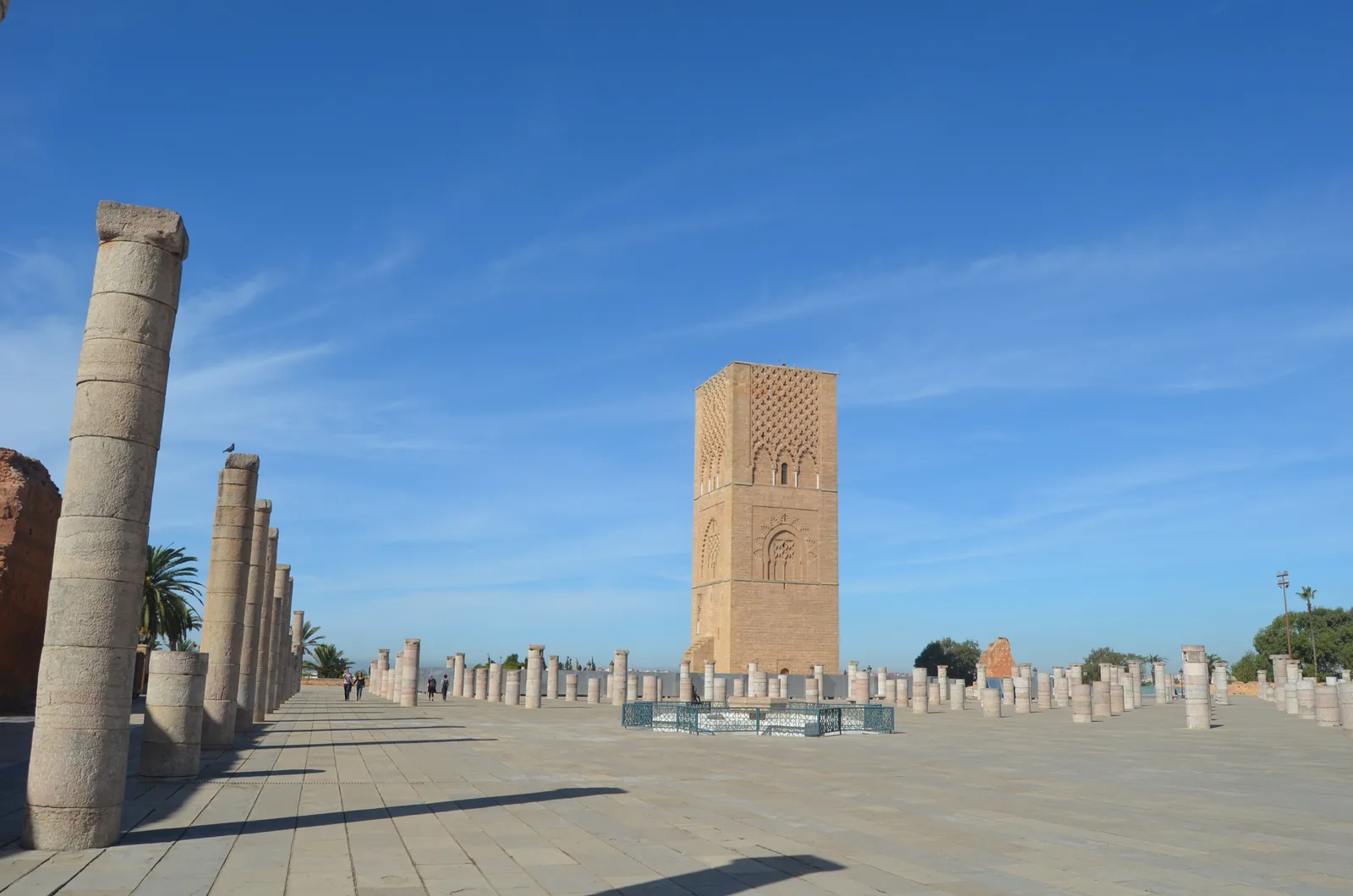
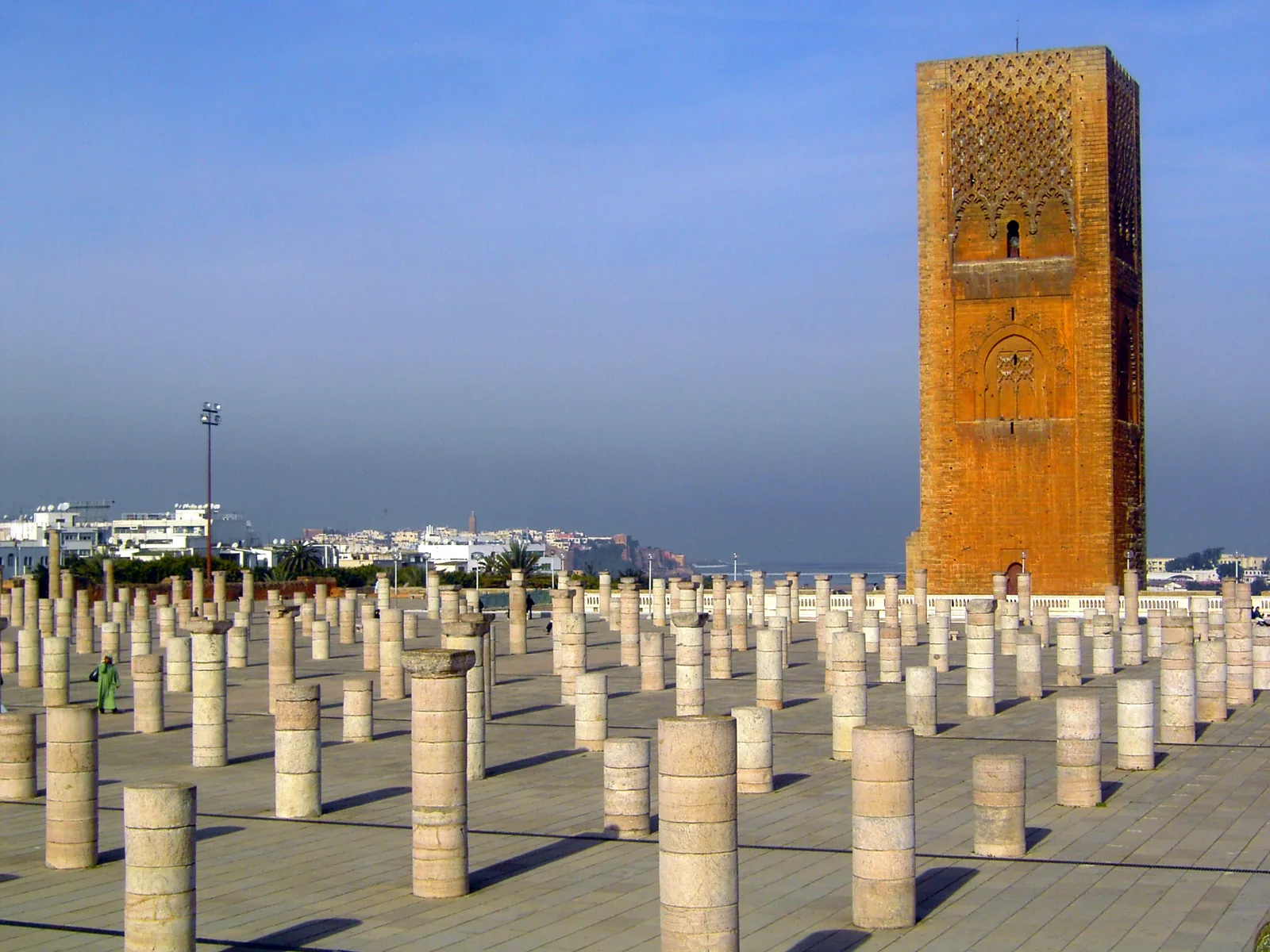
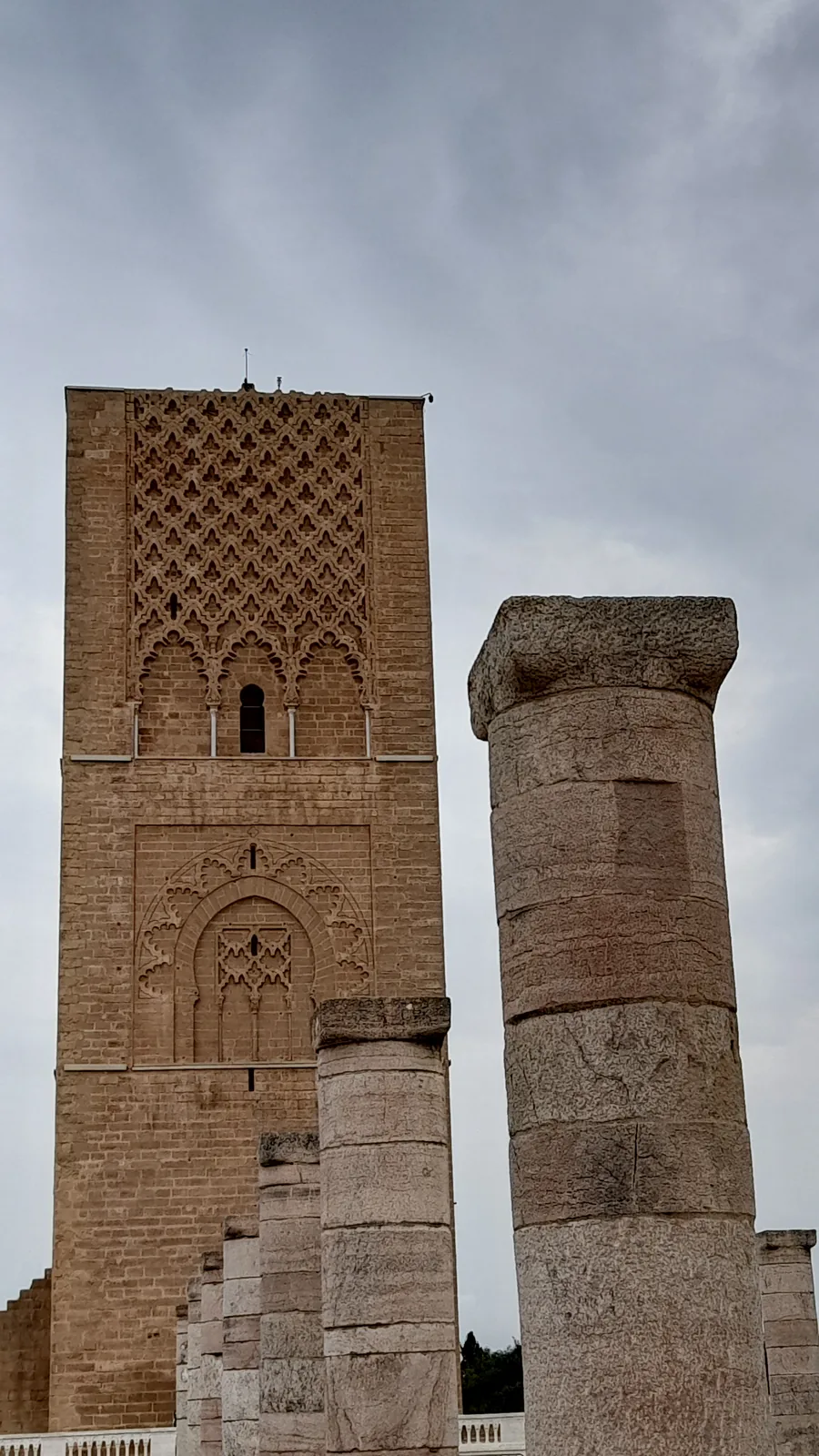
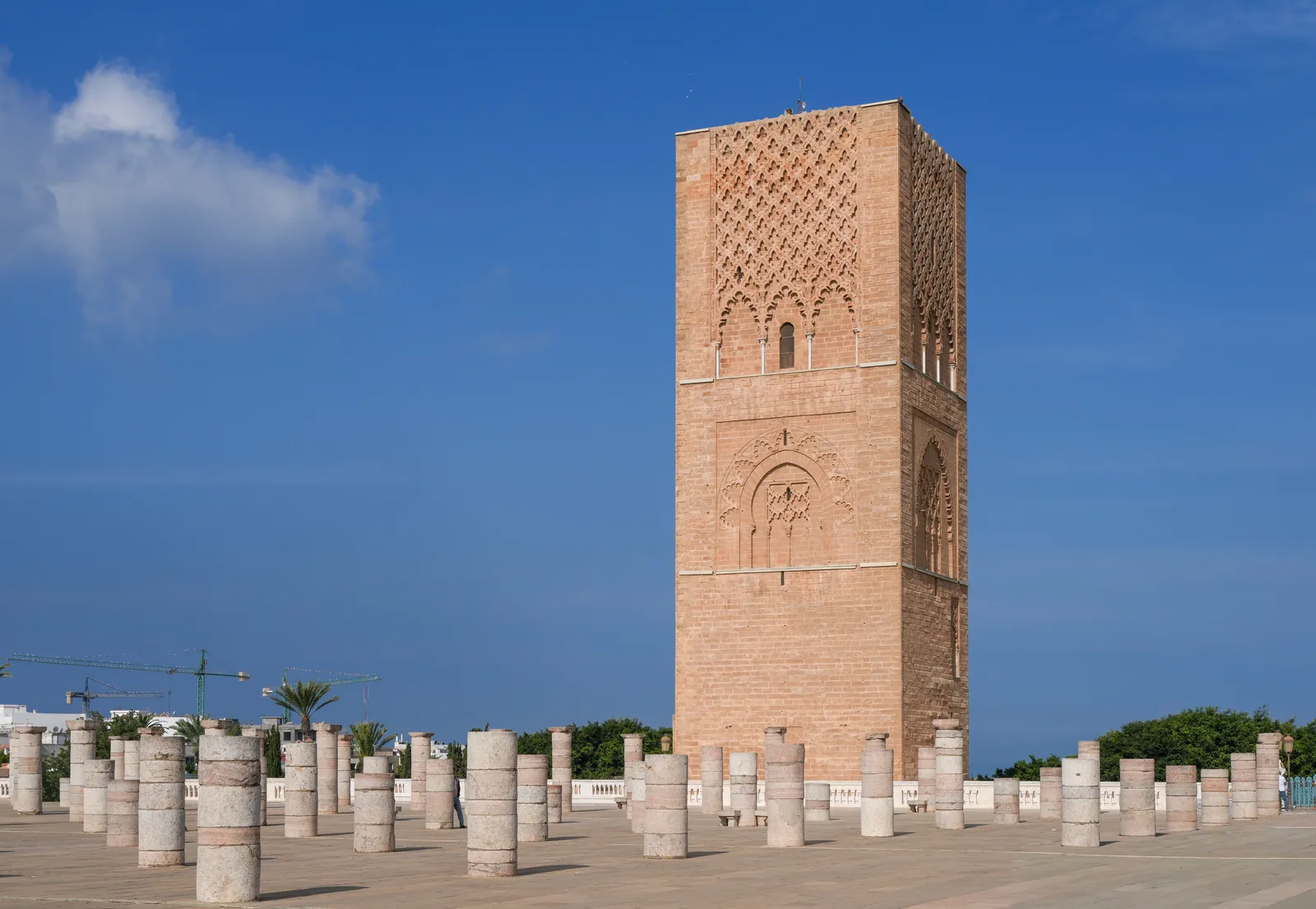
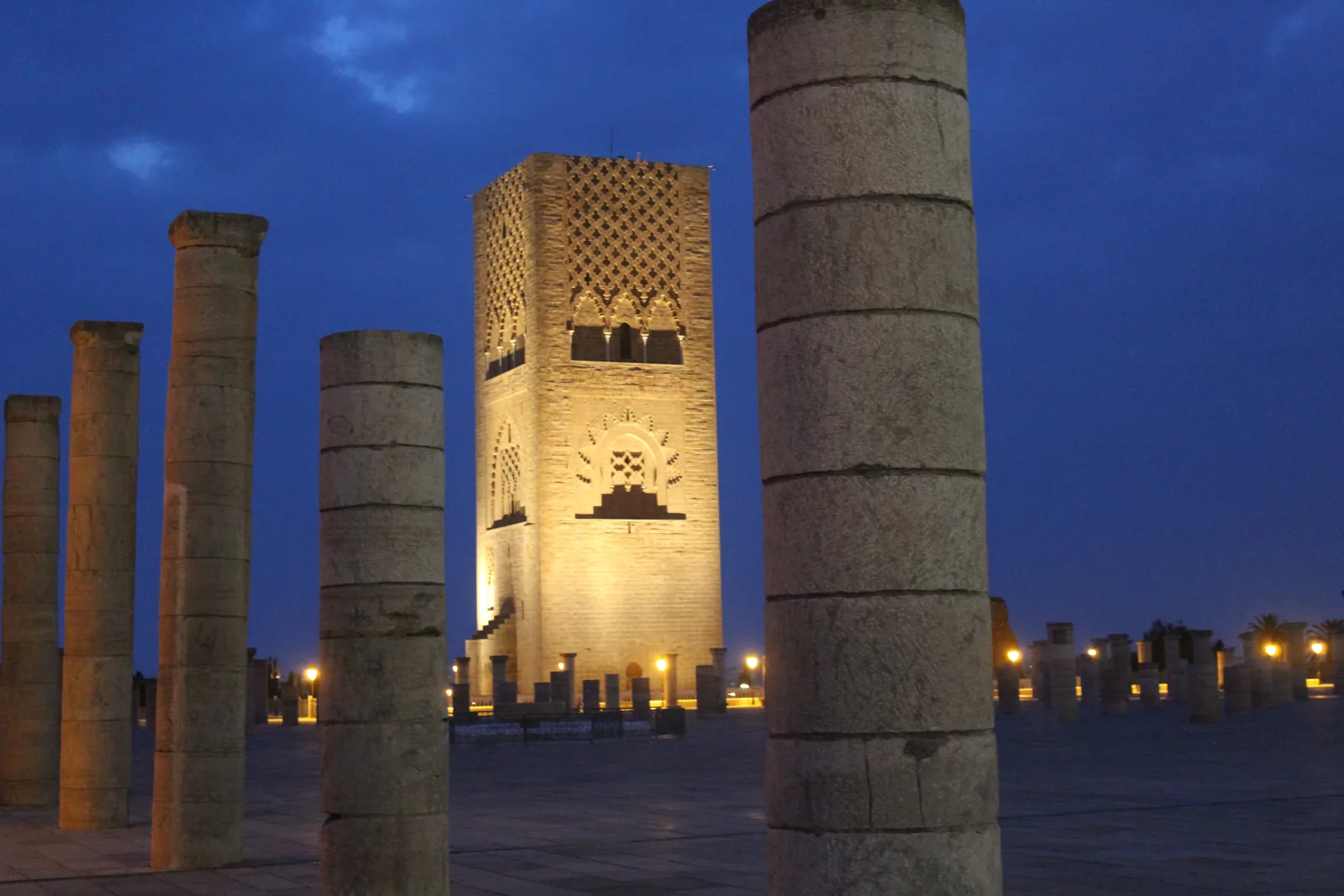
In Rabat, on an open esplanade facing the estuary of the Bouregreg, stands a forty-four metre tower of red sandstone. It is carved on every face, finished down to the smallest detail of its decoration, and yet it stops dead, as if sliced off horizontally. In front of it stretches a field of columns broken at head height, aligned in perfect rows over several hundred metres. This is not a ruin: it is an interrupted building site, left as it was for eight centuries.
The plan: the largest mosque in the Muslim west
Around 1191, the Almohad caliph Yaqub al-Mansur launched a project in Rabat with no equivalent in the region. The design called for a prayer hall of one hundred and eighty-three by one hundred and thirty-nine metres, laid out in twenty-one parallel aisles, on the hypostyle model where the roof rests on a multitude of supports rather than on a few long spans. At that scale the building would have ranked among the largest in the Muslim world of its time.
The logic behind this excess was as political as it was religious. The Almohads then ruled a territory running from southern Morocco to Andalusia, and Rabat, at the time called Ribat al-Fath, was meant to become the capital of an empire spanning both shores. A mosque able to hold an entire army at prayer was, at that precise moment, an instrument of government.
The work moved fast. Three hundred and forty-eight columns were raised, the minaret rose, the carving kept pace. Then, in 1199, the caliph died. Work stopped, and it never resumed.
Not to be confused with the Hassan II Mosque in Casablanca. Despite the name, there is no connection: the Hassan II Mosque is named after the king who commissioned it, a twentieth-century Alaouite ruler, and it was inaugurated in 1993. Hassan Tower predates it by seven centuries and belongs to the Almohads. The origin of its own name remains uncertain: sources hesitate between a place name, a tribal name and the name of the master builder. What really links the two monuments is not the name but the ambition, that of building the largest mosque of its time. See the page on the Hassan II Mosque.
A ramp, not a staircase
The minaret deserves a closer look, because it does not work the way you would imagine. Inside there is no spiral staircase but a ramp, a continuous inclined plane turning around a central core. It is wide enough and gentle enough to be ridden up on horseback, which was the intended arrangement for the muezzin.
That choice is not a whim. On a square base sixteen metres to a side, the ramp allows material to be hauled up during construction, then gives quick access to the top once the building is in use. Six stacked vaulted chambers, lit by horseshoe-arched windows, occupy the core and lighten the mass of masonry.
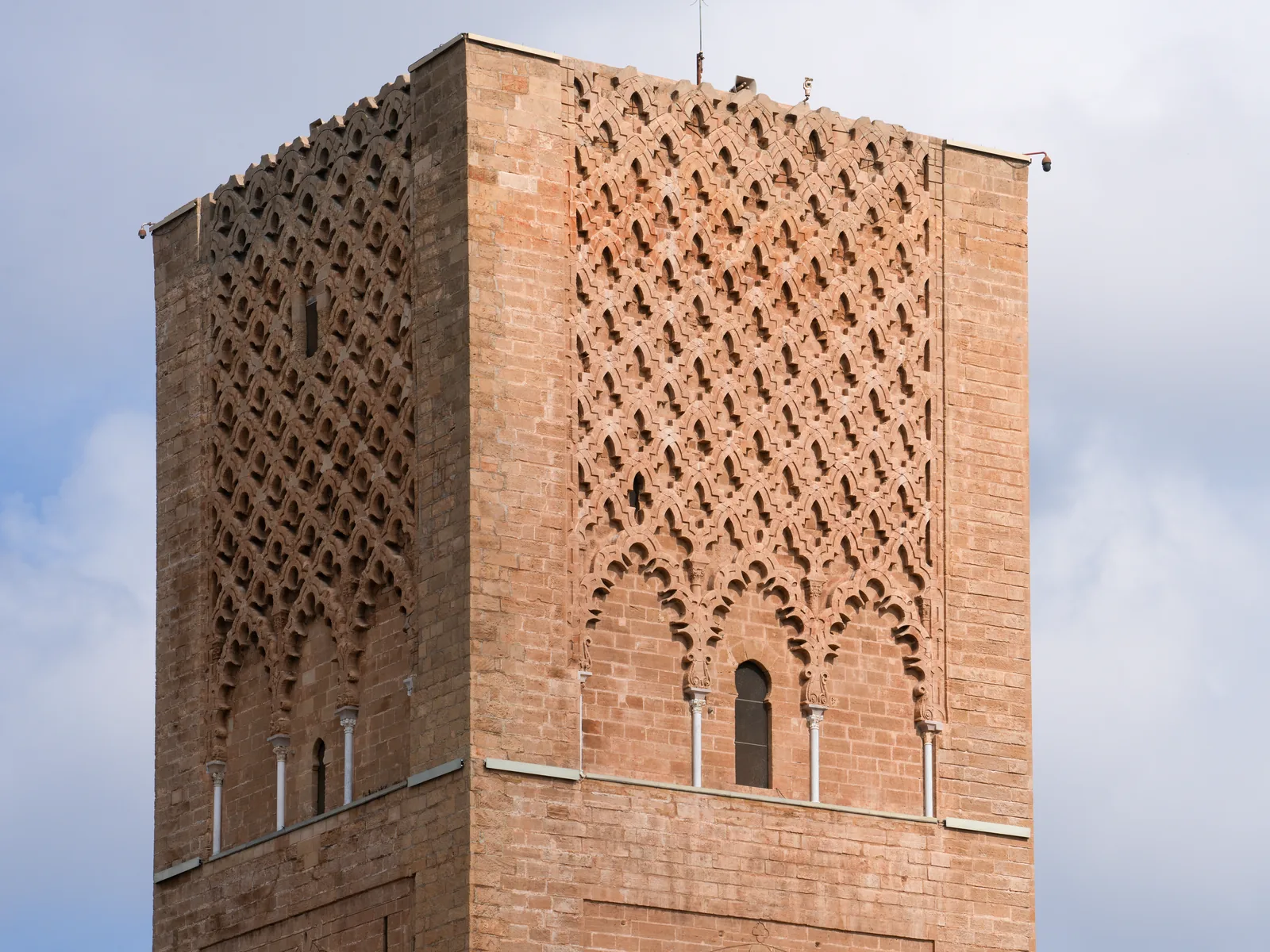
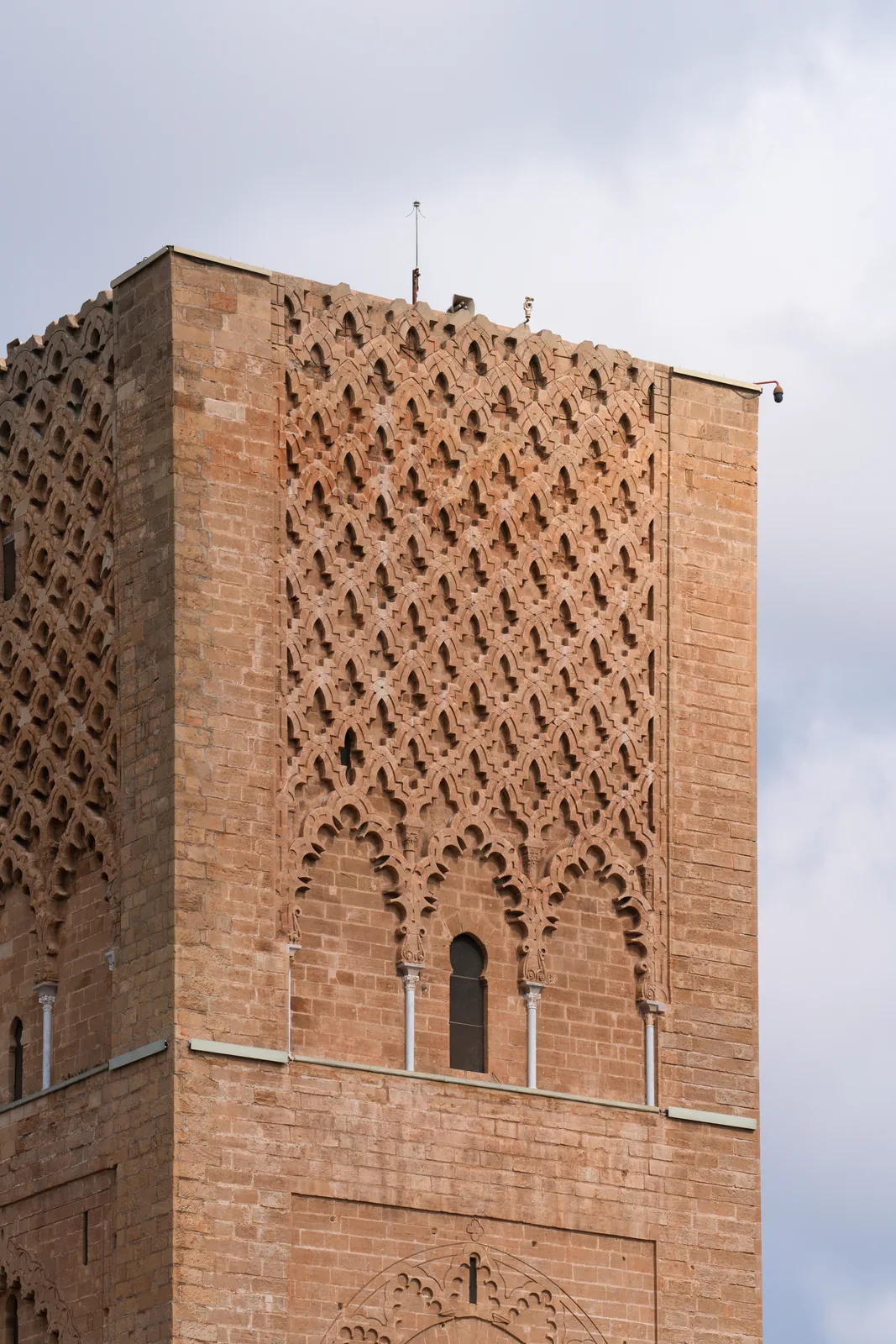
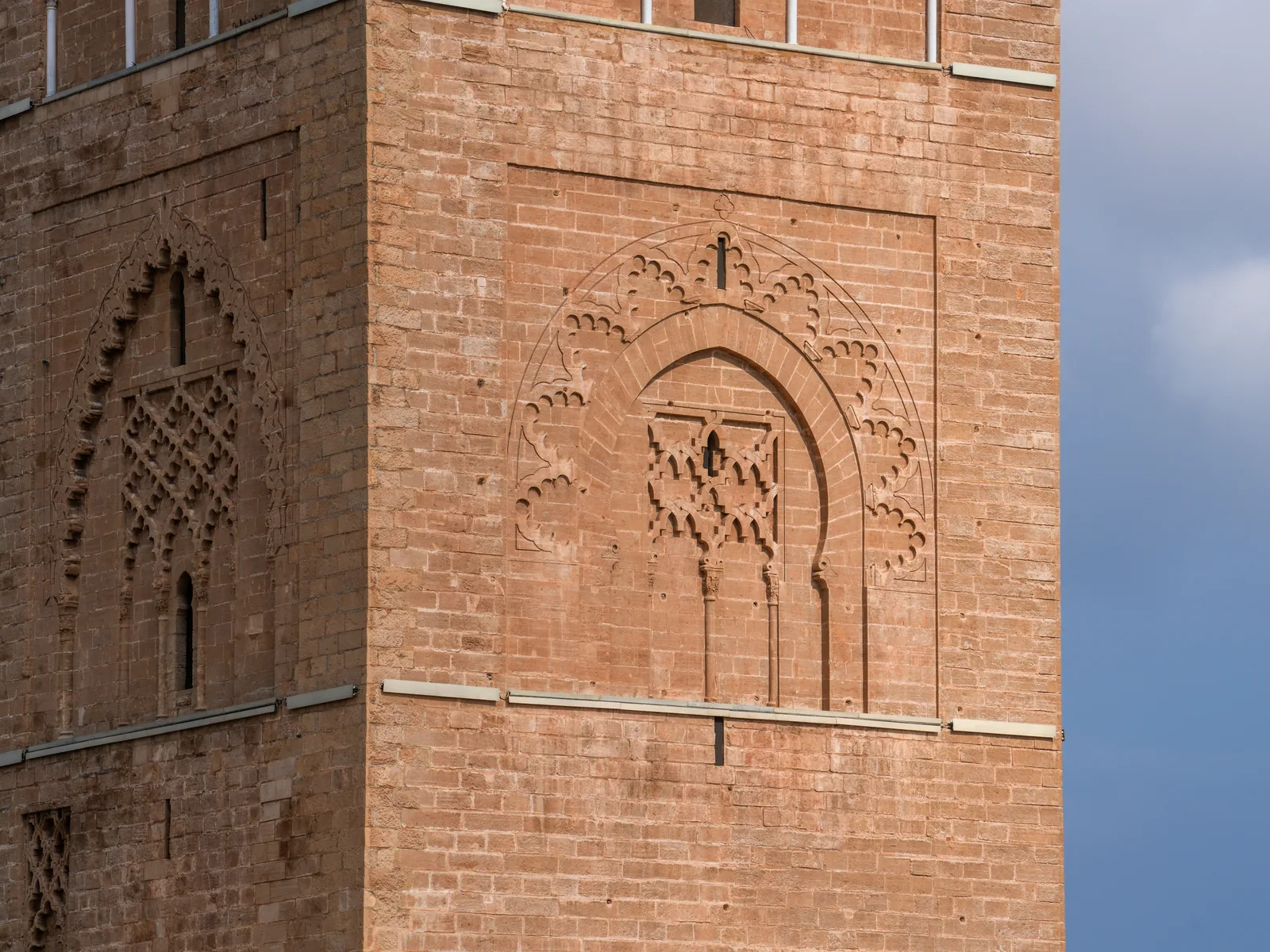
The decoration, for its part, is finished. Across each face runs a lattice of interlacing lozenges, what specialists call sebka, framing multifoil arches and blind openings. The sandstone has turned red ochre over the centuries. Nothing in this treatment betrays an abandoned site: the carving is carried through to the level reached, then stops with the masonry.
Forty-four metres out of the sixty-four planned
The tower today stands forty-four metres high. Estimates of the intended height vary between authors, from sixty-four to eighty metres once you count the lantern and finial that were to crown it. In other words, what you see is roughly two thirds of the plan, and the gap is visible to the naked eye: the masonry stops on a clean edge, with no crowning, no finished terrace, exactly where the masons put down their tools.
That is what makes the monument so unsettling. A ruin crumbles, deforms, loses its edges. Here everything is sharp. The tower has not aged, it has been paused.
The field of columns, and what brought it down
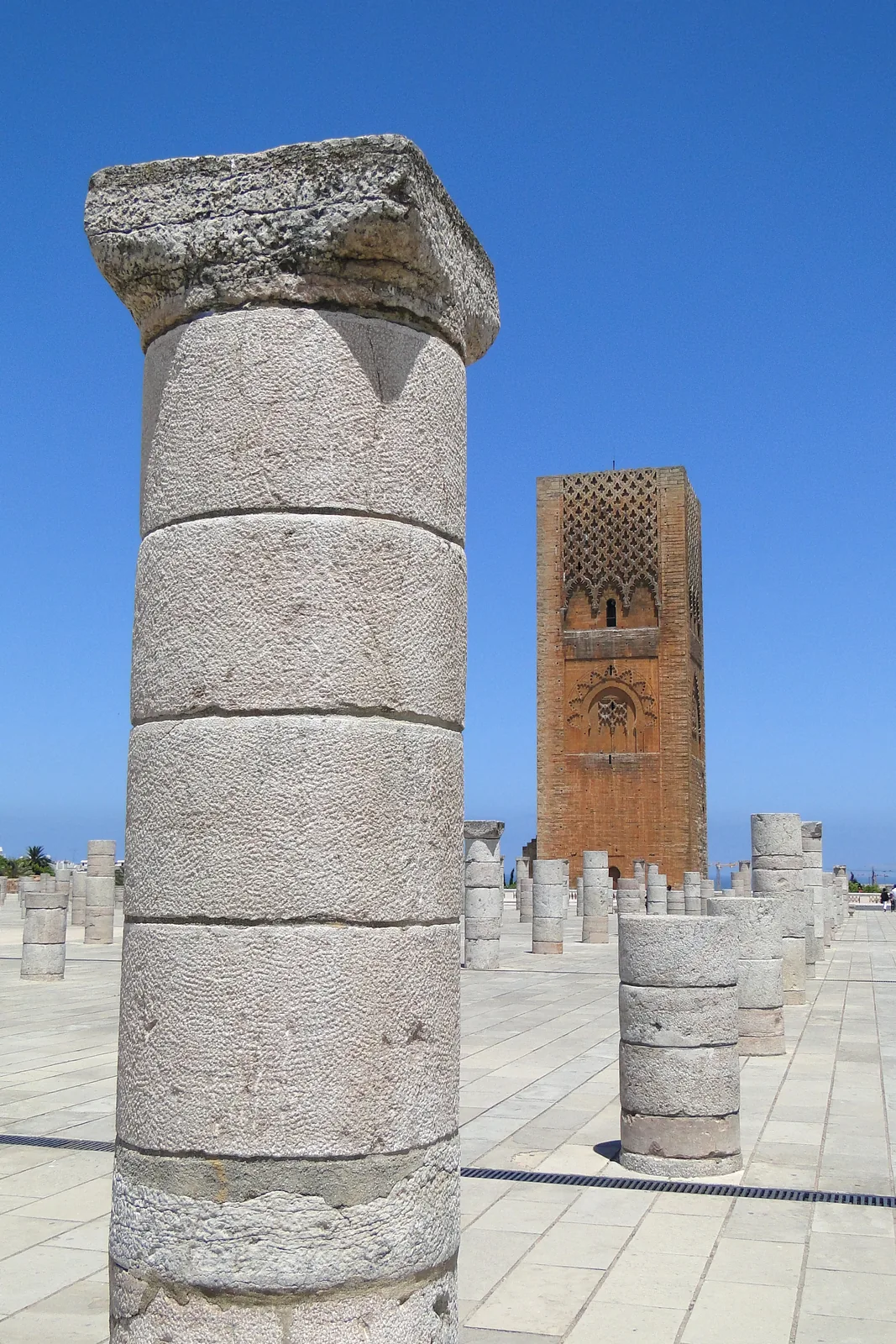
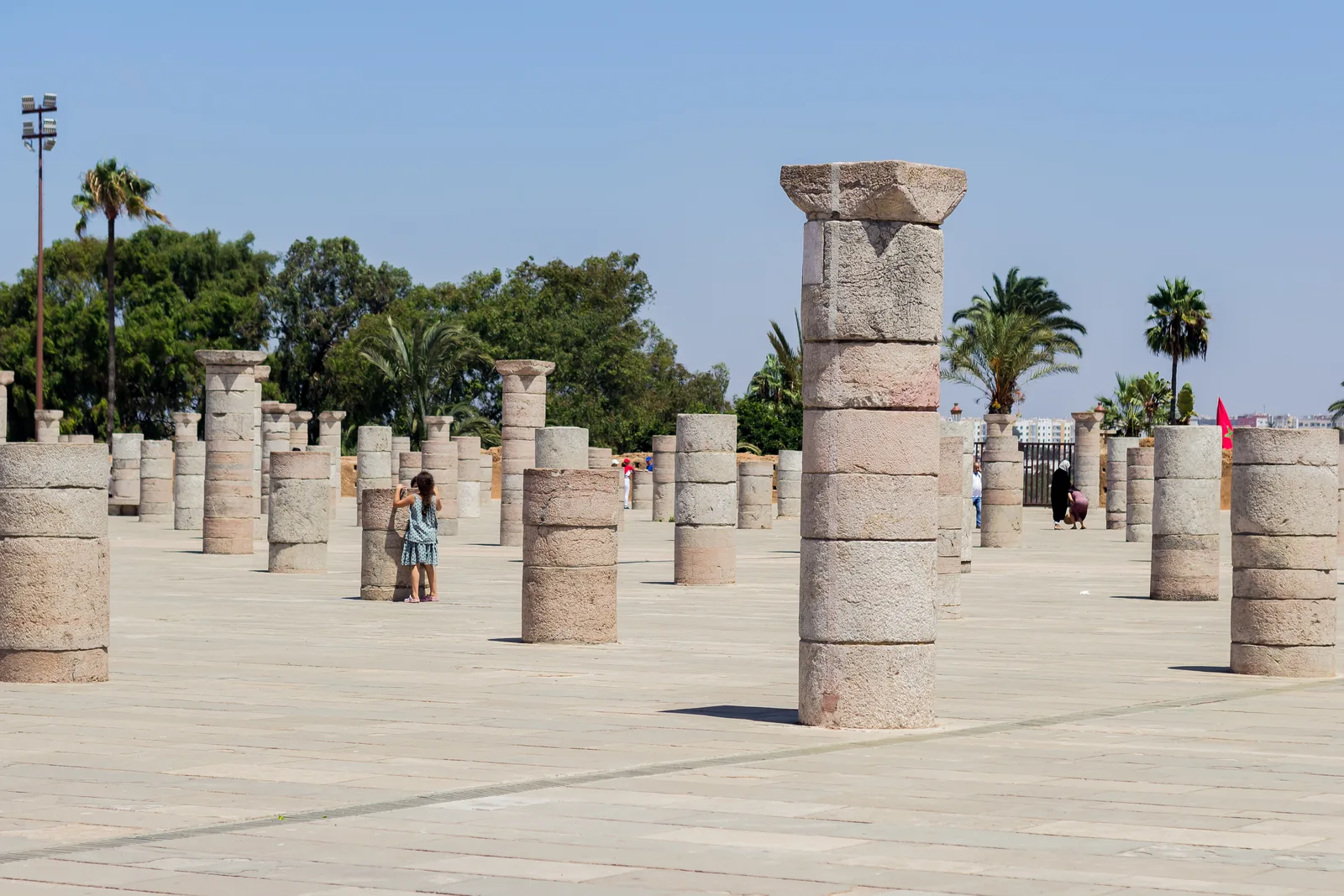
In front of the tower, the esplanade is planted with hundreds of column shafts all cut to the same height, which gives the site its most recognisable image. These columns were not carved that way: they were broken. The earthquake of 1755, the one that destroyed Lisbon, was felt as far as Rabat and threw down almost everything still standing.
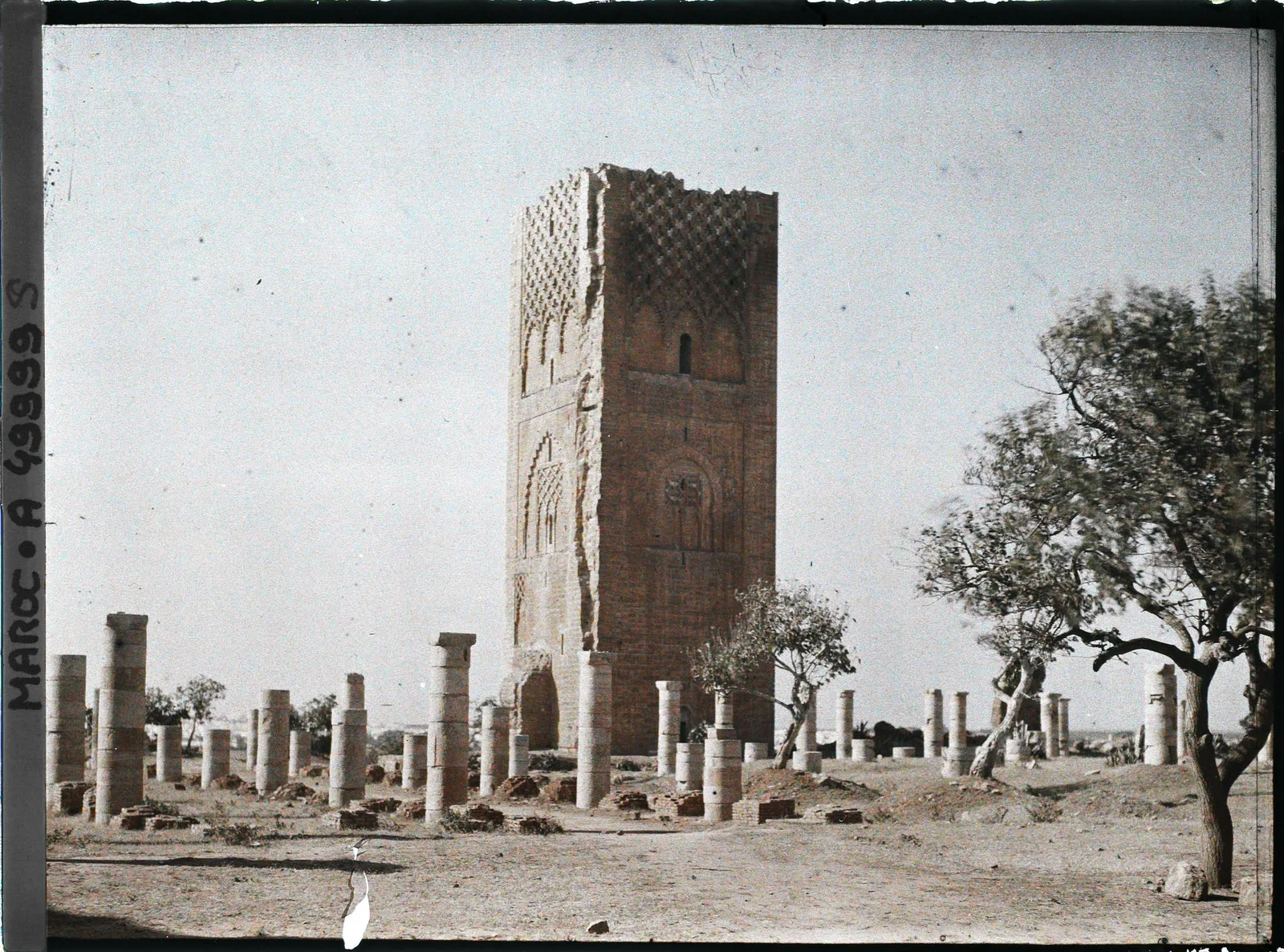
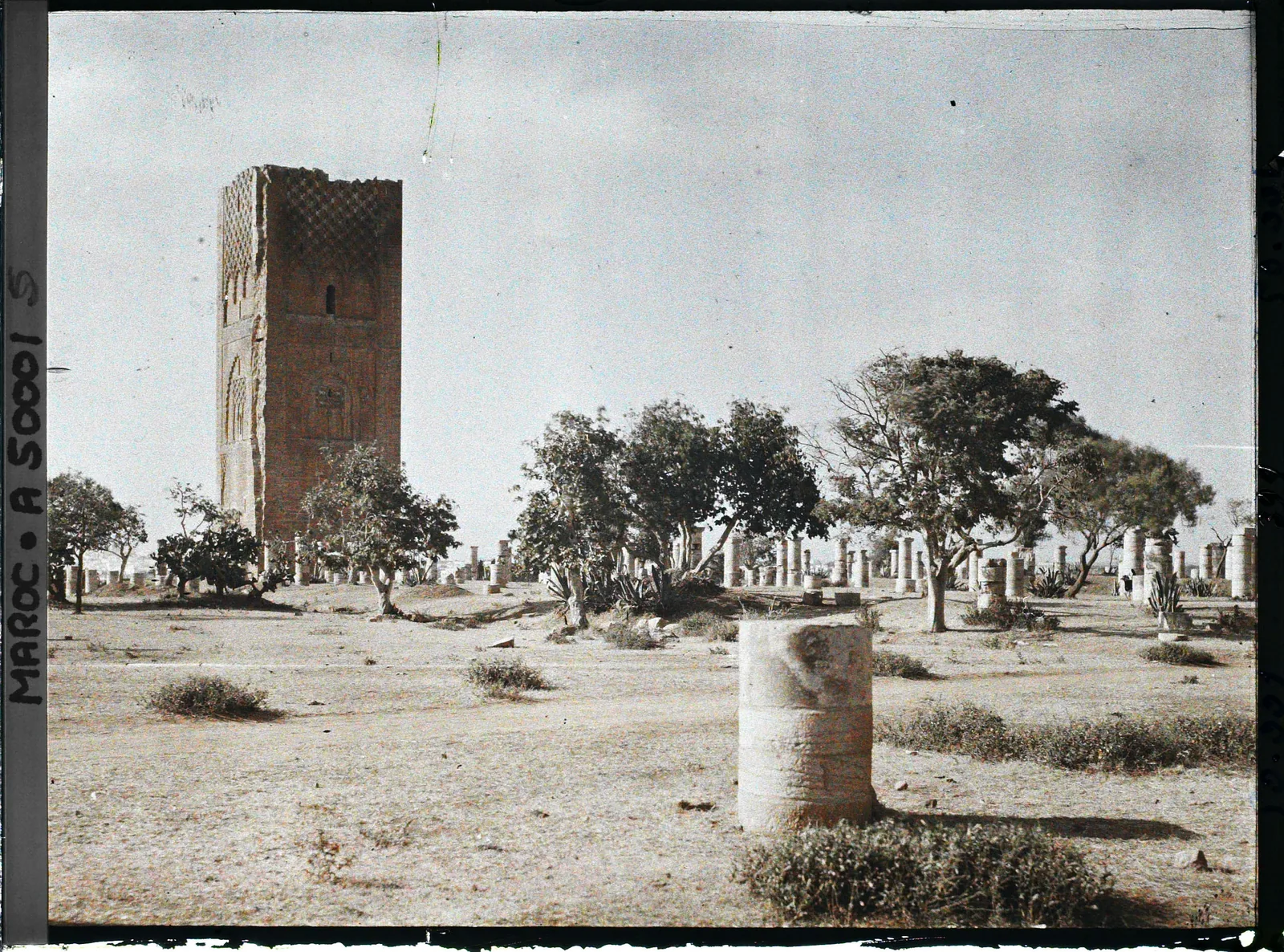
For more than five centuries before that, the site had served as a convenient quarry. Stone, timber and ready-made material were taken from it for other buildings in the city. Since the mosque had never been brought into use, little stood in the way. Old photographs show the state of the place before any works: an isolated tower among the scrub, column stubs barely clearing the ground, a few olive trees.
Excavation and clearing carried out in the twentieth century raised the shafts, restored the outline of the aisles and laid out the esplanade you walk across today. What the visitor sees is therefore not the 1199 site untouched, but an archaeological reading of that site, materialised on the ground. It has been on the UNESCO World Heritage list since 2012, as part of "Rabat, Modern Capital and Historic City".
Three sisters, two of them finished
Hassan Tower is not an isolated accident. It belongs to a family of three Almohad minarets, conceived in the same impulse and on the same principles. The Koutoubia in Marrakech, finished in the second half of the twelfth century, is the eldest and the prototype. The Giralda in Seville, begun in 1184, is the Andalusian sister; it is now the bell tower of the cathedral, capped with a Renaissance crown added in the sixteenth century, but its lower three quarters are Almohad and there too you climb by a ramp.
All three share the square base, the internal ramp, the stacked vaulted chambers and the carved lozenge lattice. In other words, the craft that produced Hassan Tower did not disappear with the site: it was already at work in Marrakech, it was at work at the same moment in Seville, and in both cases it was carried through. What stopped in Rabat was not a technique. It was funding and will.
Hassan Tower in pictures
What an interrupted site teaches
Finished monuments tell you about an intention fulfilled. Interrupted sites tell you about process. In Rabat you read the order of operations directly in the stone: the columns raised before the roof, the carving kept in step with the masonry, the ramp conceived from the outset as a site tool as much as an access.
There is a plainer lesson too. A project of this size hangs on one thing, the continuity of its patron. The caliph dies, and a mosque planned for tens of thousands of worshippers becomes a field of stones. Eight centuries later that field of stones is one of the most visited places in Morocco, and the tower appears on the country's coins. The unfinished ended up worth as much as the finished.
To go further, see the page on the Koutoubia in Marrakech, the eldest of the three, and the article on Moroccan mosques and the Almohad tradition.