
Home › Masjid al-Haram › The kiswa changed at night
Masjid al-Haram, chapter 5 · Mecca · 9 min read
It used to take an empty mosque
Every year the Kaaba is completely re-clothed. The black cloth that covers it has a name, the kiswa, and it is not cleaned or mended: it is replaced, in a single operation, from top to bottom.
This chapter is not about the beauty of that cloth but about what has to be solved in order to fit it. Close to a tonne of fabric to be installed on a building people circle without pause, and which does not close for the purpose. For decades the answer lay in a date. Since 2022 it no longer does.
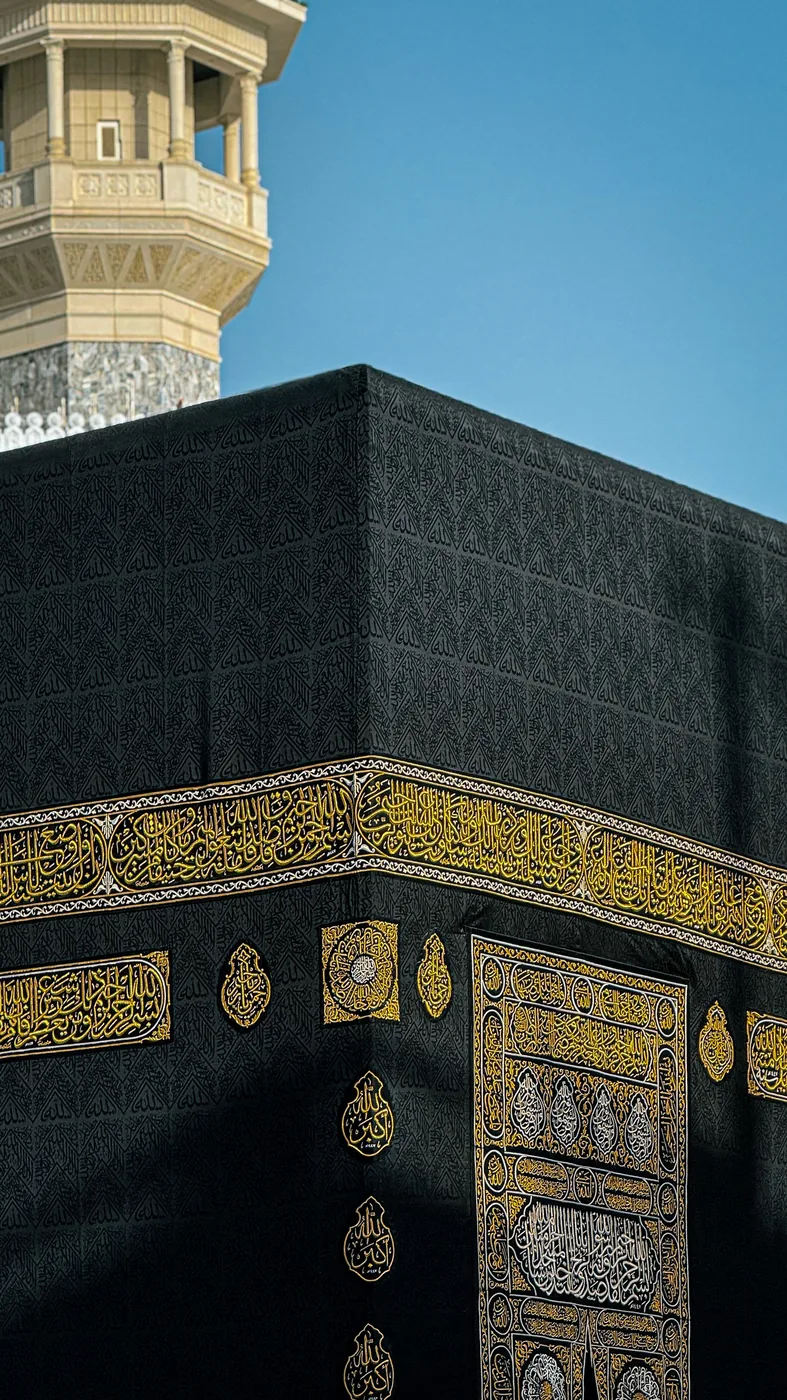
Close to a tonne of silk and metal
The figures published by the Saudi state encyclopedia give a total mass of about nine hundred and eighty kilos: roughly seven hundred and sixty kilos of silk dyed black, a hundred and twenty kilos of gold thread and a hundred kilos of silver thread.
The cloth is not a single piece. It is made of forty-seven panels ninety-eight centimetres wide and fourteen metres high. Those two numbers check each other: forty-seven times ninety-eight centimetres comes to about forty-six metres, which is the perimeter of the Kaaba, and fourteen metres is its height. The total area is in the region of six hundred and fifty square metres.
Across that black silk run Quranic verses embroidered in gold thread, including the band that girdles the building at about two thirds of its height, and the door curtain, called the sitara, which is the most ornate piece of the whole.
Manufacture takes place at the King Abdulaziz Complex for the Holy Kaaba Kiswa, at Umm al-Joud, seventeen kilometres from the sanctuary. It takes some ten months and involves around two hundred and twenty people.
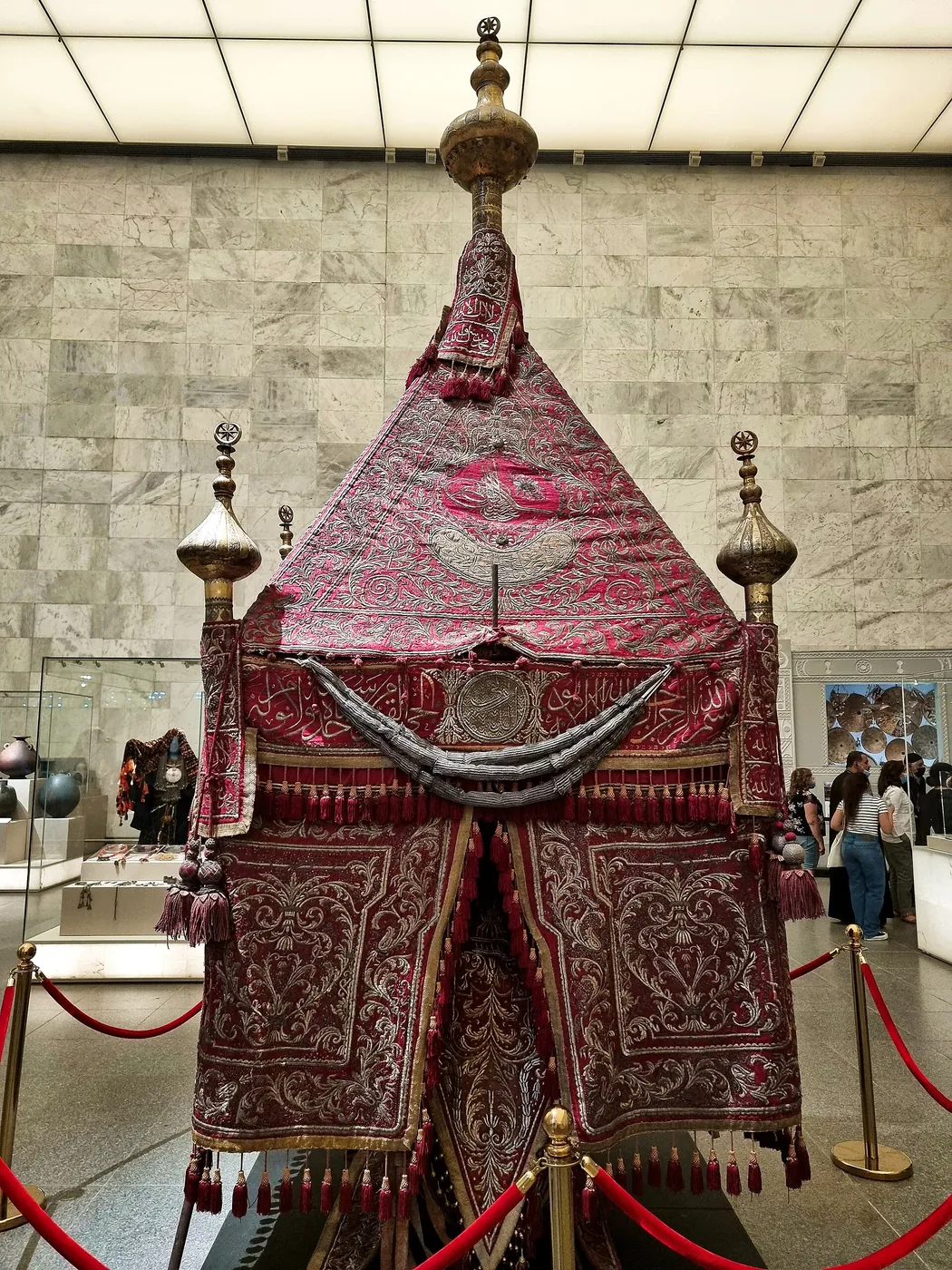
Before 1962 it crossed a desert
That proximity is recent. For centuries the kiswa was made not in Mecca but in Cairo, notably at the workshop of Dar al-Khoronfosh, and it was carried each year with the pilgrim caravan.
The convoy had a staging of its own. The cloth travelled accompanied by the mahmal, a richly embroidered ceremonial litter borne on a camel, which left Cairo in the middle of a procession and returned from Mecca in the same manner. The Egyptian mahmal is now kept in a Cairo museum, and several early photographs show it standing at its camp, in travelling dress.
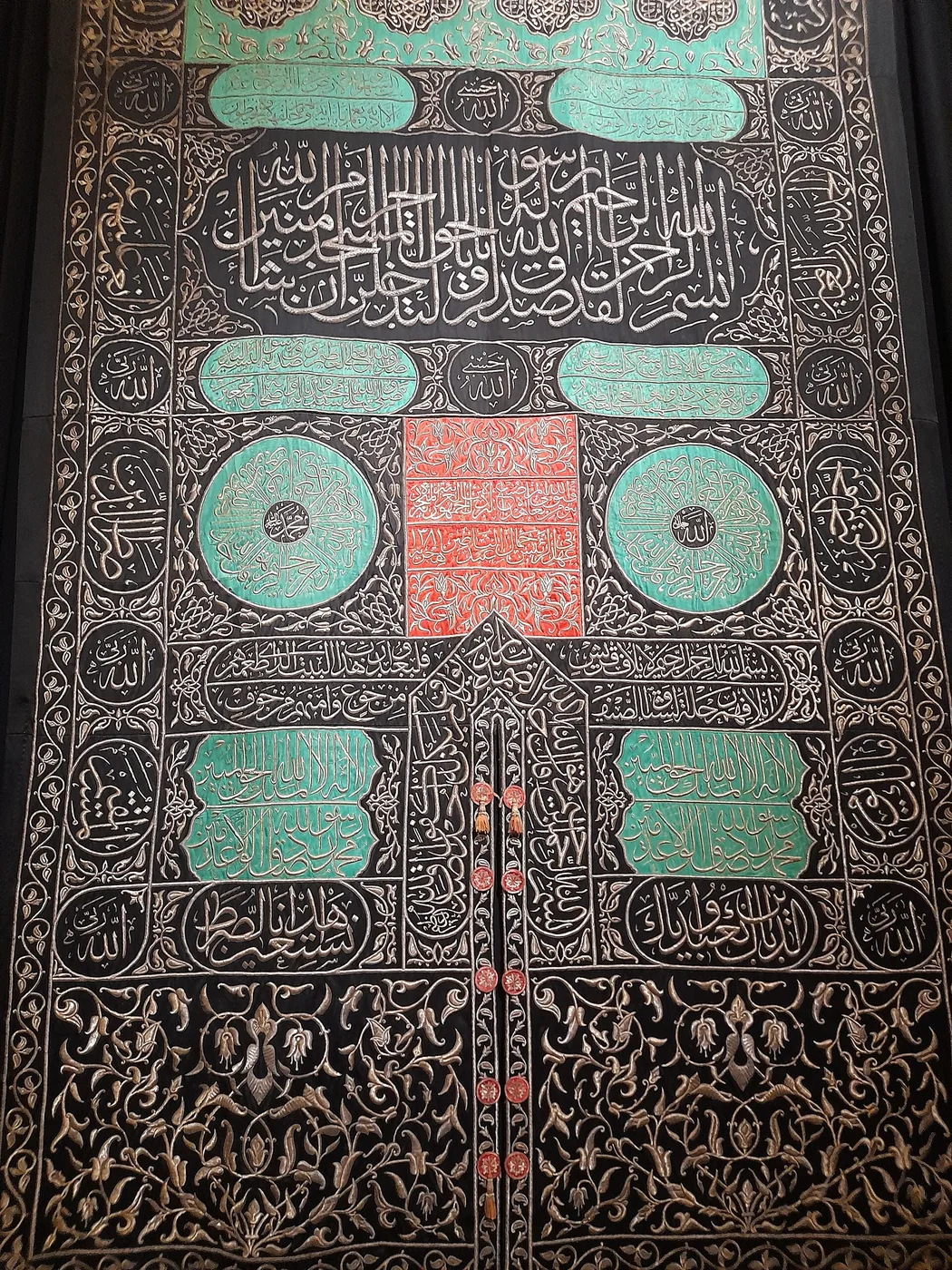
The Egyptian consignment ceased in 1962, amid tension between Cairo and Riyadh, and manufacture moved entirely to Mecca. One object keeps the trace of it: the sitara of the last Egyptian kiswa survives and has been photographed.
The journey therefore went from several weeks of desert to seventeen kilometres of road. What did not change is the problem that follows: the fitting.
The date that was not a religious date
For decades the kiswa was replaced on the morning of the ninth of Dhul Hijjah. On that day the pilgrims have left Mecca for the plain of Arafat, some twenty kilometres to the east, where they spend the day. The circling area around the Kaaba then empties as it never otherwise does.
One might take that for a date chosen for its own merit. The director general of the kiswa factory, Muhammad Bajodah, says exactly the opposite: from a religious standpoint there is nothing special about picking the Day of Arafat, and if it was picked it was because the small number of pilgrims present made it possible to work fast.
In other words, the timetable of the operation was set by the crowd. That is the constraint running through this whole series, and here it appears at its barest: only one morning a year was workable, and that was the one taken.
The exact sequence of dates is a little longer than that summary. The old practice of the ninth was followed by an order in 2021 setting the change on the tenth, the day of Eid al-Adha. A supreme order then moved the operation to the first day of Muharram, from 1444 of the Hijri calendar, that is July 2022.
The reason for the change, and what it does not say
The stated reason for that move is calendrical: to tie the change of the kiswa to the beginning of the Hijri year. No public document mentions any other reason, and it would be unwise to impute one.
The consequence, however, is measurable. The first day of Muharram is not a day on which the mosque empties. The operation therefore takes place at night, and it has had to change.
Releases from the General Presidency for the Affairs of the Two Holy Mosques document that evolution. In 1447 of the Hijri calendar the replacement began at midnight and ended at twenty to seven in the morning, four hours less than the customary duration of previous years. Credited for it are panels pre-stitched before fitting, adhesive tape marking in advance the upper and lower limits of the embroidered band in place of manual alignment, and pre-calibrated ropes set to determined heights. In 1448, that is in June 2026, the same operation was completed in three hours.
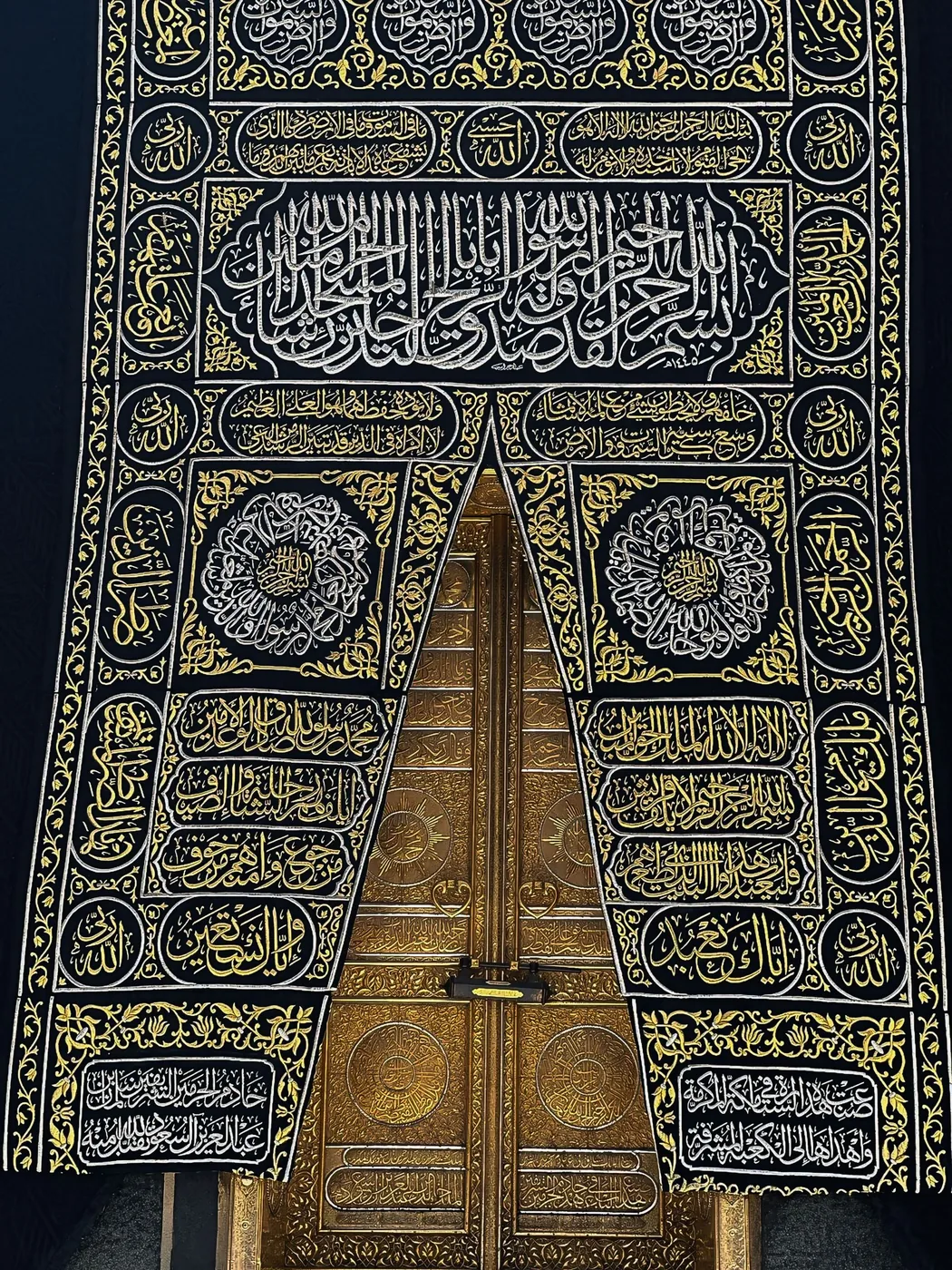
You do not undress the building, you re-dress it over the top
The technical point that decides everything is the order of the gestures, and it is described in the official releases.
The new kiswa arrives in five pieces: the four sides and the door curtain. Each side is hoisted separately to the top of the building. There it is unfolded over the old side, which is still in place, then fastened from above. The ropes of the old cloth are released only afterwards, and the old cloth then falls away below.
The consequence of that order is that at no moment does the building appear bare. There is no instant at which the stone would be seen. It is also why no photograph can show the principle: it would take a moment when the two cloths were separate, and that moment does not exist.
The team carrying out this work numbered one hundred and fifty-nine technicians and craftsmen at the change of 1446.
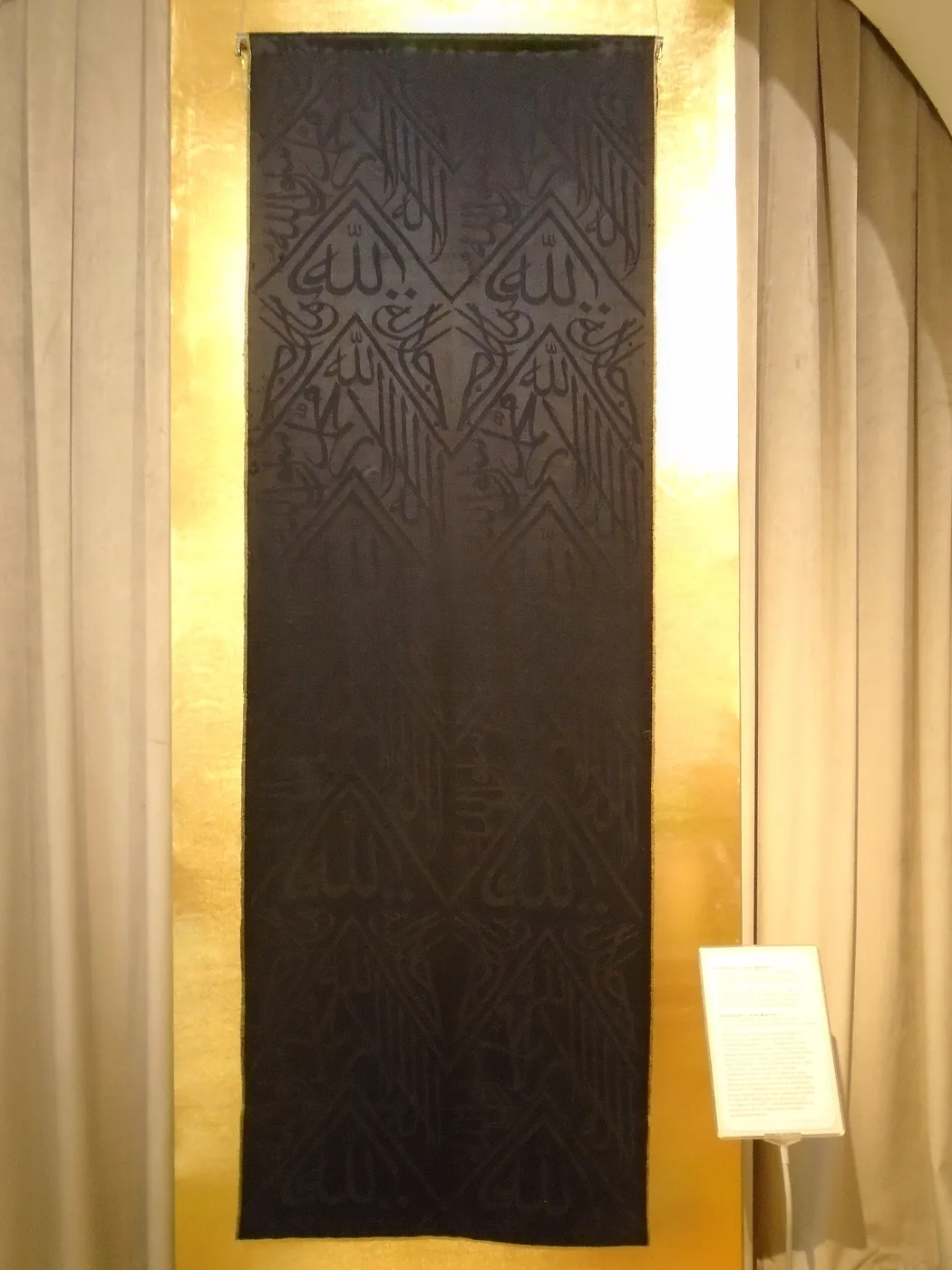
What becomes of the old one
The cloth taken down is not destroyed. It is cut into pieces of various sizes which are given to institutions, museums and figures across the Muslim world. Several public collections hold them, shown as framed fragments.
The best known gesture dates from 1982: Saudi Arabia presented the United Nations, on behalf of the Muslim community, with the sitara, that is the part of the kiswa which covered the door of the Kaaba.
What this chapter adds to the series
Earlier chapters showed a sanctuary that grows by demolishing around itself, that burns and rises again, that is carried off by a flood and rebuilt. This one shows something else: an annual operation, finely tuned, whose very date was an admission.
As long as it was necessary to wait for the one morning when the circling area empties, the crowd was in command. It no longer empties, and the work is done all the same, at night, in a few hours.
Our sources
- Weights, dimensions, number of panels, manufacturing time and staffing: Saudipedia, the state encyclopedia.
- The sequence of the fitting, the number of technicians and the statement by the director of the kiswa factory: releases from the General Presidency for the Affairs of the Two Holy Mosques and their coverage in the Saudi press.
- Durations for 1447 and 1448: Hay'at al-'Inaya bi-l-Haramayn.
- On the mahmal and Cairo manufacture, Egyptian public collections and early photographic archives.
- Photographs: Pexels and Wikimedia Commons.