
Home › Qibla › This mosque does not point towards Mecca
Qibla, episode 6 · Marrakesh · 9 min read
They rebuilt an entire mosque for five degrees
In Marrakesh, two almost identical mosques were built on the same ground less than a decade apart. One thing really separates them: their plans form an angle of five degrees. The gap to the shortest path to Mecca, meanwhile, is more than sixty.
Two twin mosques
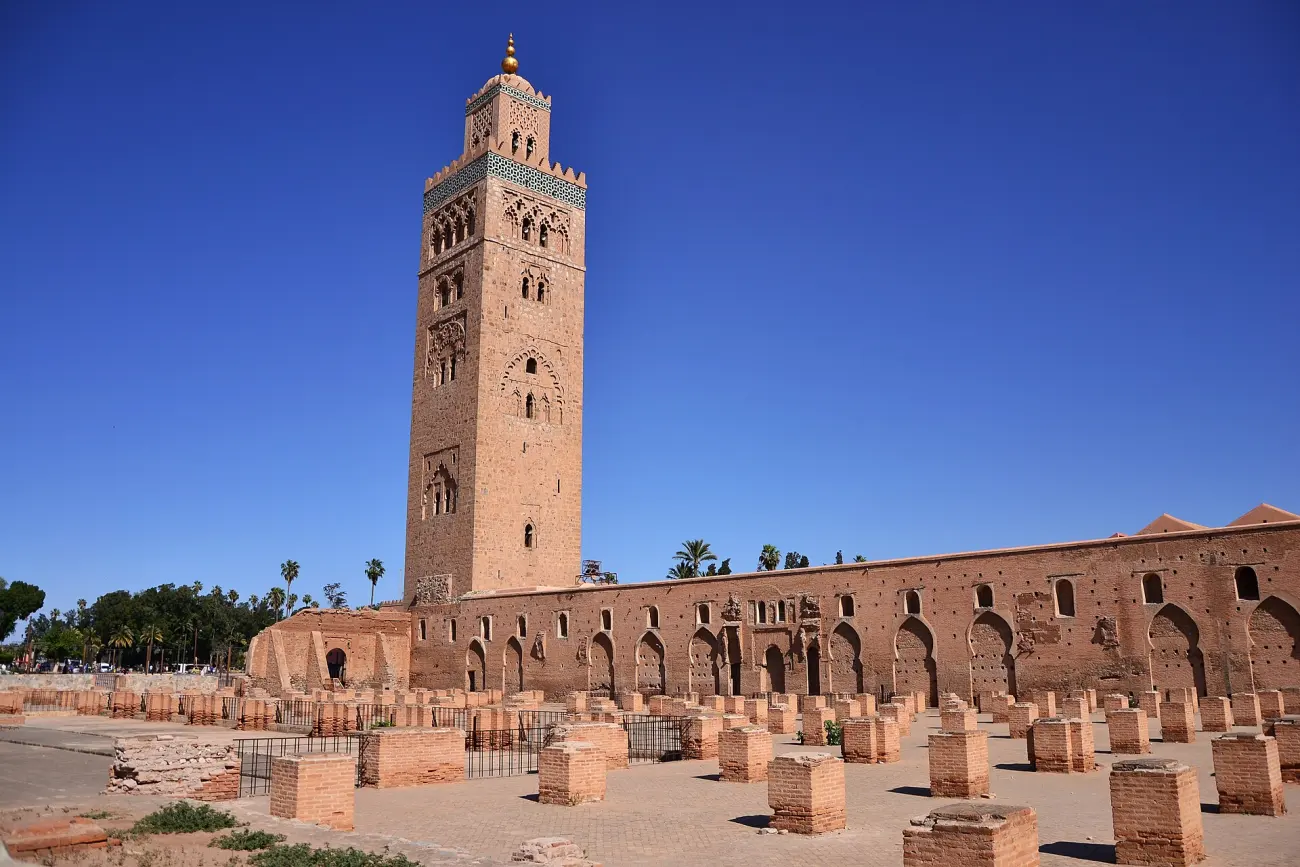
The first Kutubiyya is begun between 1147 and 1154 and completed around 1157. A year later, in September 1158, prayers are already being said in a second mosque, almost identical, raised right beside it.
This is not an extension. It is a complete second building, on the same site, within the same decade. It also runs against a common practice, that of having a single great Friday mosque per city.
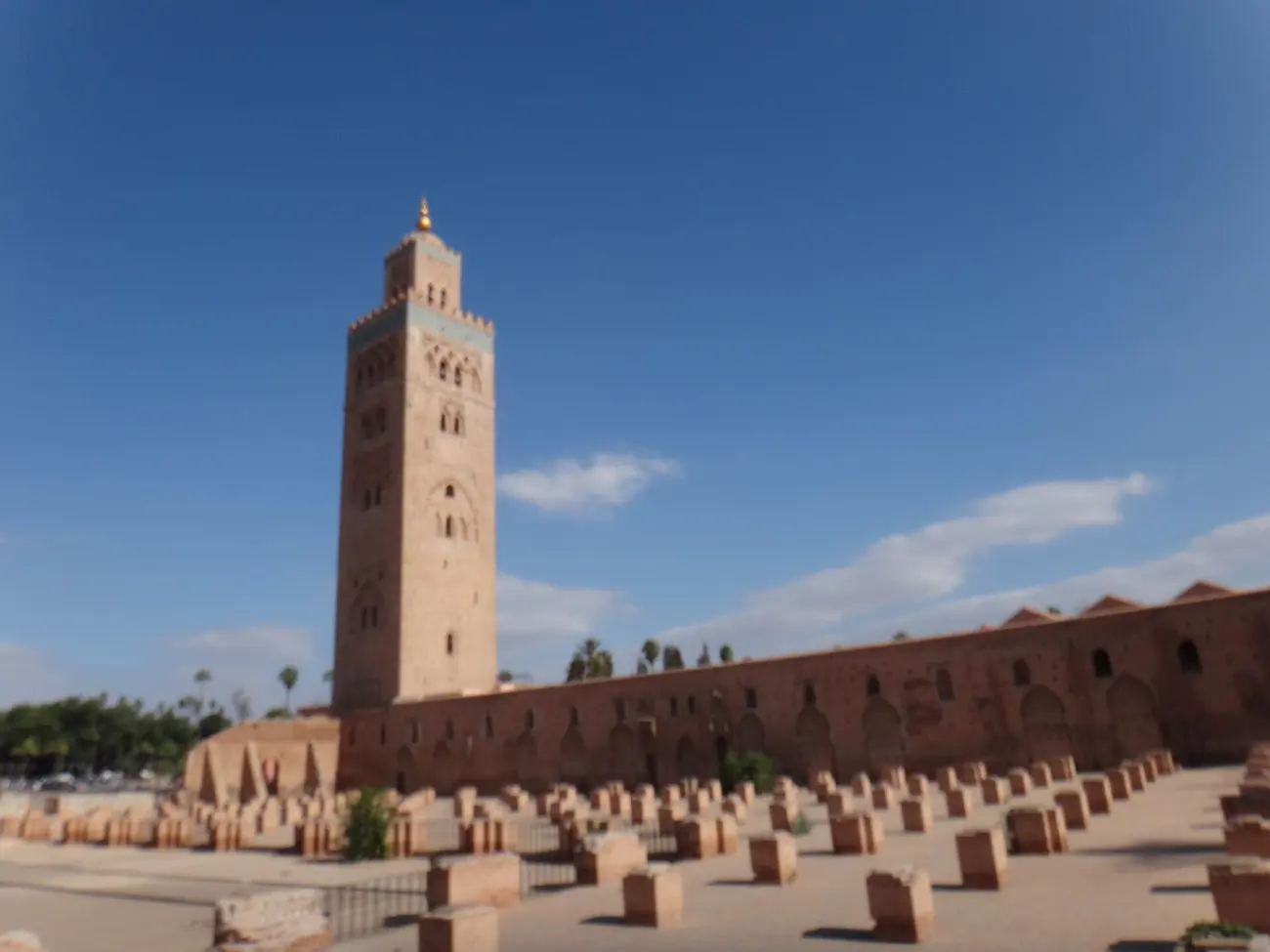
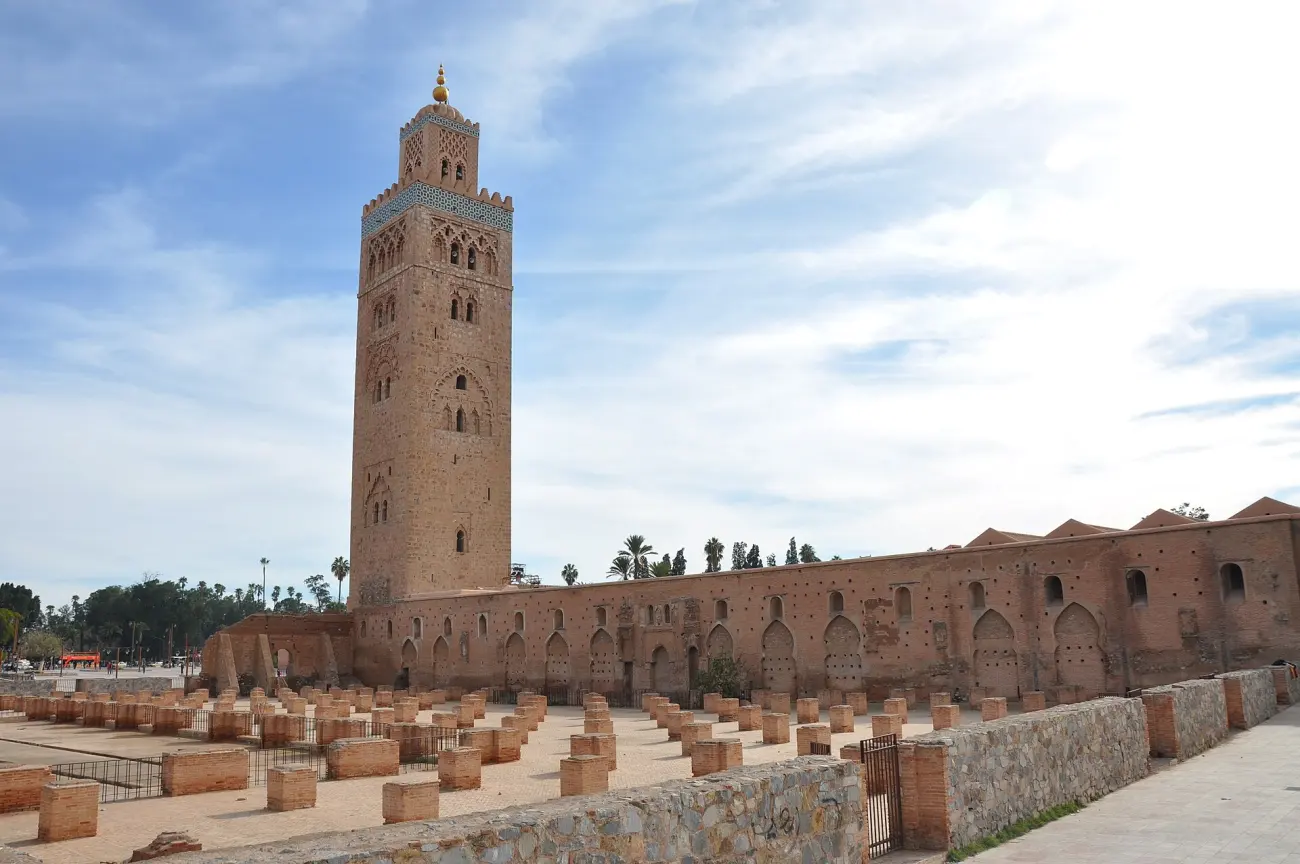
Today it is the second that stands. Of the first, the ground plan remains, a field of column stumps you cross on arriving. It is probably the only place in the world where two mosque plans can be seen offset from one another.
Five degrees
The difference between the two plans is a pivot of about five degrees of the qibla wall.
Five degrees, on a building of that size, is a few metres of offset from one end of the hall to the other. And that, it seems, was enough to have a second one built.
Five degrees of what?
To weigh those five degrees, you need to know where Mecca lies from Marrakesh.
We ran the calculation, by the great-circle formula, and anyone can repeat it: 4,851 kilometres, bearing 91.4 degrees. That is to say almost exactly east.
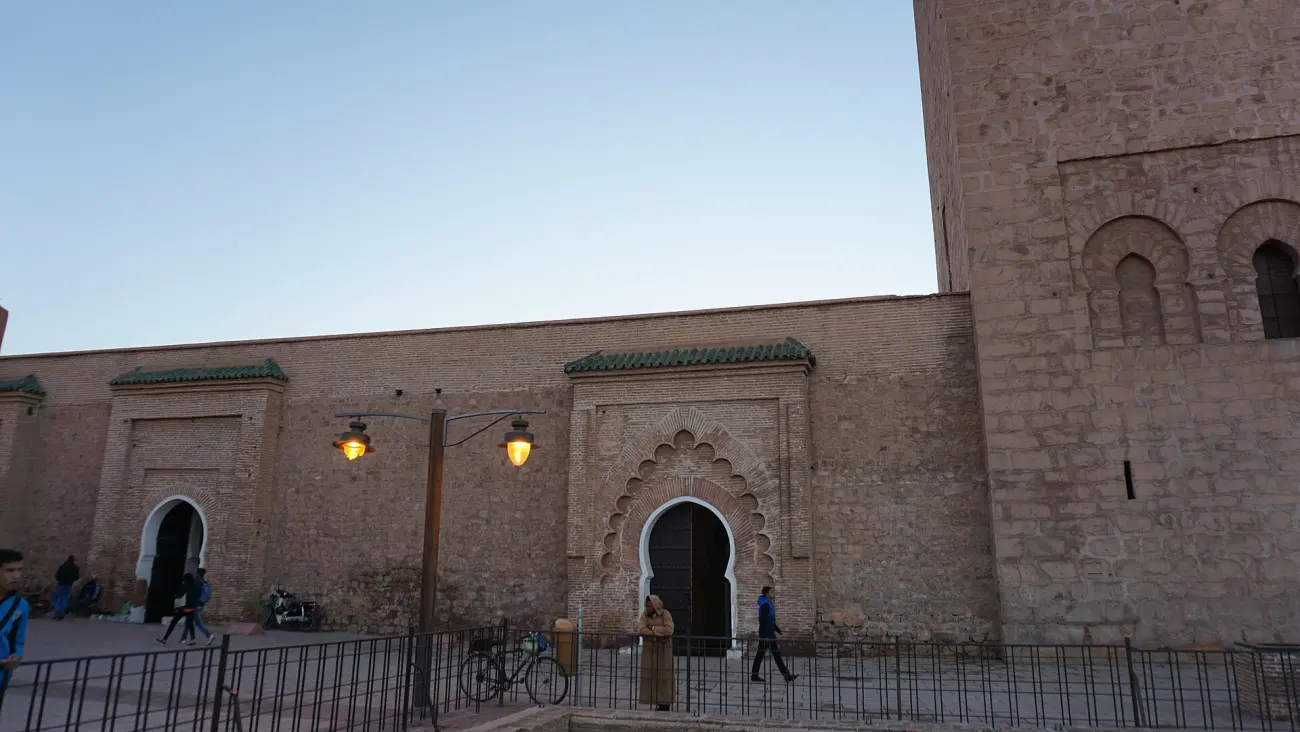
Both mosques, by contrast, face south: 154 degrees for the first, 159 for the second.
Five degrees between them. More than sixty between each of them and the shortest path. The dispute therefore concerned less than a twelfth of the real angular gap.
What five degrees are worth in kilometres
This series habitually converts bearing differences into kilometres missed, because a degree cannot be felt.
Over the 4,851 kilometres between Marrakesh and Mecca, five degrees move the arrival point by 384 kilometres. Roughly the distance from Paris to Lyon.
And the sixty degrees separating each mosque from the shortest path? Following either of those bearings for the right distance, you do not arrive near Mecca: you end up off the coast of southern Africa, some 4,700 kilometres short.
These numbers are not a verdict. They simply measure what a different rule produces when applied rigorously.
⚠️ What this does not mean
Here a reading has to be stopped short, one that comes unbidden and is false: that of medieval builders incapable of measuring a direction.
The treatises of the period set out methods for determining the qibla, by the sun and by the stars. They were written, taught and followed. And throughout the Muslim West, the Maghreb and al-Andalus, a southern orientation was held to be the oldest and the soundest.
Those sixty degrees are therefore a gap between two methods, not between a method and the truth. The shortest path on the sphere is our rule. It was not theirs, and they were not trying to satisfy it.
Our sources, and why these
On a subject this exposed, it seems worth saying where our figures come from.
David A. King is emeritus professor of the history of science at Goethe University Frankfurt, where he held the chair from 1985 to 2007, after Yale, a Smithsonian-funded project on medieval Islamic astronomy in Cairo, and New York University. His work rests on more than five hundred medieval astronomical manuscripts he identified himself, and it documents precisely these qibla methods and the reckoning of prayer times. He explicitly criticises authors who, faced with an unexpected orientation, conclude that the mosque was not facing Mecca at all.
His work is available on his Goethe University page.
Michael E. Bonine (1942-2011) was professor of geography and of Near Eastern studies at the University of Arizona, and executive secretary of the Middle East Studies Association from 1981 to 1989. His article "The Sacred Direction and City Structure: A Preliminary Analysis of the Islamic Cities of Morocco", Muqarnas 7, 1990, gives orientation surveys made in the field: the older mosques of Morocco cluster around 155 to 160 degrees, the modern ones around 91 to 97.
The reference: the article's record on Archnet.
From Bonine we take the measurements, which are survey data. We do not take his interpretive thesis that these orientations follow the layouts of Roman towns: it is contested, and it is the kind of explanation that reduces a well-documented medieval method to an external inheritance.
What we declined to write
It is often read that the second mosque points further from Mecca than the first, and that the rebuilding therefore made matters worse. It is a striking claim, and we do not repeat it.
Two reasons. First, every page asserting it refers, directly or not, to a single work, which we were unable to consult. Several pages repeating one source do not make several sources.
Second, and decisively, those pages contradict one another. They describe a rotation "five degrees counter-clockwise", which in azimuth moves closer to the direction of Mecca, while giving values that describe the opposite. One of the two statements is false and we do not know which.
On a point that would be the whole interest of the story, that doubt is enough to set it aside.
The question that remains
Why rebuild an entire mosque? Historians have not settled it.
The reorientation of the plan is the most significant change between the two buildings, and it is probably the reason. But other hypotheses circulate, and they are not absurd: construction defects in the first building, or a capacity grown insufficient.
What can be said without risk is that the matter was serious enough to justify a second complete building campaign less than a decade after the first. In a city the Almohads had just made their capital, that is not nothing.
To go further
This series covers the direction and its geometry. See also the episode on Cordoba, which asks the same question of another building, and the one on the orientation of the Kaaba itself.