
Home › Blog › The Sixty Dome Mosque
Bagerhat, Bangladesh · 9 min read
This mosque is called « sixty domes », it has seventy-seven
It is called the "sixty dome" mosque. Count them: there are seventy-seven. Add the corner towers and you reach eighty-one. What there are sixty of in this building are the pillars. The simplest hypothesis is that one word replaced another, and that nobody has corrected it in five centuries.
Where we are
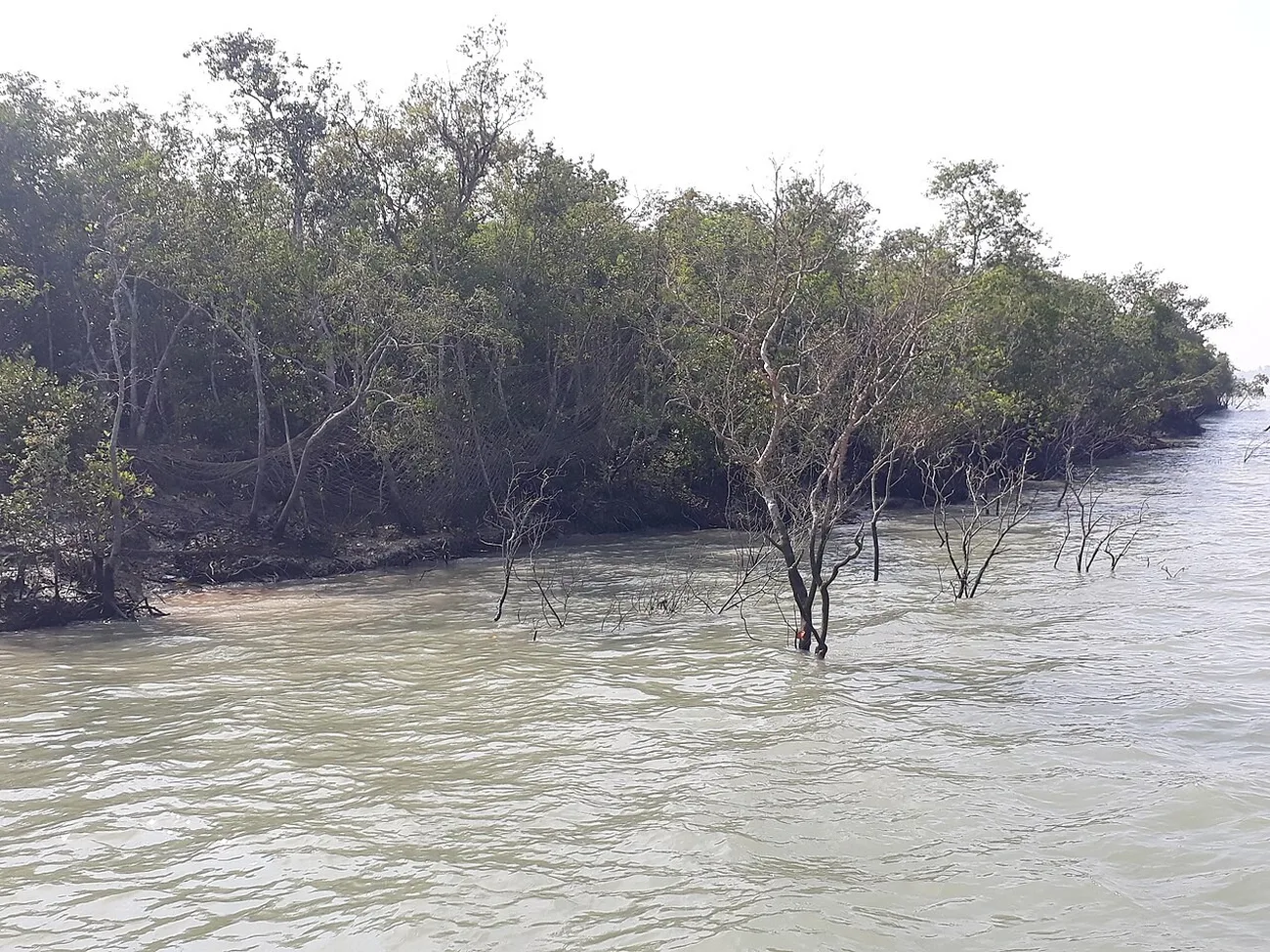
In southern Bangladesh, where the Ganges and the Brahmaputra end their course, begins the largest mangrove forest in the world: the Sundarbans.
Bagerhat stands on its edge. The town was once called Khalifatabad, and it was founded in the fifteenth century. What remains of it is a UNESCO World Heritage Site, inscribed in 1985 as the Mosque City of Bagerhat.
A city of mosques, literally. Tradition counts three hundred and sixty of them. The figure is plainly symbolic, but it gives a sense of the scale of what was built there.
The man who founded a city in a swamp
He is known as Khan Jahan, or Ulugh Khan. And it should be said at once that his origins are poorly established.
His title suggests a Turkic origin in Central Asia. He is thought to have been a noble of the Delhi Sultanate, and to have moved to Bengal after the capture of Delhi in 1398. That is the most common reconstruction, but a reconstruction is what it remains.
What is certain is what he did. He was given charge of a portion of the Sundarbans, and he built a capital there. Not only mosques: roads, bridges, and above all freshwater reservoirs, which are the very condition of life in a salt delta. Clearing a tidal swamp to set a city in it is work of a different order from raising a building.
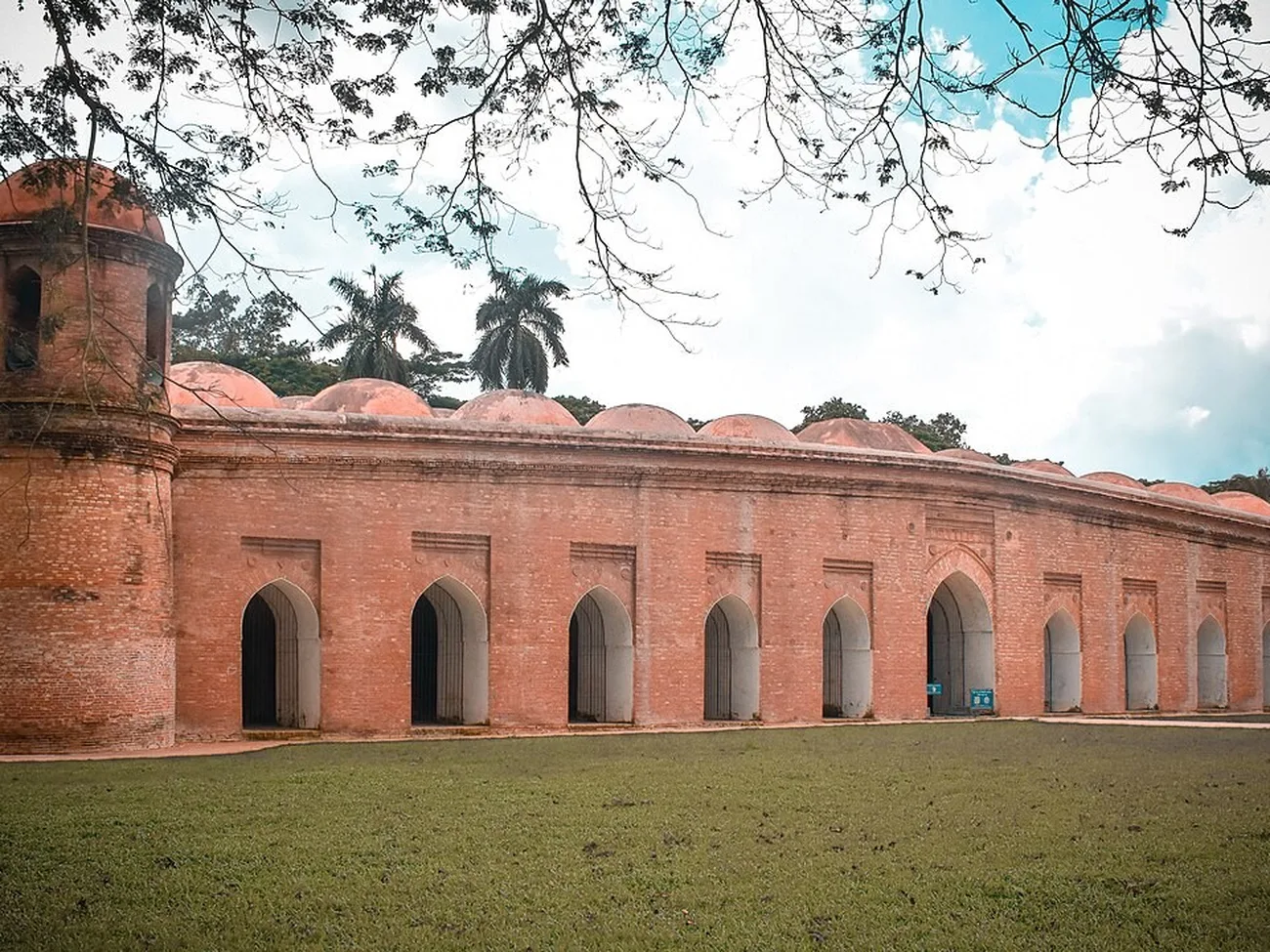
The building
The largest of those mosques is this one. It is the biggest religious building in Bangladesh from the sultanate period.
From outside it is a long block of red brick with very thick walls, flanked by four massive corner towers. The roof is not dominated by a single great dome as in Ottoman or Persian architecture: it is covered with a multitude of low domes, set in rows.
This way of building has a name, the Khan Jahan style: thick laterite walls, no abundance of carved decoration, rows of stone pillars and a forest of low domes. It is an architectural answer to a climate, that of the monsoon, as much as an aesthetic choice.
The count
Now to the number, since the number is the subject.
The prayer hall carries seventy circular domes. The central aisle carries seven more, elongated, called chauchala, a form borrowed from the thatched roofs of Bengal. Total: seventy-seven.
Add the four domes of the corner towers and you reach eighty-one.
That is why you will read both figures depending on the source. They do not contradict each other: they are not counting the same thing. What is certain is that no count comes to sixty.
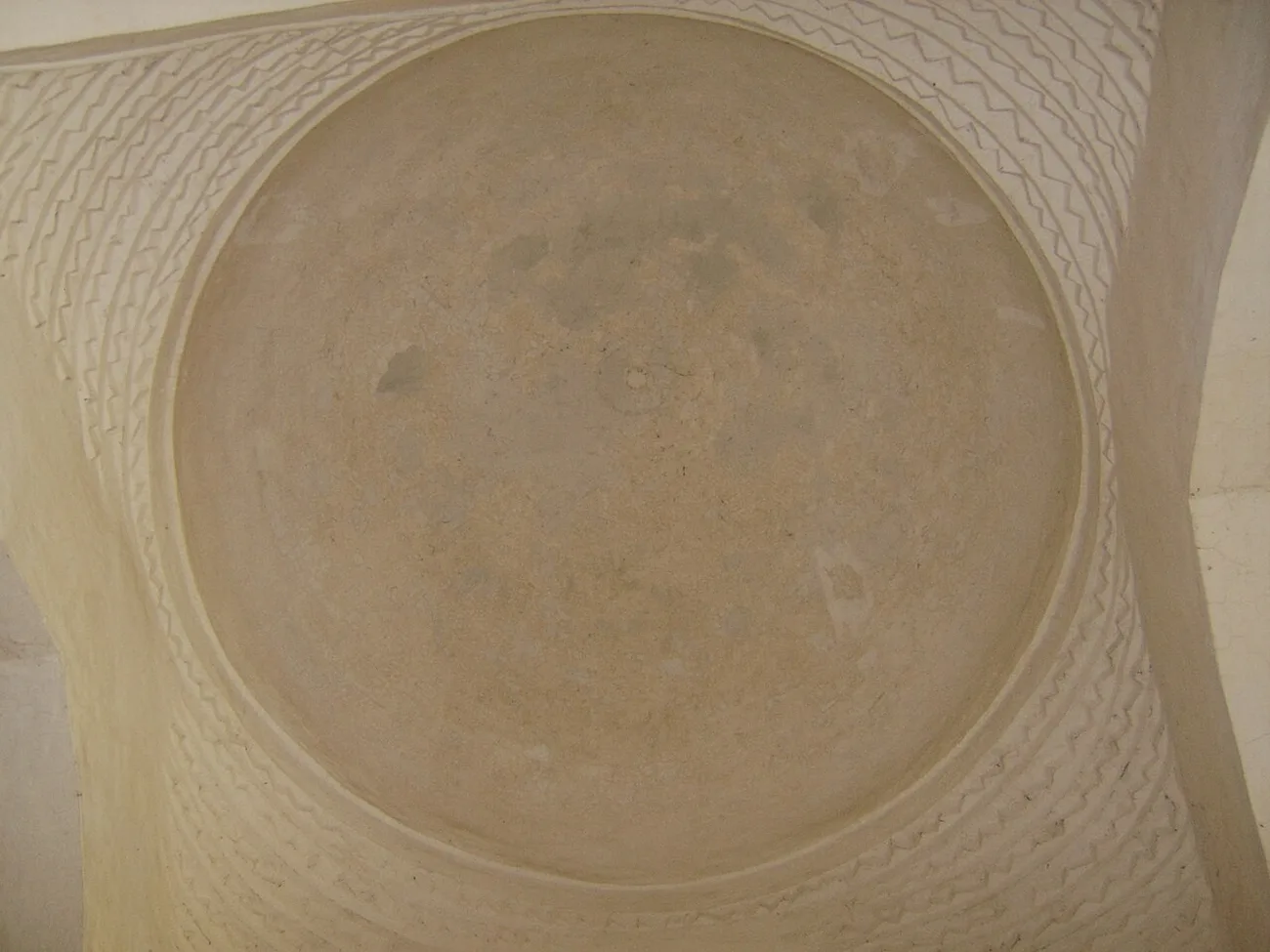
What there are sixty of
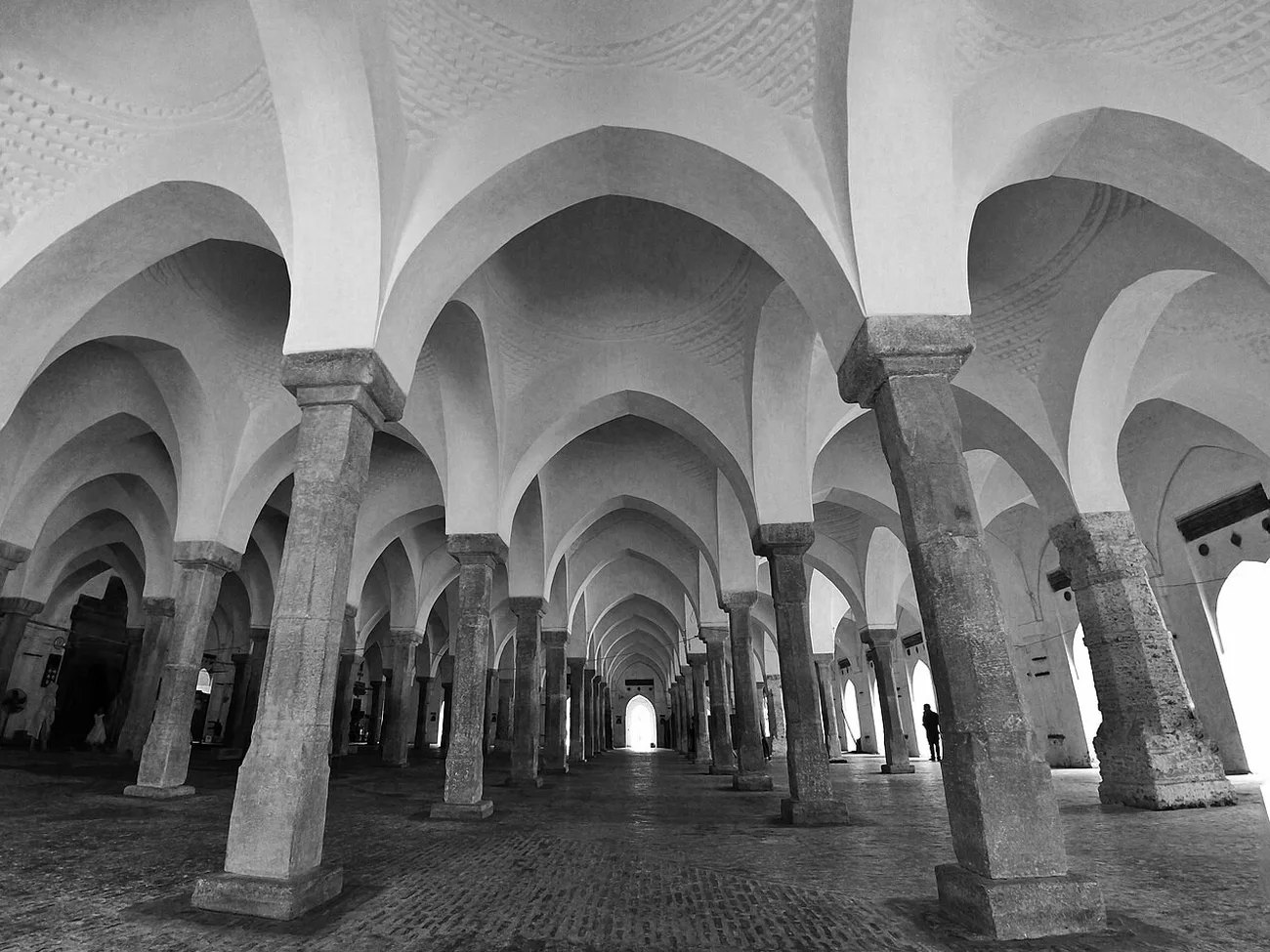
Go inside, and look up later. Look first at what surrounds you.
The hall is divided by rows of stone pillars that cut it into eleven deep bays. You can count them: there are exactly sixty. Fifty-five of stone, five of brick.
And the effect, on entering, is not that of a ceiling. It is that of a forest.
The hypothesis
Here is the explanation that has been proposed, and it must be given for what it is: a hypothesis, not an established fact.
In the local dialect, the word for a pillar is khamba. The word for a dome is gombuj. The two sound very close.
The original name would then have been shat khamba, the mosque of sixty pillars. Over time khamba would have been heard as gombuj, and the building would have become the mosque of sixty domes.
What argues for this reading is that it explains the one figure that comes out right. Sixty matches no count of domes, and matches exactly the number of pillars.
What stops it from being a certainty is that no contemporary document attests it. It is a retrospective reconstruction, plausible, and nothing more. We will not write that it is proven.
What else we do not know
We do not know when it was built. There is no foundation inscription, which is unusual for a building of this importance. It is placed in the fifteenth century, in Khan Jahan's lifetime, and that is all that can honestly be said.
The contrast is worth noting: here is a World Heritage monument, the largest of its period in the country, and we know neither its exact date, nor the certain origin of its founder, nor the sure reason for its name. Three unknowns about a building that is itself perfectly standing.
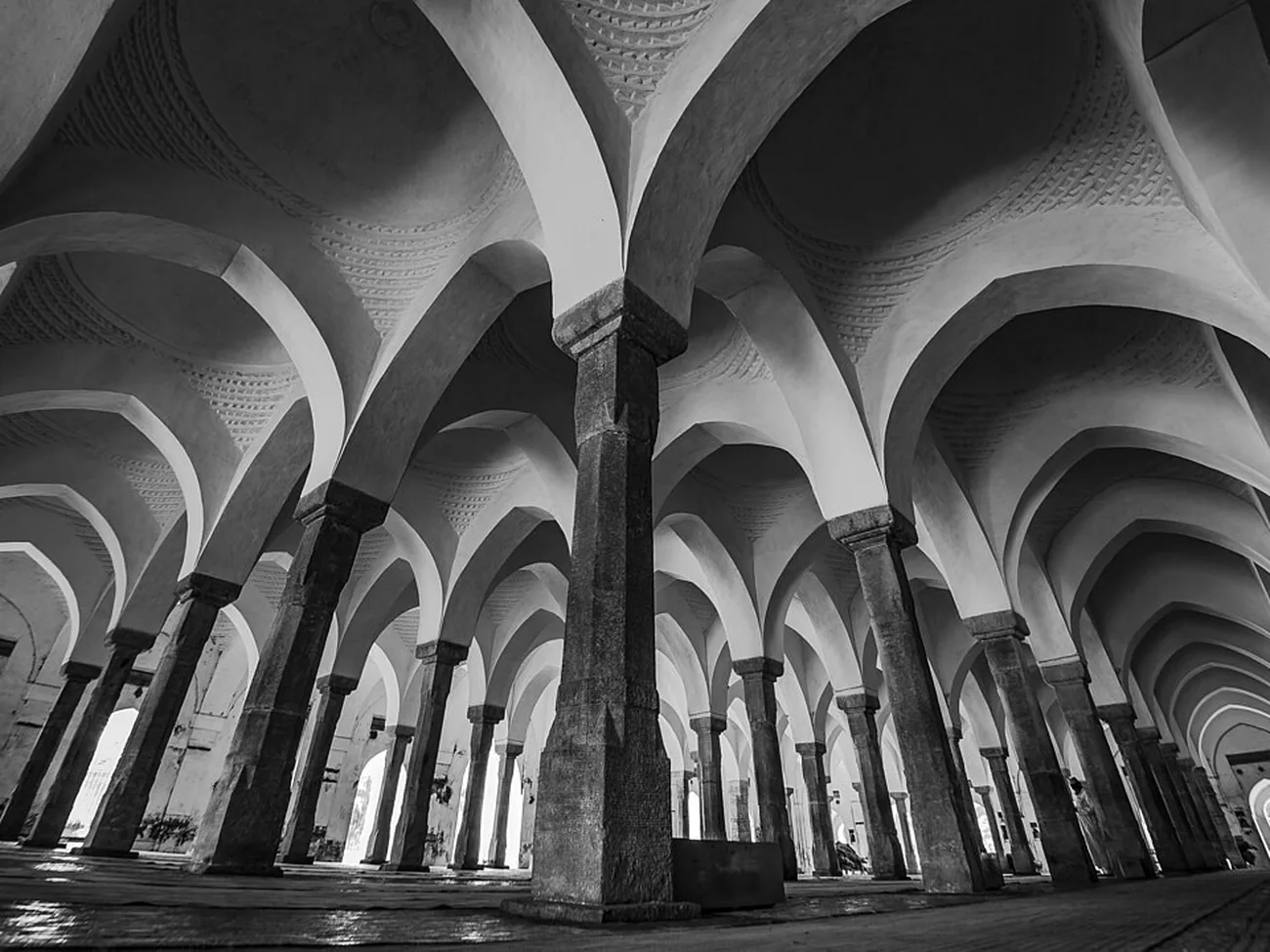
A word on the images
The two interior photographs are in black and white. They are the only freely licensed views of the forest of pillars we could find, and they are remarkable. The contrast with the colour exteriors is deliberate.
The complex also holds its founder's mausoleum, the second most visited place on the site. In keeping with our standing rule, it appears in no image in this article or in the video, and we do not treat it.
Our sources
We give the links in the open, so that anyone can check them without going through us.
- UNESCO, Historic Mosque City of Bagerhat, inscribed in 1985 under criterion (iv): whc.unesco.org. The source for the listing, the fifteenth-century dating and the attribution to Ulugh Khan Jahan.
- Banglapedia, the national encyclopedia of Bangladesh, entry "Khan Jahan": en.banglapedia.org. For the biography and its uncertainties.
- Beautiful Bangladesh, the official tourism portal, page on the mosque: beautifulbangladesh.gov.bd. For the count of domes and pillars.
Read on
Another case of wholly local architecture serving an Islamic function: the timber mosque of Kerala, with neither dome nor minaret. And for a building where everything is local except the direction, the Great Mosque of Xi'an.