
Home › Qibla › This mosque does not point towards Mecca
Qibla, episode 7 · Xi'an, China · 8 min read
Everything about this building is Chinese, except its direction
The Great Mosque of Xi'an looks like no Arab mosque. Courtyards in a row, timber frames, glazed tiles, a minaret you would take for a pagoda. One element alone escapes China, and it is the one that makes the building a mosque.
What you see on arriving
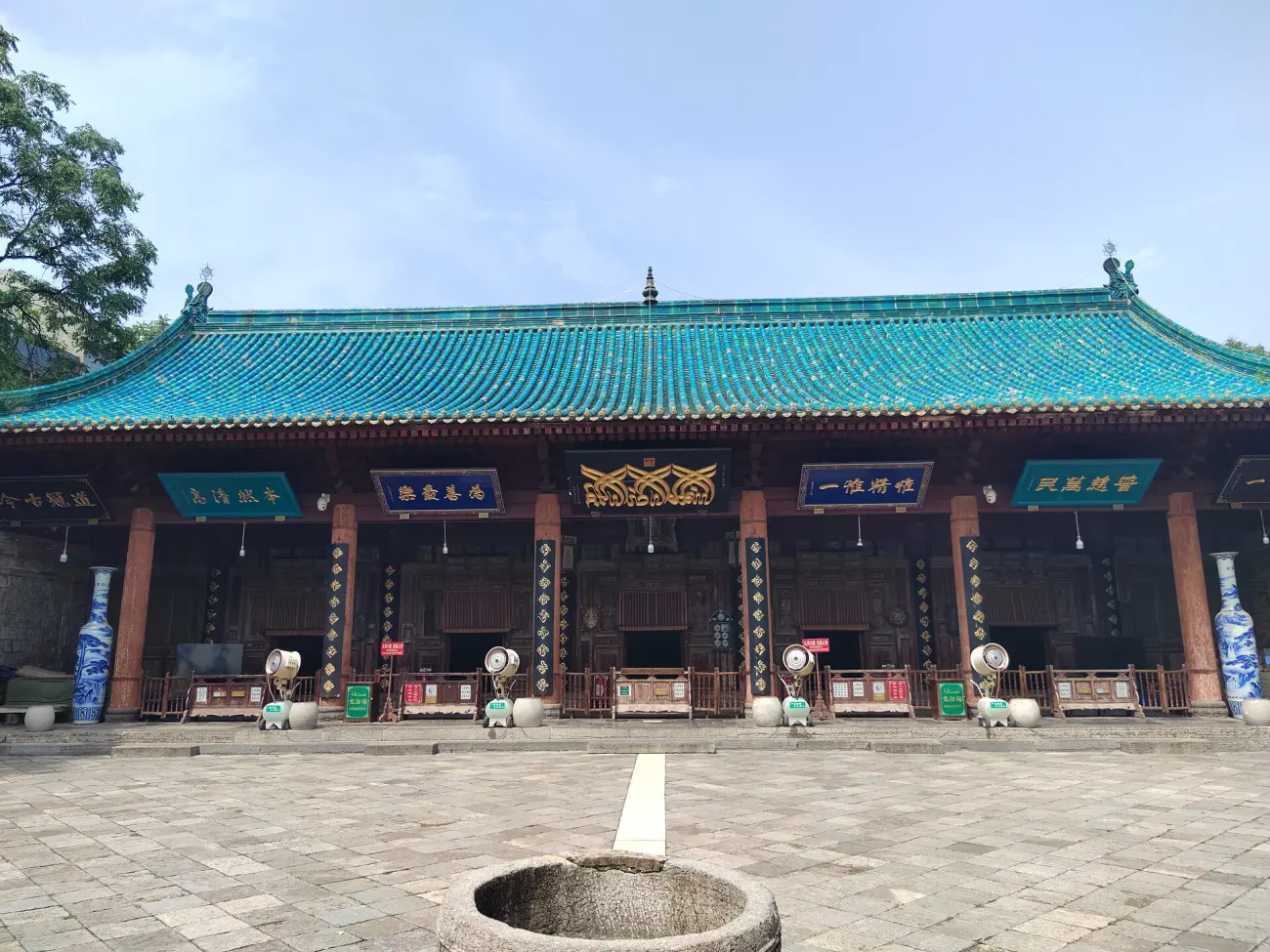
Nothing, at first glance, announces a mosque. No dome. No horseshoe arch. No tower minaret: in its place, a timber pavilion with upswept eaves that looks like a pagoda and serves the purpose.
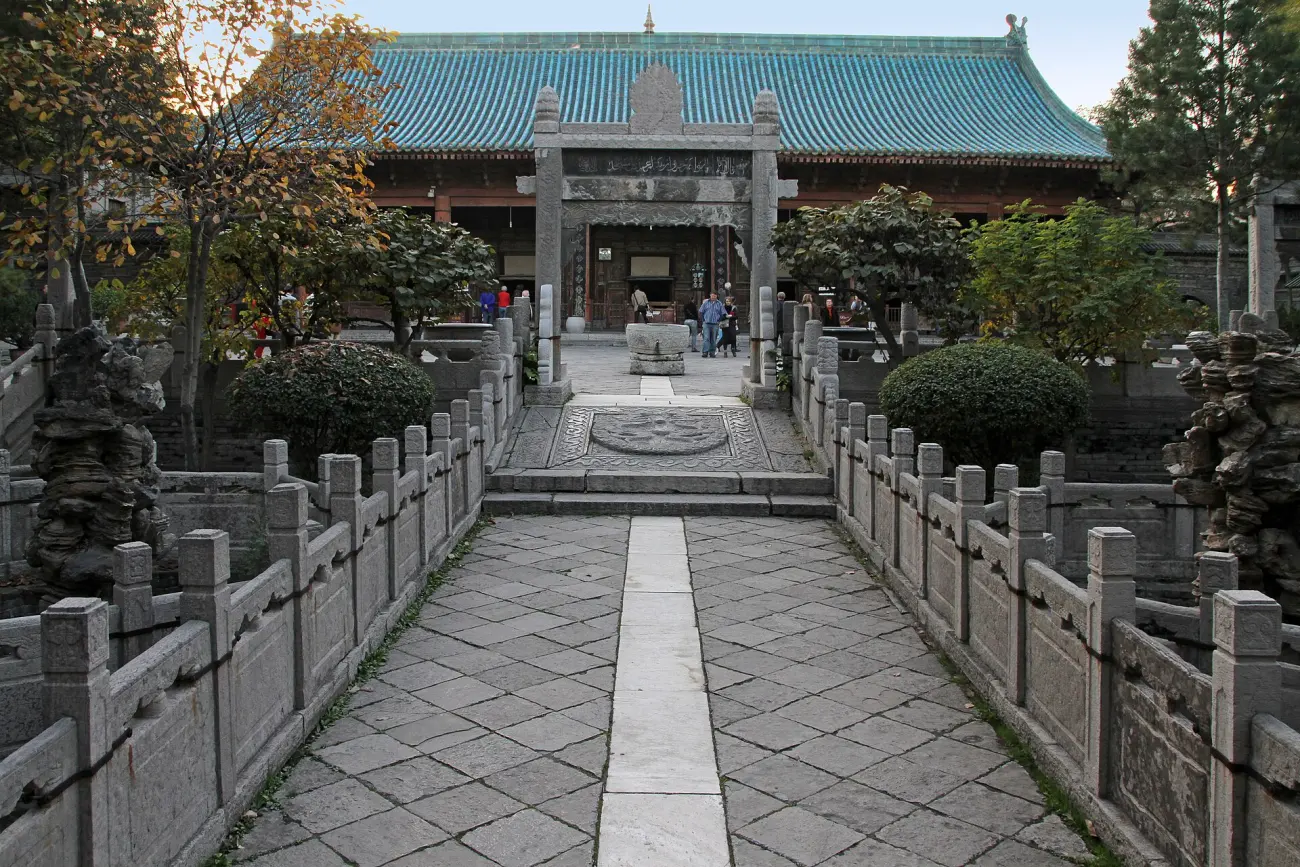
The plan is that of a classical Chinese complex: five courtyards in succession, separated by monumental gates, each more withdrawn than the last. It is the arrangement of a palace or a temple, drawn directly from courtyard residential architecture.
Its present form dates from 1392, under the reign of Hongwu, first Ming emperor. It is also known as the Huajue Lane mosque.
The axis
And then there is the detail you do not notice on the spot, and which leaps off a plan.
In China, a religious or palatial building runs north to south. It is a rule of composition holding for the whole country, from temples to imperial palaces, tied to traditional principles of orientation.
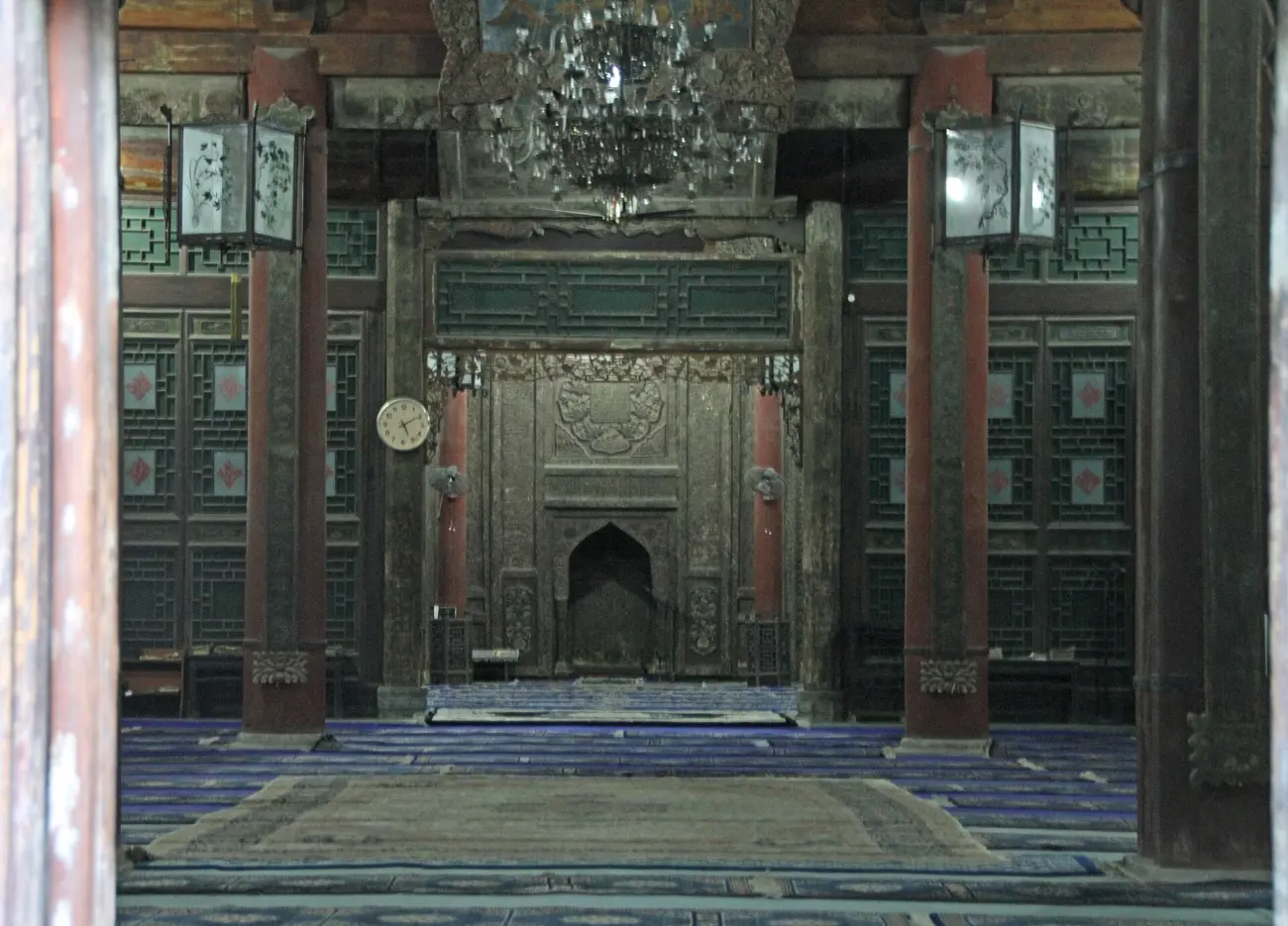
This one runs east to west. The five courtyards follow one another towards the setting sun, and the prayer hall sits at the very end, to the west.
The same plan, the same grammar, the same materials. Turned a quarter turn.
Why west
Because that is where Mecca lies.
We ran the calculation, by the great-circle formula, and anyone can repeat it: from Xi'an, Mecca is 6,819 kilometres away, on a bearing of 277.5 degrees. That is to say almost exactly west, very slightly north of it.
And had the building followed the Chinese rule, due south? Travelling the same distance on that bearing, you do not arrive near Mecca: you end up in the Indian Ocean, more than nine thousand kilometres short.
The quarter turn is therefore no fine adjustment. It is the difference between arriving and missing by a continent.
What we do not say
We do not claim that the building's axis is exactly 277.5 degrees. We do not know, and we have found no source measuring it.
What is established, and it is more than enough, is that it runs east-west where the Chinese rule would have it north-south. The question of fine adjustment, those seven and a half degrees north of due west, remains open for us.
The animation accompanying this episode is a schematic: five symbolic courtyards, not a survey.
What China gave the building
It is worth spelling out what "Chinese" means here, because it is not a veneer.
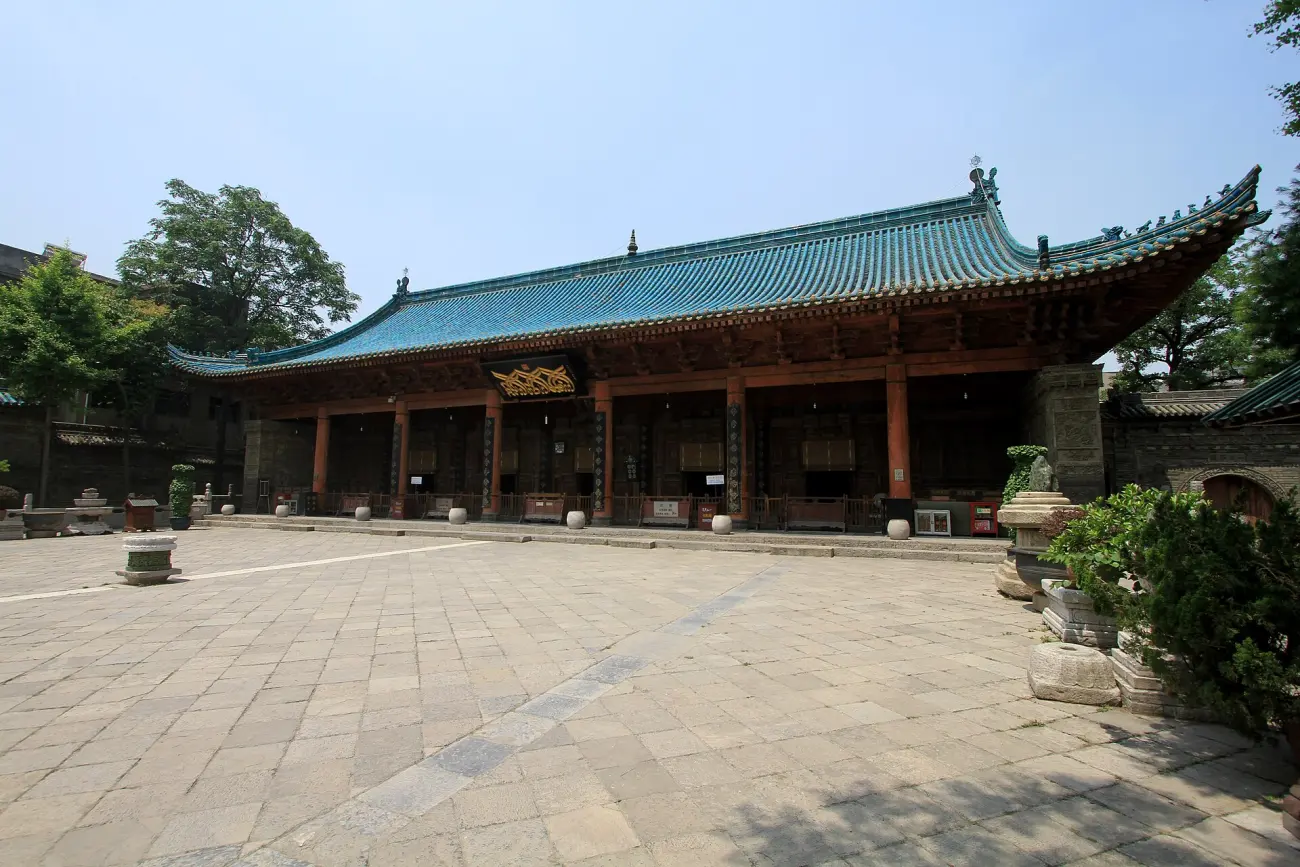
The structure is a timber frame, posts and beams joined without nails, carrying curved roofs covered in glazed tiles. It is the constructional system of all Chinese monumental architecture, and it has nothing to do with the masonry that carries the domes of the Arab or Ottoman world.
The composition proceeds by successive thresholds. You do not take in the building at once: you pass a gate, cross a court, pass another. The sacred is signalled not by height, as a minaret or a dome would do, but by remoteness and repetition.
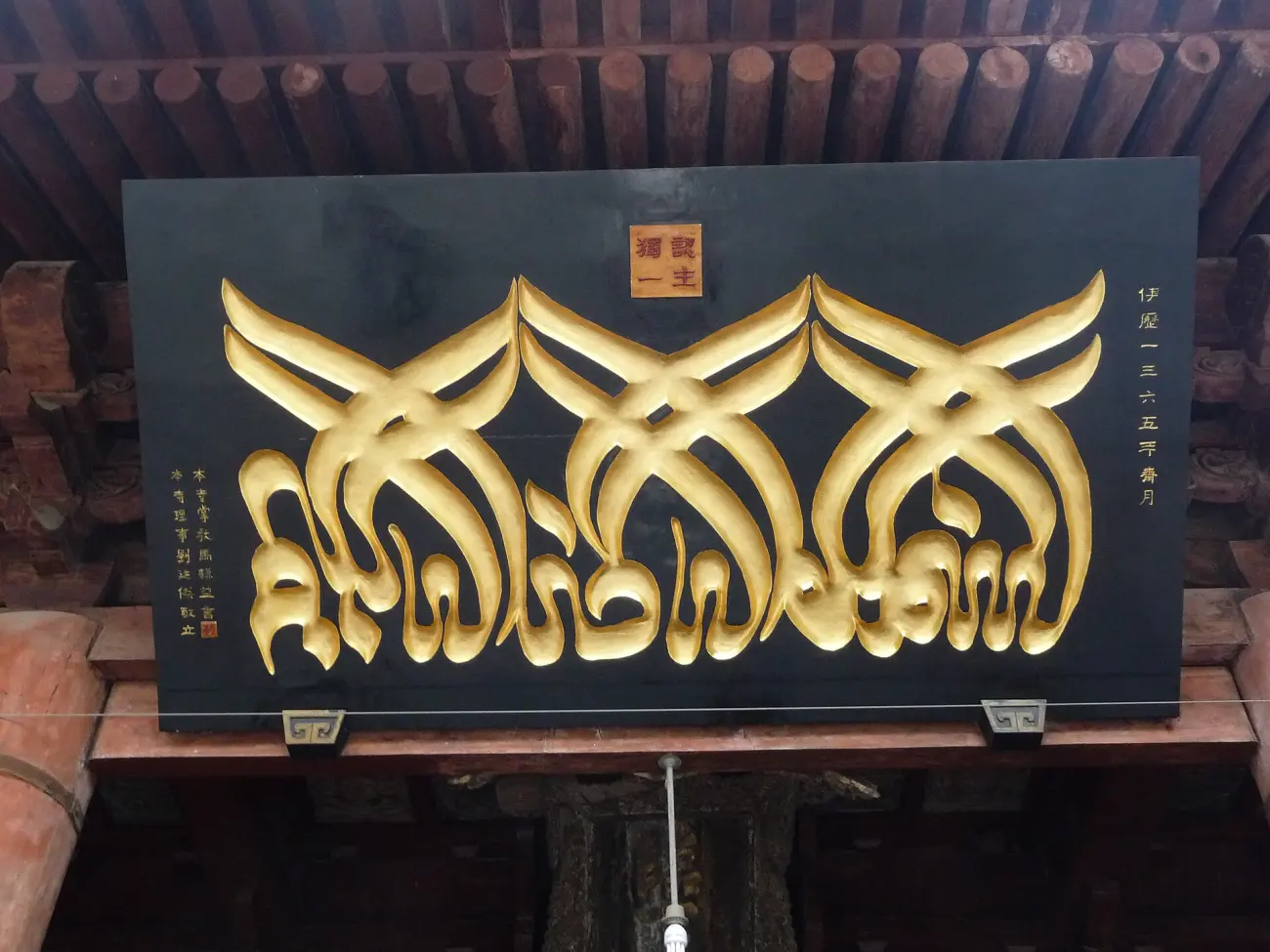
Then the decoration. Lacquered timber panels, engraved steles on plinths, clipped gardens, green-glazed tiles. And onto these perfectly Chinese supports comes the Arabic calligraphy. The result is not a blend, it is a script laid over a grammar.
A family, not an exception
This mosque is no isolated case. Most mosques built in China between the Ming and the Qing follow the same principle: a Chinese architectural form serving an Islamic function.
The point deserves stating plainly, because these buildings are sometimes presented as curiosities. They constitute instead a coherent architectural type, with its rules, its duration and its area of diffusion.
And within that type, the constraint of direction always plays the same role: it is the one element that is not negotiable. The rest accords itself to the country.
What five degrees, and what a quarter turn, are worth
This series habitually converts bearing differences into kilometres, because a degree cannot be felt.
Over the 6,819 kilometres between Xi'an and Mecca, a single degree of error moves the arrival point by about a hundred and twenty kilometres. Due west rather than 277.5 degrees would land you some seven hundred kilometres short, in the Arabian peninsula but well away from Mecca.
And due south, the Chinese rule, lands more than nine thousand kilometres away, in open ocean.
These figures measure a constraint, not a competence. They show what the builders would have given up had they followed the local rule, and therefore what they were unwilling to give up.
A fusion, not a compromise
It would be tempting to read this building as an arrangement, a religion bending to local forms for want of anything better. That would be to look at it badly.
Everything that could be Chinese has become so, and fully: the frame, the proportions, the courtyards, the engraved steles, down to the decorative vocabulary.
And the one thing that could not yield did not yield. A constraint of direction changes neither the materials, nor the forms, nor the plan. It changes one thing, and that one thing is enough.
The contrast with the previous episode
The comparison is worth making, because the two cases are opposites.
In Marrakesh, two mosques five degrees apart, and more than sixty between each and the shortest path: the orientation followed a method of its period, different from ours. We told that story here.
In Xi'an, the direction is almost exactly that of the great circle, and it is everything else in the building that gave way. Two opposite answers to the same constraint, at the two ends of the Muslim world.
To go further
Episode 1 of this series poses the opening question: why do all these mosques face the same point?