
Home › Blog › Djenné, Larabanga, Bobo-Dioulasso: the art of mud brick in West Africa
Discovery · 6 min read · 2026-03-09
Djenné, Larabanga, Bobo-Dioulasso: the art of mud brick in West Africa
From Mali to Ghana via Burkina Faso, one architectural tradition crosses borders: that of banco, sun-dried mud brick, sculpted into facades bristling with wood and maintained every year by an entire community.
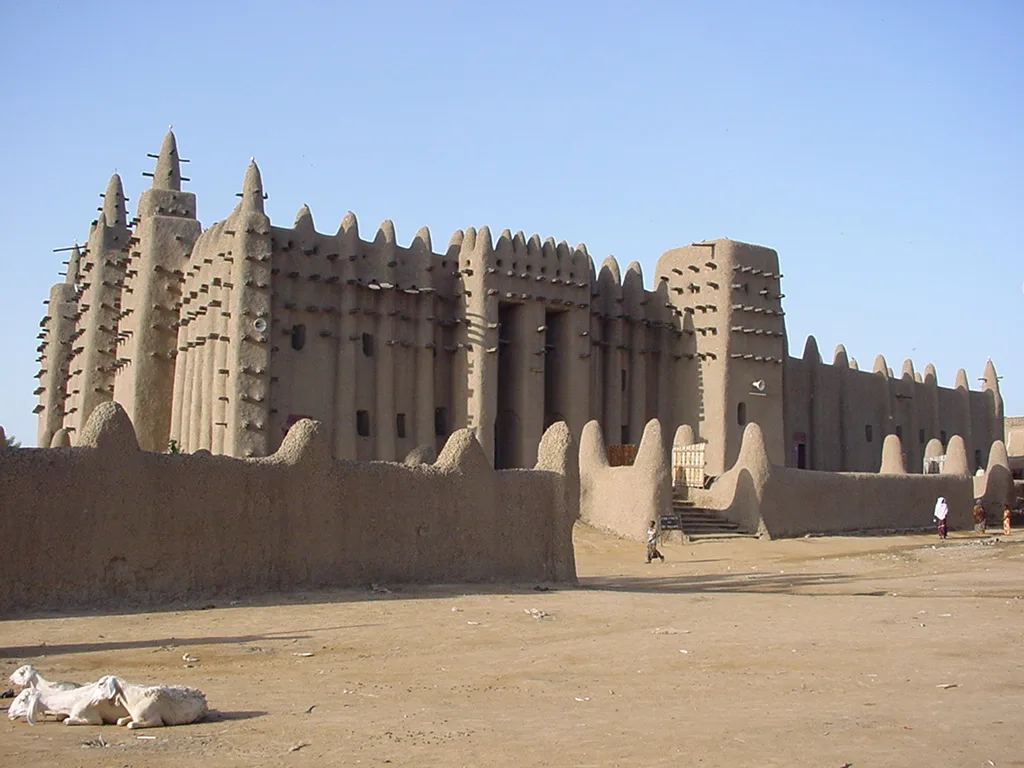
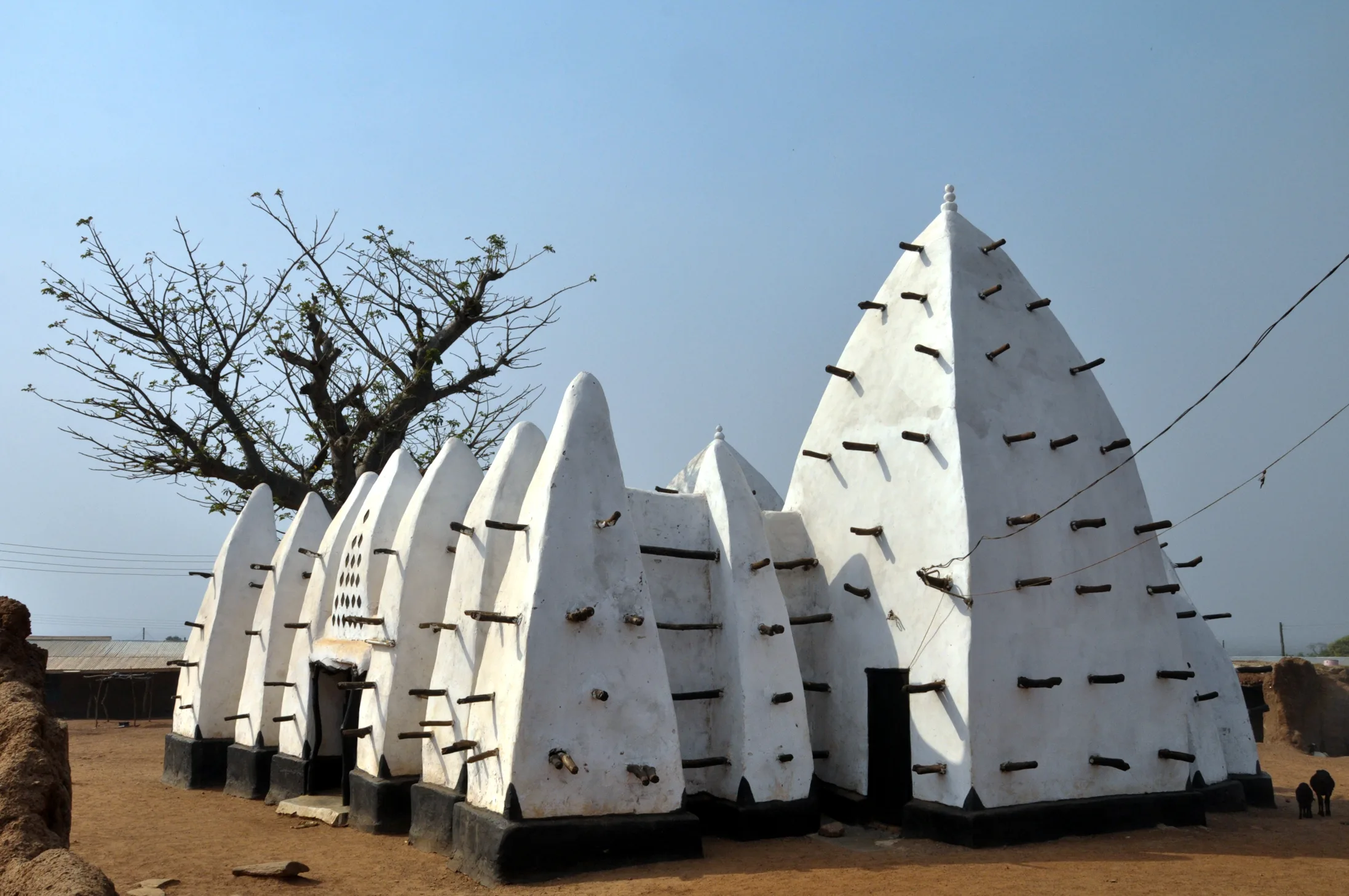
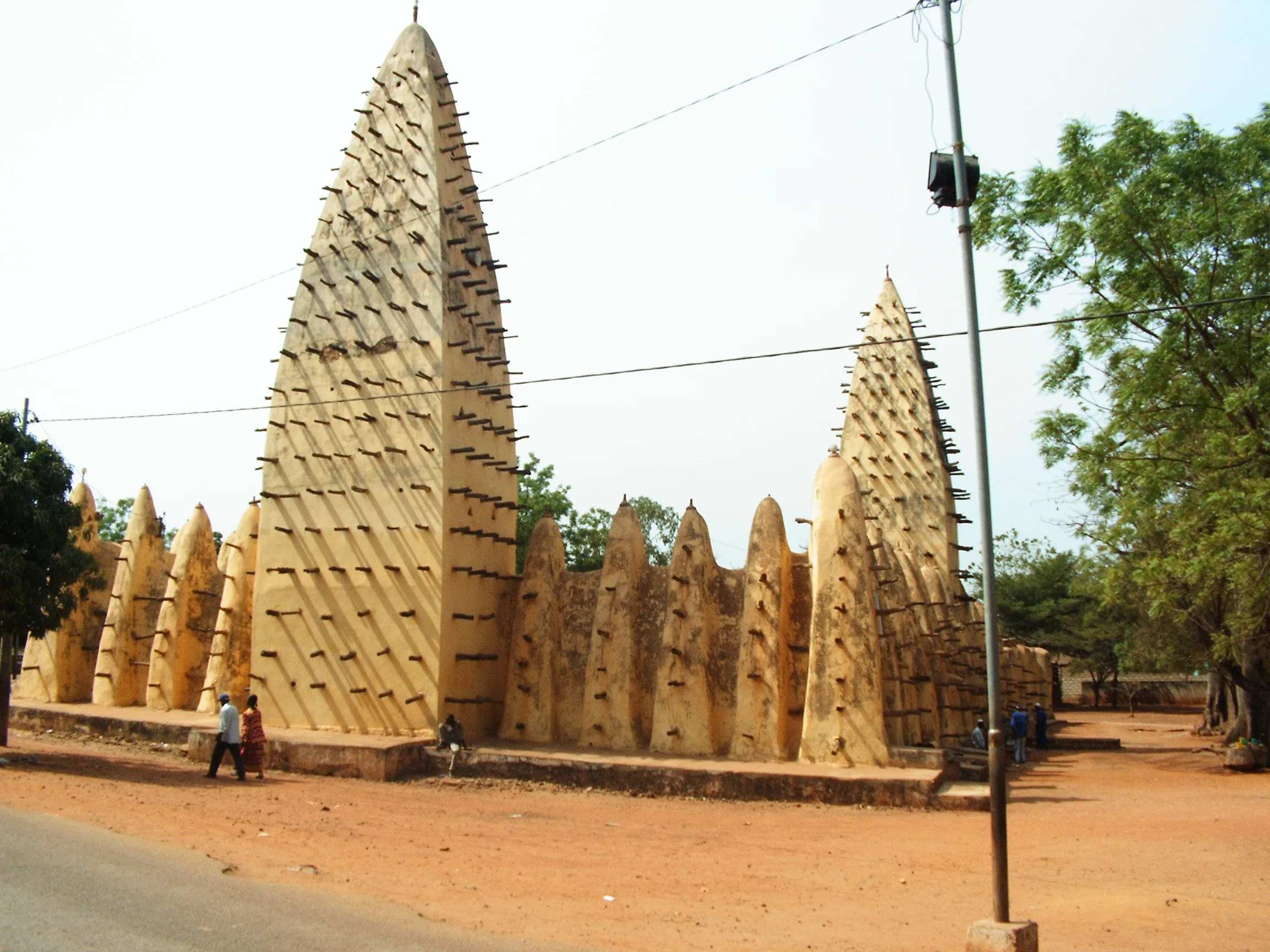
Djenné, the largest mud-brick building in the world
The Great Mosque of Djenné, in Mali, is the largest mud-brick (banco) building in the world. Every year, before the rainy season, the whole town takes part in the "crépissage", a collective festival where the walls are re-plastered with fresh mud by hand. The palm-wood bundles bristling from the facade are not decorative: they are permanent scaffolding, embedded in the wall, that makes this annual upkeep possible, an upkeep essential to the building's survival.
Larabanga, the "Mecca of West Africa"
Founded according to tradition in 1421, the Larabanga Mosque, in Ghana, is considered the oldest in the country and one of the oldest in West Africa, earning it the nickname "Mecca of West Africa". Twelve conical buttresses, reinforced with protruding horizontal timber, support its mud walls. According to local tradition, it houses an ancient Qur'an believed to be a divine gift given in 1650 to Imam Bramah.
Bobo-Dioulasso, born of a political alliance
Probably the finest example of Sudano-Sahelian architecture in Burkina Faso, the Great Mosque of Bobo-Dioulasso is built entirely of laterite, clay, and shea butter. Its construction, between 1812 and 1880 depending on the source, is linked to the alliance between the religious leader almamy Sidiki Sanou and the kingdom of Sia, in the face of the threat from the neighboring kingdom of Kénédougou. As in Djenné, its protruding wooden towers and pillars serve as permanent scaffolding for the annual re-plastering.
What banco actually is
The word covers both a material and a method. Earth is taken on site, usually from the bed or banks of the nearby river, then mixed with water and plant fibres, rice husk, chopped straw or dung, which limit cracking as it dries. Bricks are hand-moulded, sun-dried and never fired, laid with mortar made of the same earth. The wall is then coated with a render of that same material.
That homogeneity is the key to the system. Since there is only one material, the building is repaired with what made it, with no incompatible joint and no visible patch. In exchange, it cannot survive neglect: a few rainy seasons without maintenance are enough to erase the edges, then to take the walls away.
Walls are therefore thick, often more than half a metre at the base, and strongly battered, that is wider at the bottom than at the top. That slope is not a stylistic effect: it provides stability, keeps run-off away from the foot of the wall, and lets the building stand without a frame.
Architecture that repairs itself every year
The annual re-plastering at Djenné is the best known example, but it should be understood as a mechanism, not as folklore. The wall loses material with every rainy season, the community gives it back the equivalent before the next one. The building you see today is not the same as last year's in material terms, while being strictly the same building.
That arrangement requires something no material can replace: people. It takes a guild of masons holding the gestures, a collective calendar, and transmission from one generation to the next. At Djenné that guild exists and runs the operation. Where it disappears, the building disappears with it, however sound its design.
The threat is not the rain, it is cement
It is tempting to imagine these buildings threatened by the climate. They have withstood it for centuries, precisely because they are designed to be repaired. The real risk lies elsewhere.
When a cement render is applied over an earth wall, it seems at first to solve the problem: the surface becomes hard and annual maintenance looks unnecessary. But cement is impermeable and rigid where earth breathes and flexes. Moisture rising from the ground stays trapped behind the render, the earth crumbles out of sight, and the cement layer eventually detaches, taking with it the wall it was meant to protect. The remedy also removes the reason to maintain, and therefore the guild that knew how.
This is why conserving these monuments depends less on one-off works than on keeping a craft and a collective organisation alive. Here, heritage is as much human as material.
A network, not a collection
These mosques are not isolated cases. They line the trans-Saharan trade routes that linked the Sahel towns to the northern ports, and the same vocabulary recurs from one end to the other: projecting buttresses, towers with conical tops, protruding wooden beams, a minaret built into the mass rather than standing apart.
Timbuktu offers the other great example, with the Djinguereber mosque, built in the fourteenth century in the wake of Mansa Musa's pilgrimage, which we cover in this article. The three buildings presented here, Djenné, Larabanga and Bobo-Dioulasso, belong to the same technical family, at different scales and in different countries.
A living architecture, not a fixed backdrop
What sets these three mosques apart from most historic monuments is that they are not static: they are literally rebuilt every year by the hands of their communities. Banco is not a permanent material like stone, but a living substance that demands constant collective upkeep, an architecture that survives only because it remains inhabited and practiced.
Discover more
Mosques mentioned in this article
Great Mosque of Djenné
The largest mud-brick building in the world, re-plastered every year by the whole town in a festival.
Larabanga Mosque
Nicknamed "the Mecca of West Africa", Ghana's oldest mosque, built of earth and wood.
Great Mosque of Bobo-Dioulasso
Burkina Faso's finest example of mud-brick architecture, maintained every year by the whole town.
About this page's content: this site offers editorial and cultural content written with care and respect for the religious traditions concerned; it does not constitute theological advice or an authoritative religious source. Despite our checks, errors, inaccuracies, or approximations may remain. If you spot one, please let us know via the Contact page or by email at qibla.mosk@gmail.com, and we will gladly correct it.