
Home › Blog › The upside-down tulip of the Selimiye
Edirne · Türkiye · 7 min read · 2026-09-20
The upside-down tulip of the Selimiye Mosque
In the Selimiye Mosque in Edirne, the building Sinan held to be his master work, a tulip is carved upside down. It sits on a marble leg of the muezzin's platform, at the exact centre of the hall. Nobody knows why.
Where the flower is
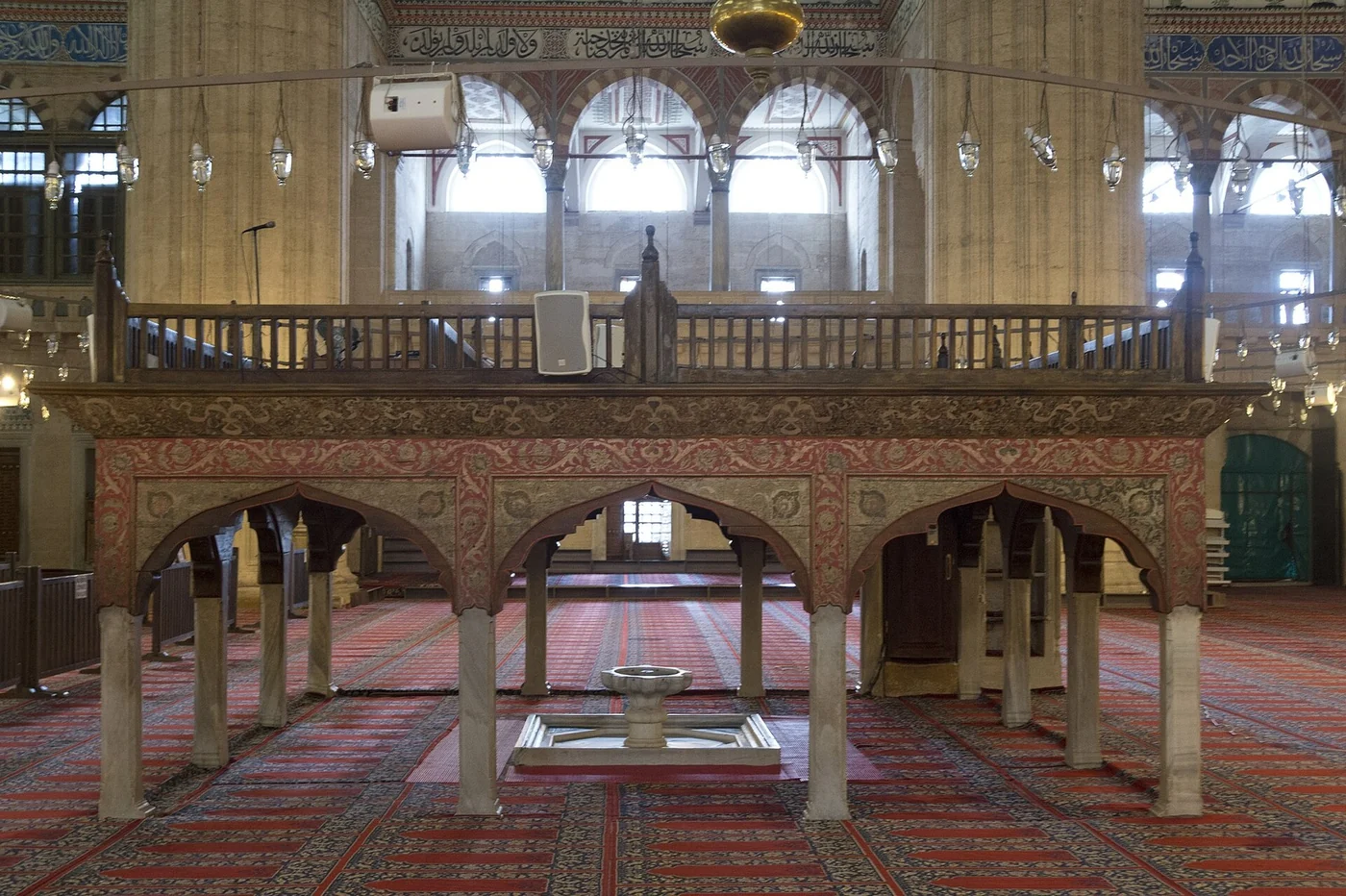
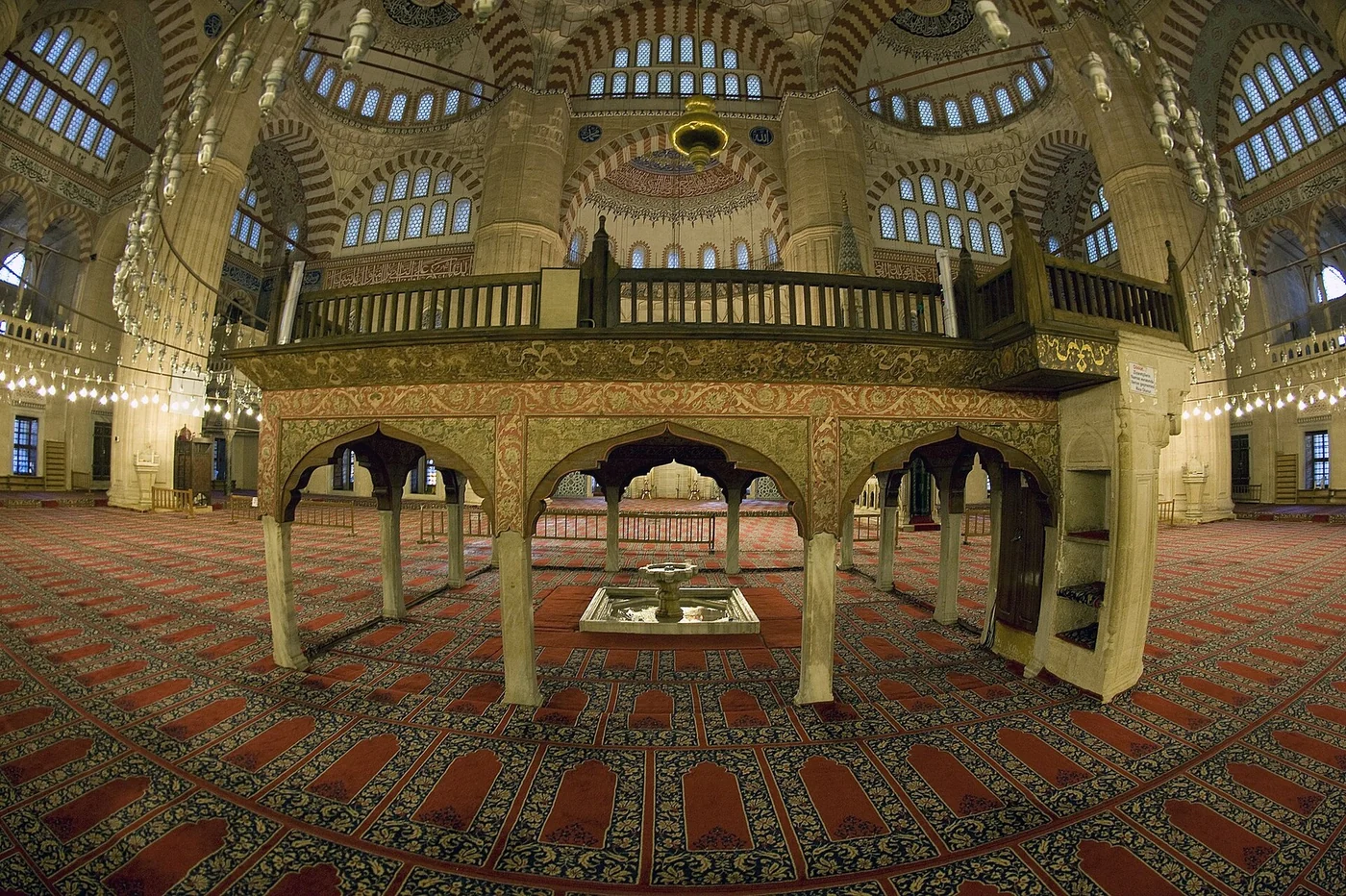
The muezzin's mahfil is a square stage carried on a dozen small columns, set under the centre of the dome above a small basin. Its position is unusual: in most Ottoman mosques this platform stands against a wall or near the entrance. Here Sinan put it in the middle, on the most looked-at spot in the building.
It is on one of the marble legs of that stage that the reversed tulip is carved. You have to know it is there to see it, and guides in Edirne have been pointing it out for a long time.
A building set to the millimetre
The anomaly only counts because nothing else is one. The mosque was raised between 1569 and 1575 for Sultan Selim II, on the high point of Edirne. Its dome is thirty-one metres thirty across, slightly wider than the one at Hagia Sophia, and rests on eight piers that make themselves forgotten. Its four minarets rise to seventy-one metres. The complex, with its madrasa and its school of hadith, has been a World Heritage Site since 2011.
Sinan ranked his own buildings: the Şehzade mosque was his apprentice work, the Süleymaniye his journeyman work, and this one his master work. The ranking is his own, recorded in the autobiography he dictated, and we have told that story in the three mosques ranked by Sinan.
Why Edirne, and not Istanbul
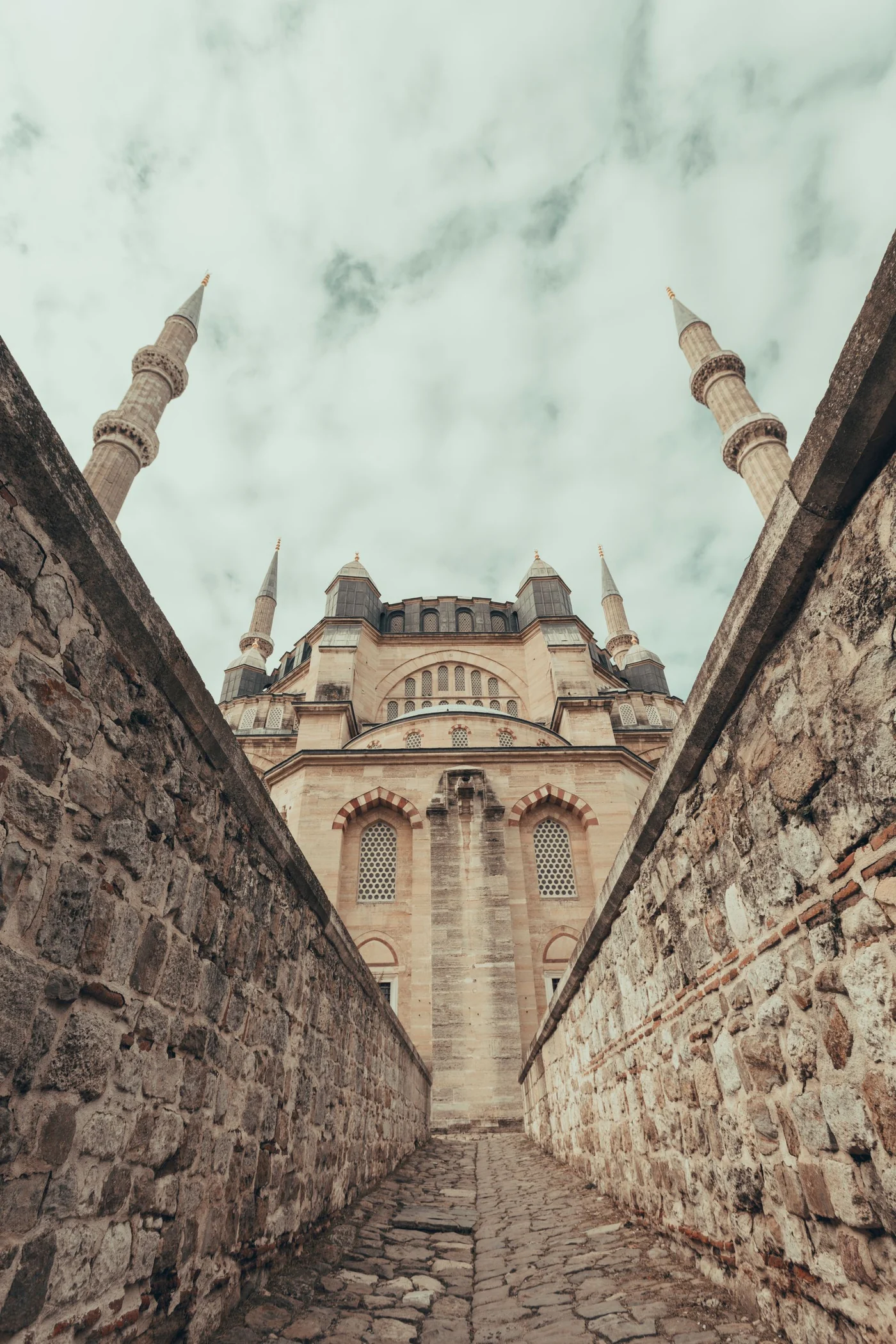
One question keeps coming up in front of this building: why does the summit of Sinan's work stand in Edirne rather than in the capital? Edirne is no secondary town in Ottoman history: it was the capital before Constantinople, and it remained an imperial residence, a hunting town and a gateway to Europe. Selim II was attached to it.
The chosen site, the highest point of the town, does the rest. The mosque is visible from everywhere, and its four minarets frame the dome instead of standing away from it, which gives the silhouette its recognisable verticality. Sinan had spent his life raising domes; here he had the room and the commission to take the idea as far as it would go.
Everywhere else, the tulip stands upright
The motif is not rare at all. In the sixteenth century the tulip is one of the favourite flowers of Ottoman decoration: it covers Iznik tiles, textiles, bookbindings and the tilework of imperial mosques. It is almost always shown upright, stem down, cup up, in tightly codified compositions.
That is what gives the Edirne tulip its standing. In so regulated a repertoire, a reversed flower is not a stonecutter's slip: it is a decision, taken by somebody, for a reason.
The two stories
The first version is the more common. The chosen ground is said to have belonged to someone who grew tulips and refused to give up the garden. He is said to have given in at last, and the reversed flower is said to keep the memory of that stubbornness, half tribute, half revenge.
The second is more intimate. Sinan is said to have brought his granddaughter to Edirne, and she is said to have died during the works, the inverted tulip standing as a sign of mourning.
Both circulate in guidebooks, in the Turkish press and on site panels. Neither is attested by a sixteenth-century source. They are oral traditions recorded much later, and they have the typical shape of stories built around a visible, unexplained detail.
What can be said, and what cannot
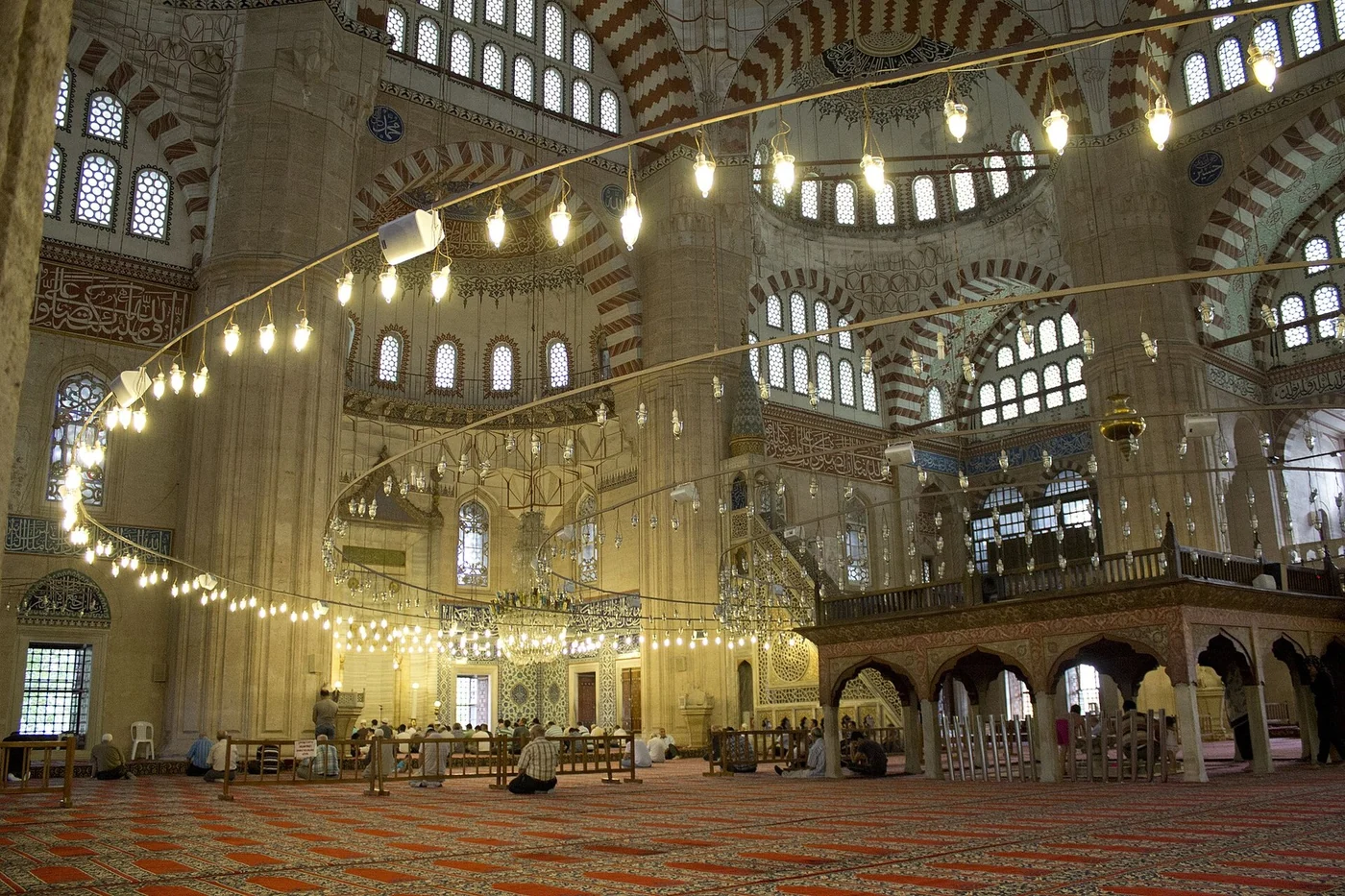
What is established: the tulip is there, it is reversed, it is on the muezzin's mahfil, and the building around it is one of the most controlled in all Ottoman architecture.
What is not: the reason. And it is exactly that gap which produced two stories rather than one. We report them as stories, never as facts, because that is what they are.
An image we had to draw
A word about our illustrations. For the video that goes with this article we looked for a freely licensed photograph of the tulip: none exists, neither on Wikimedia Commons nor in the open image banks. The motif is small, it sits on a marble leg, and photographers frame the whole platform.
So we drew it, as an acknowledged diagram, to show what is being discussed. It is a rule we apply to ourselves: when an image is missing we do not manufacture something that passes for a photograph, we draw it and we say so.
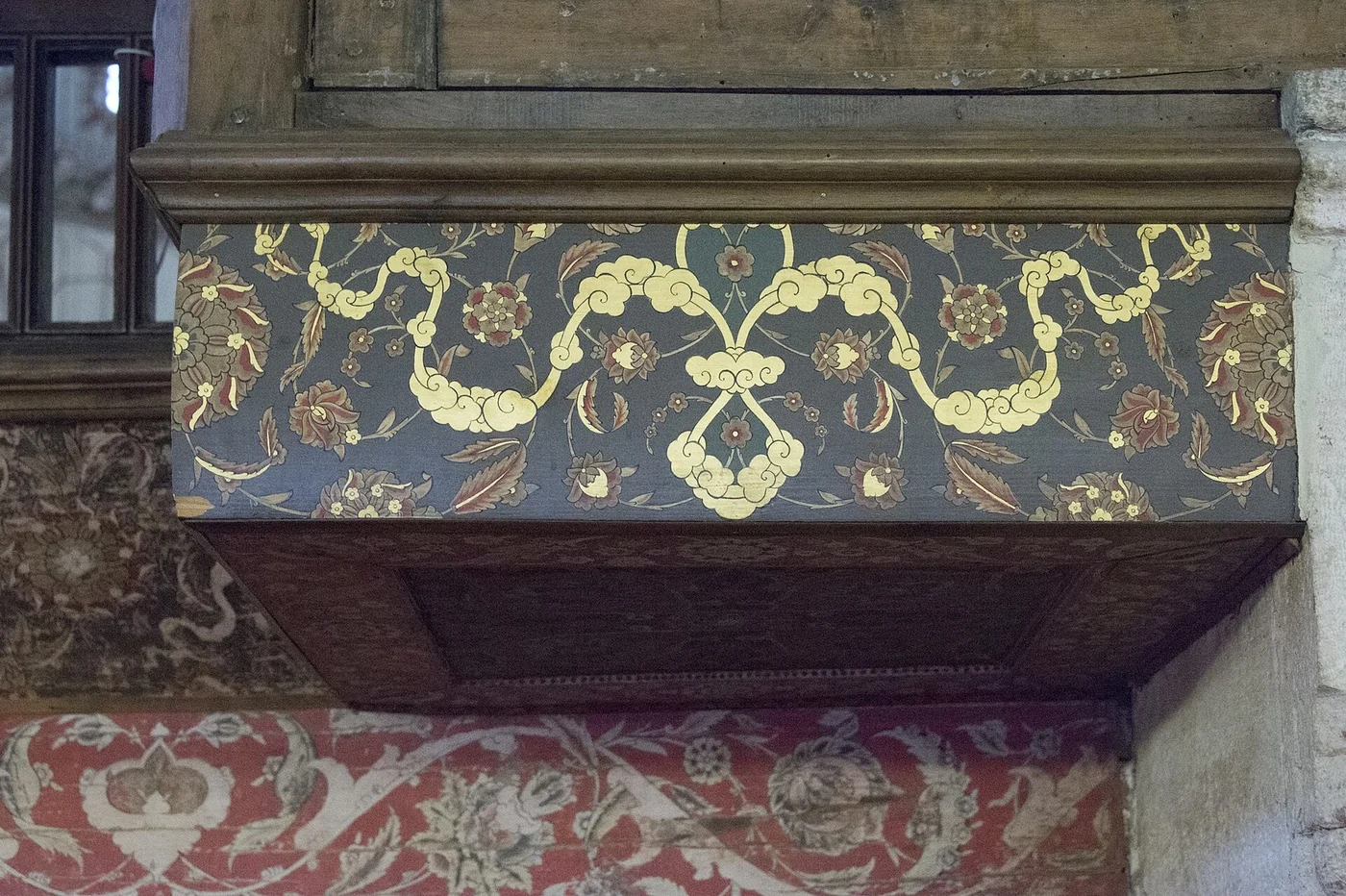
What remains is the pleasure of the thing. Four hundred and fifty years after the work was finished, in the building its architect considered his summit, a marble flower still looks downward, and we do not know why. For another mosque detail that turns on a mechanism rather than a riddle, see the retractable roof of the Hassan II Mosque.
Discover
Mosques mentioned in this article
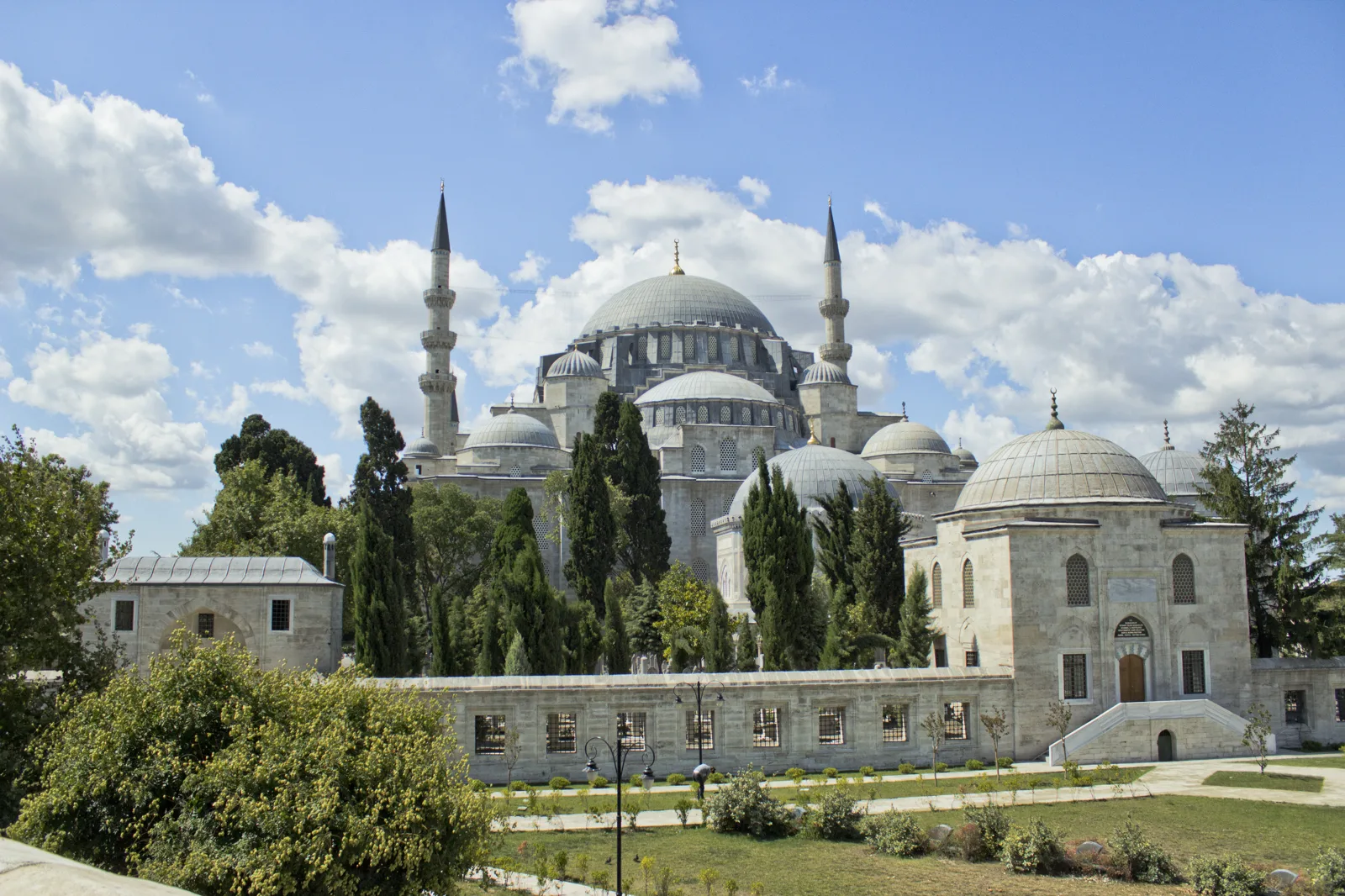
Süleymaniye Mosque
Sinan's journeyman work, its dome and its acoustic jars, above the Golden Horn.
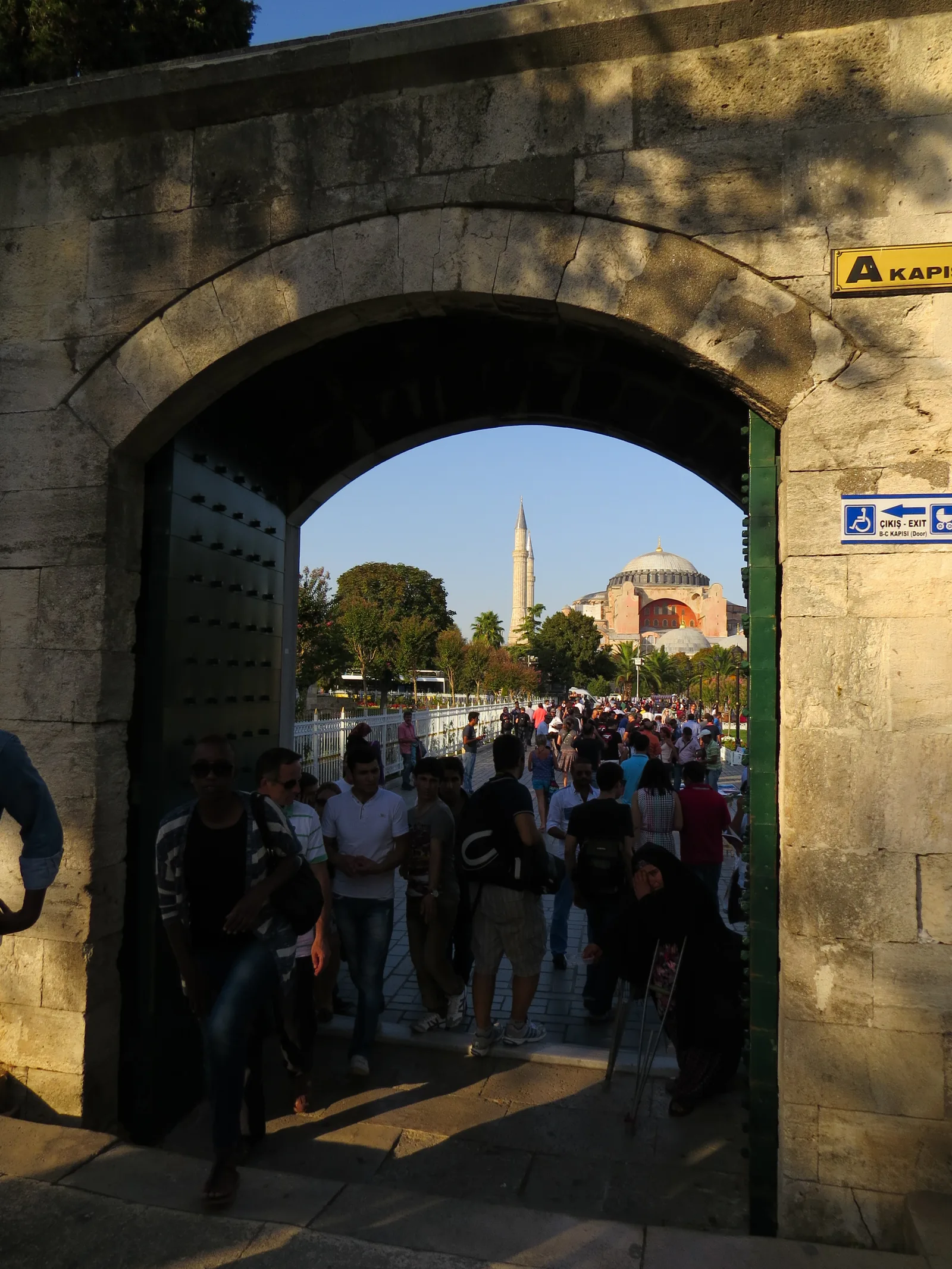
Blue Mosque (Sultan Ahmed)
Six minarets, a cascade of domes and more than 20,000 Iznik tiles: the icon of Istanbul.
About this page's content: this site offers editorial and cultural content written with care and respect for the religious traditions concerned; it does not constitute a theological opinion or a source of religious authority. Despite our checks, errors, inaccuracies or approximations may remain. If you spot one, please let us know via the Contact page or by email at qibla.mosk@gmail.com, and we will correct it gratefully.