
Home › Masjid al-Haram › The permanent building site
Masjid al-Haram, chapter 8 · Mecca · 9 min read
A million fewer pilgrims, three years running
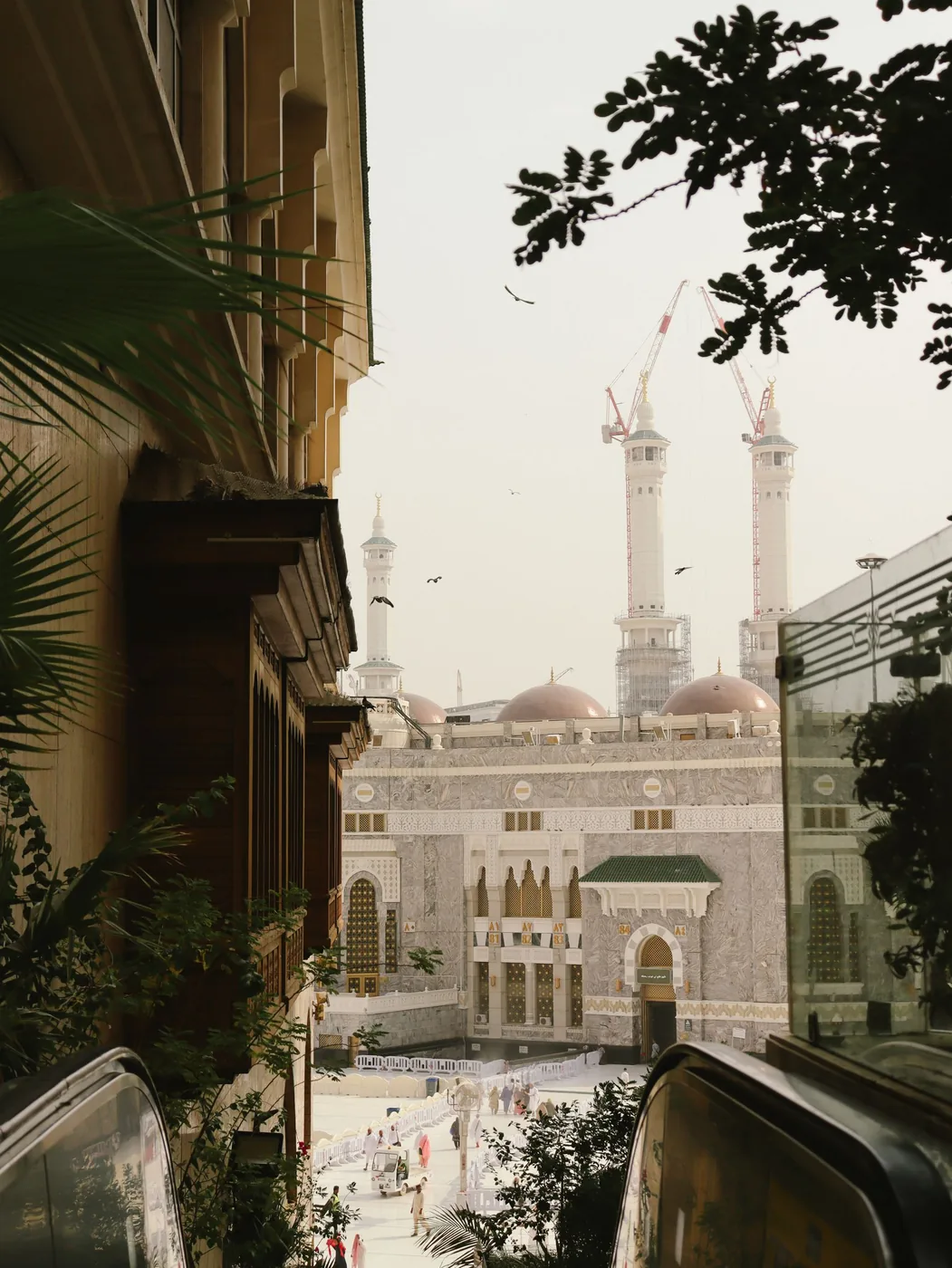
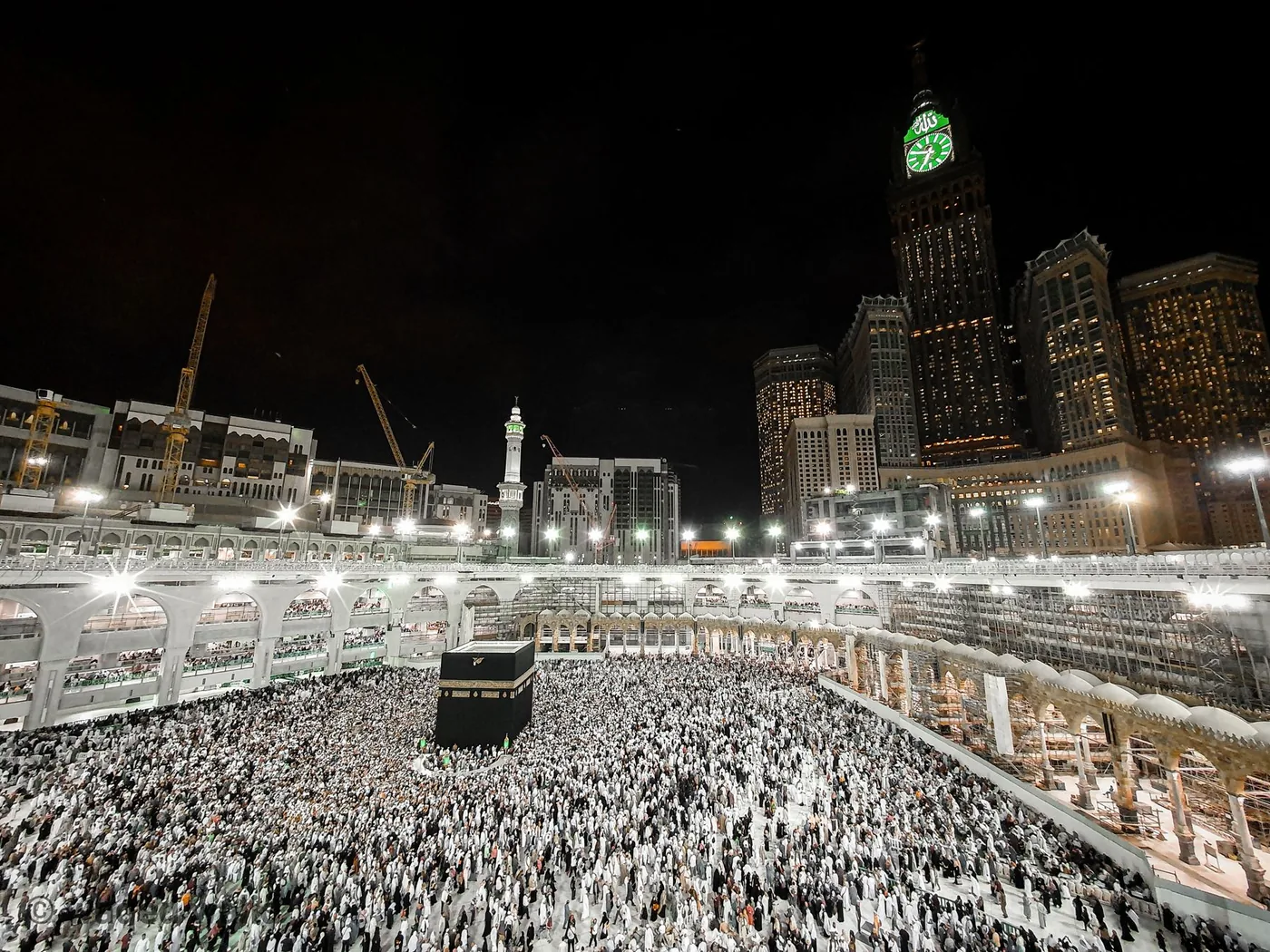
The Grand Mosque of Mecca is a permanent building site. Since the mid-nineteen fifties it has hardly ever stopped growing, and the phases, stages and campaigns that have followed one another are beyond counting.
Throughout that time, the works have not interrupted the prayer. That is a fact, and a remarkable one. But it is also a sentence to be handled with care, because it is often widened into "the mosque has never closed", which is false: it was closed at night from 5 March 2020, and the umrah suspended, on health grounds. That interruption did not come from a building site.
Seventy years, in three great campaigns
The word "permanent" deserves qualifying, because it does not mean the cranes never left the site for a single day.
What are called the Saudi enlargements come in three great campaigns. The first opens in the mid-nineteen fifties and runs to the early seventies. The second is launched in the nineteen eighties and closes at the end of that decade. The third begins in 2011 and is not finished.
Between those campaigns the building is never truly at rest: there remain maintenance works, repairs, alterations, and above all the annual preparation for the Hajj, which is itself an operation on a large scale.
Over a span of seventy years, what can be said without exaggeration is that the sanctuary has never known a long period in which it was not, somewhere, under works. And throughout that time the daily prayer has been held there.
How you build without stopping the prayer
The method rests on two principles, and neither is spectacular.
But one false idea has to be set aside first: there is no quiet season. The Hajj falls on a fixed date in the lunar calendar and lasts only a few days, but the umrah, the lesser pilgrimage, is performed all year round, and the month of Ramadan is a second peak. The mosque therefore has no quiet period in which the works could be concentrated.
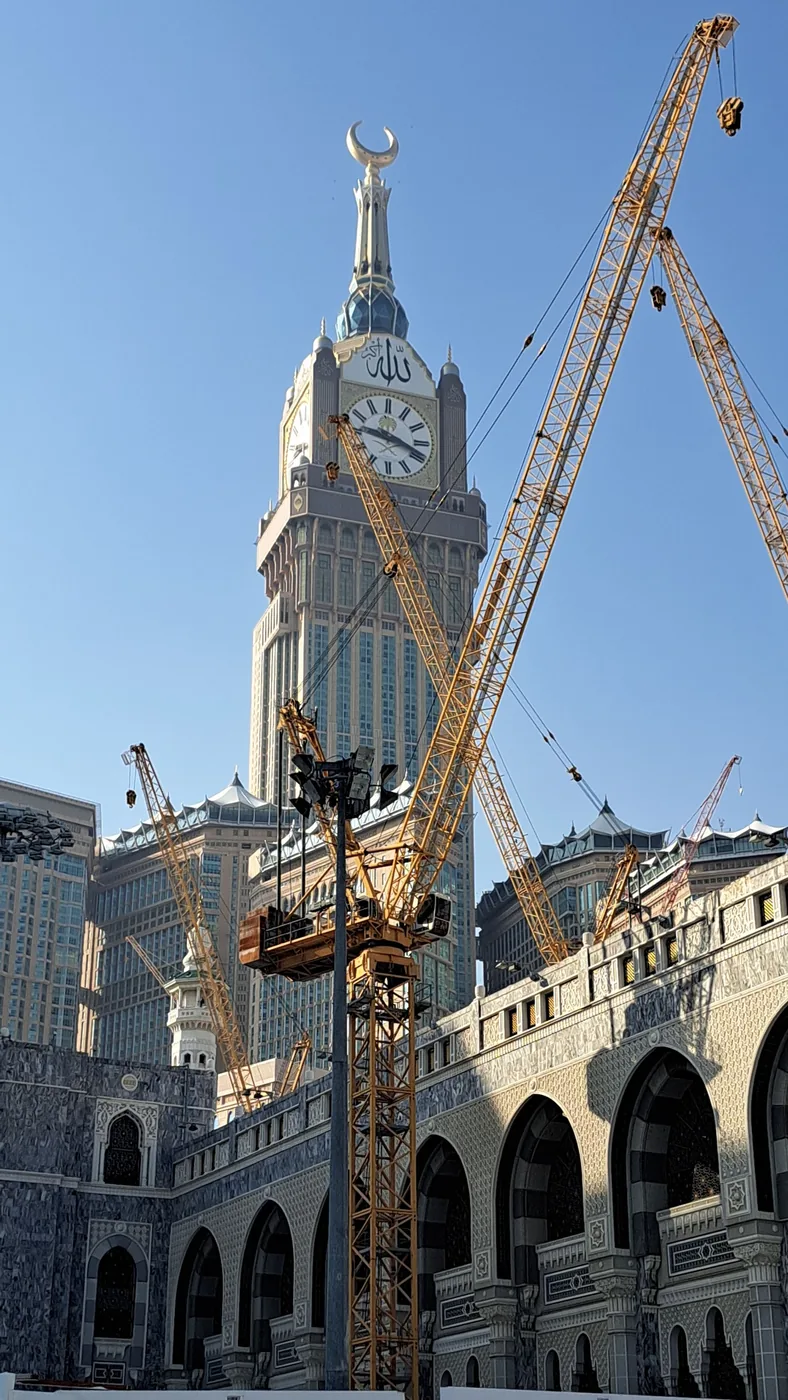
The first principle is working at night. The second is division: a section of the building is closed, rebuilt, reopened, and then the next one is taken. It is never the whole that is under works, always a piece.
One sometimes reads that the work is carried out in complete silence, with no noise liable to disturb the prayer. That claim should be taken for what it is, a form of communication: a civil engineering site of this size is not run without noise. What is verifiable, on the other hand, is the phasing.
The real client is the calendar
There is a constraint that this site shares with almost no other in the world, and it is what explains the division.
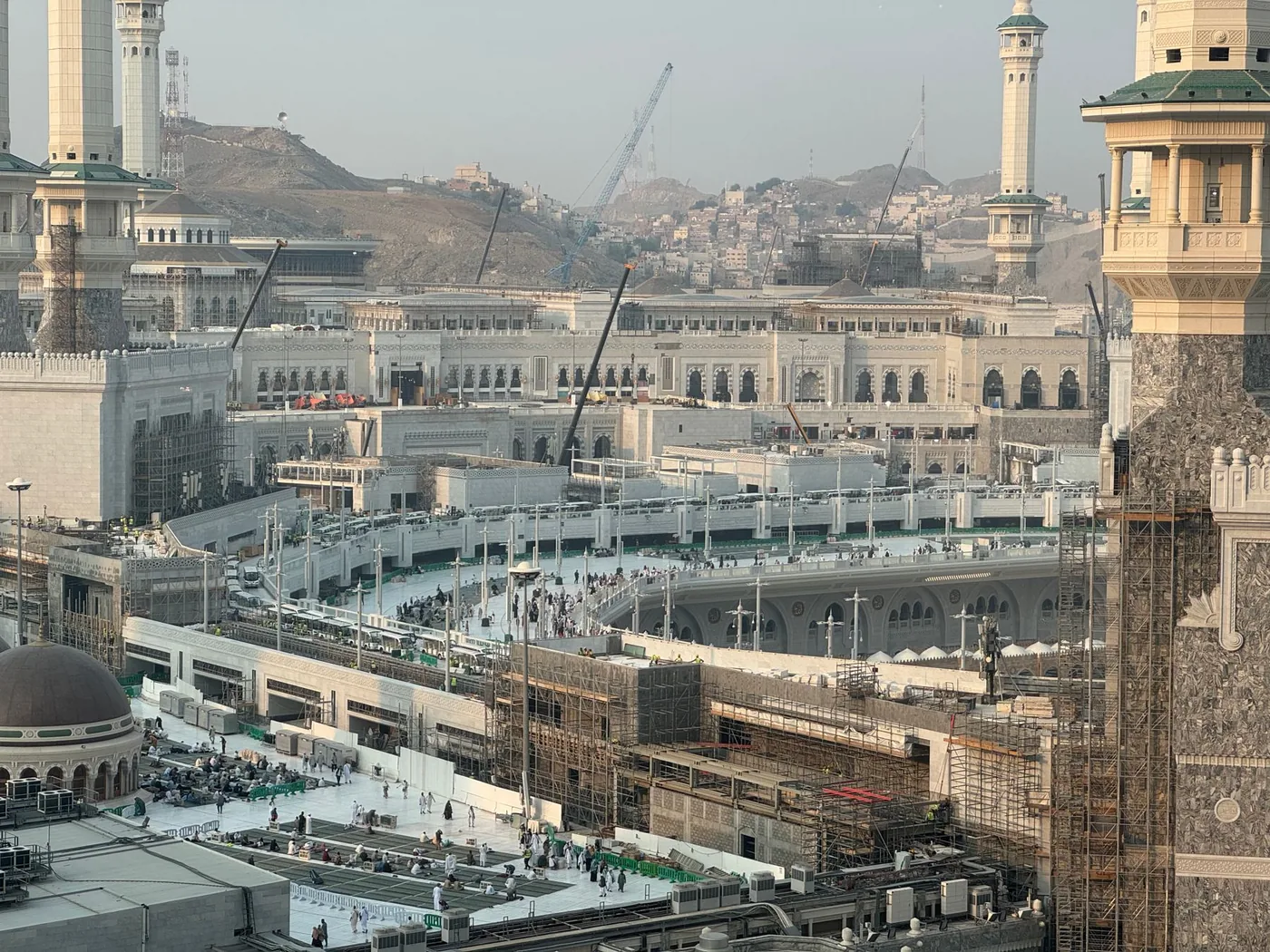
Every year the Hajj comes round. On that date the mosque has to receive the largest recurring human gathering on the planet, and the site has to have vanished: areas handed back, hoardings removed, circulation clear. An ordinary site negotiates its deadlines; this one works to a date that does not move.
The consequence shows in how the works were run. The first phase of the enlargement launched in 2011, covering the ground and first floors, the first and second mezzanines and the northern, southern and western courtyards, was delivered just in time for the Hajj of 2013.
What those works cost
It would be wrong, however, to conclude that the site cost no one anything. The price was paid, and it is public.
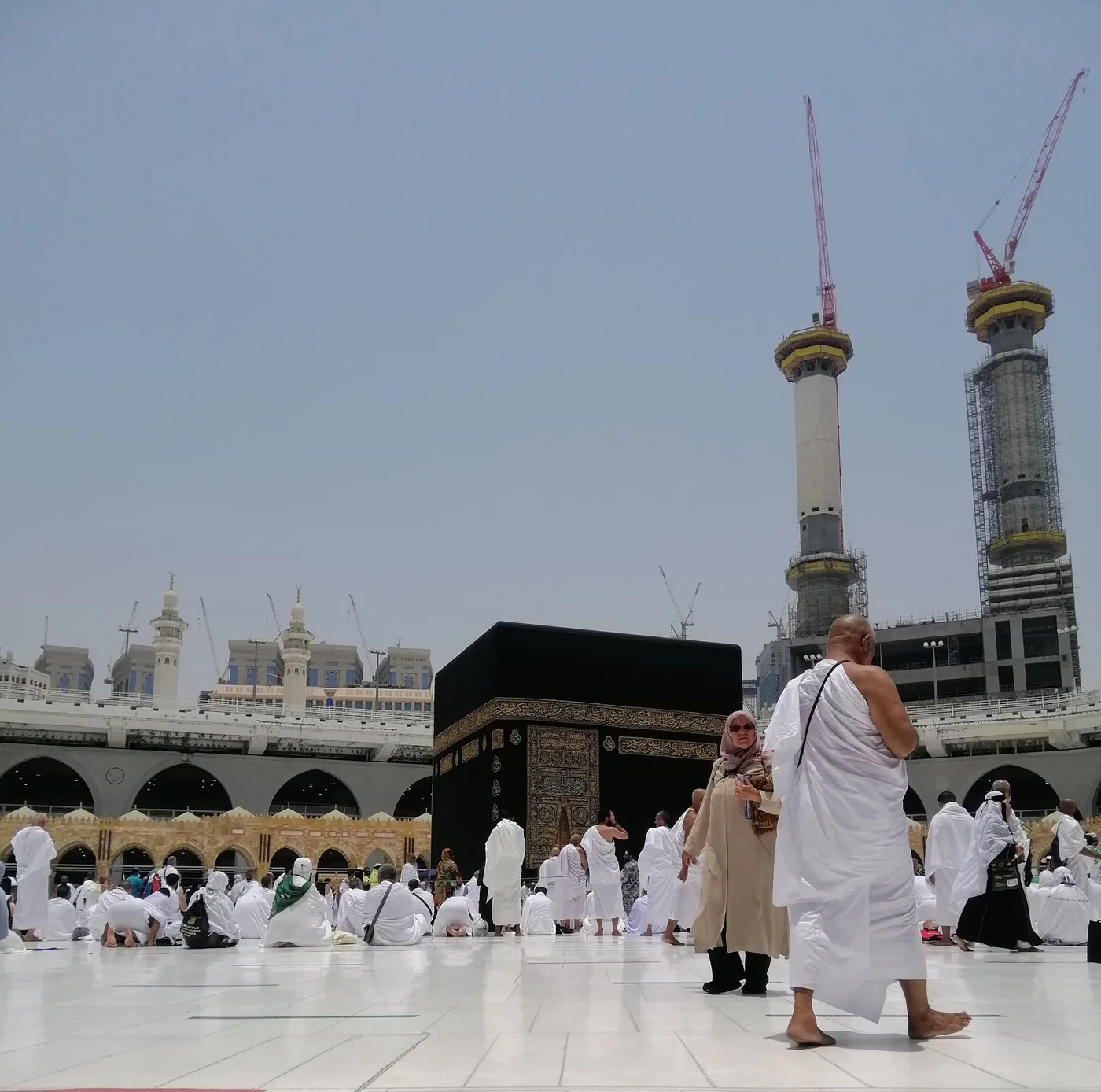
In 2012, three million one hundred and sixty thousand people performed the Hajj. That is the highest total of the decade. The following year there were only one million nine hundred and eighty thousand, the lowest total of that same decade. One million one hundred and eighty thousand fewer people, from one year to the next.
It was not demand that had weakened. It was the quotas that were lowered, explicitly because of the enlargement works: twenty per cent fewer pilgrims from abroad, and half as many for those resident in Saudi Arabia.
Nor was it an isolated year. The ceiling of around two million was kept in 2014 and in 2015, while the works advanced. Three years running.
Set against a population of pilgrims that had been rising for years, that drop is not a statistical accident. It was a decision, taken so that the works could go on at all.
A sentence to be corrected, then
"The building site never interrupted the prayer" remains true. But to describe what happened, the second half of the sentence has to be added.
The site did not interrupt the prayer: it reduced the number of those who could come and perform it here. That is not the same as closing, and it is not nothing either.
What this says about the rest of the series
The previous chapters showed the same mechanism twice. Widening the circling ring is paid for in demolition, since the mosque's own porticoes have to come down. Stacking a floor is paid for on the ground, as the temporary bridge showed, whose supports cut the capacity of the circling by a third for three years.
This chapter adds the third case, and the broadest. Building is paid for in pilgrims who do not come.
In this building, nothing is obtained without being paid for somewhere else. That may be the only rule that holds across the whole sanctuary, and it holds as much for a square metre of paving as for a million people.
Our sources
- On the Hajj totals for 2012 and 2013 and on the lowering of quotas, Saudi pilgrimage statistics and their coverage in the regional press.
- On the phasing of the enlargement launched in 2011 and the delivery of the first phase before the Hajj of 2013, publications devoted to the project.
- On the night closure of March 2020 and the suspension of the umrah, the official announcements of the time.
- On the two previous chapters, see the throughput problem and stacking the levels.
- Photographs: Pexels, free licence.