
Home › Masjid al-Haram › The throughput problem
Masjid al-Haram, chapter 6 · Mecca · 9 min read
The only solution: rings stacked on rings
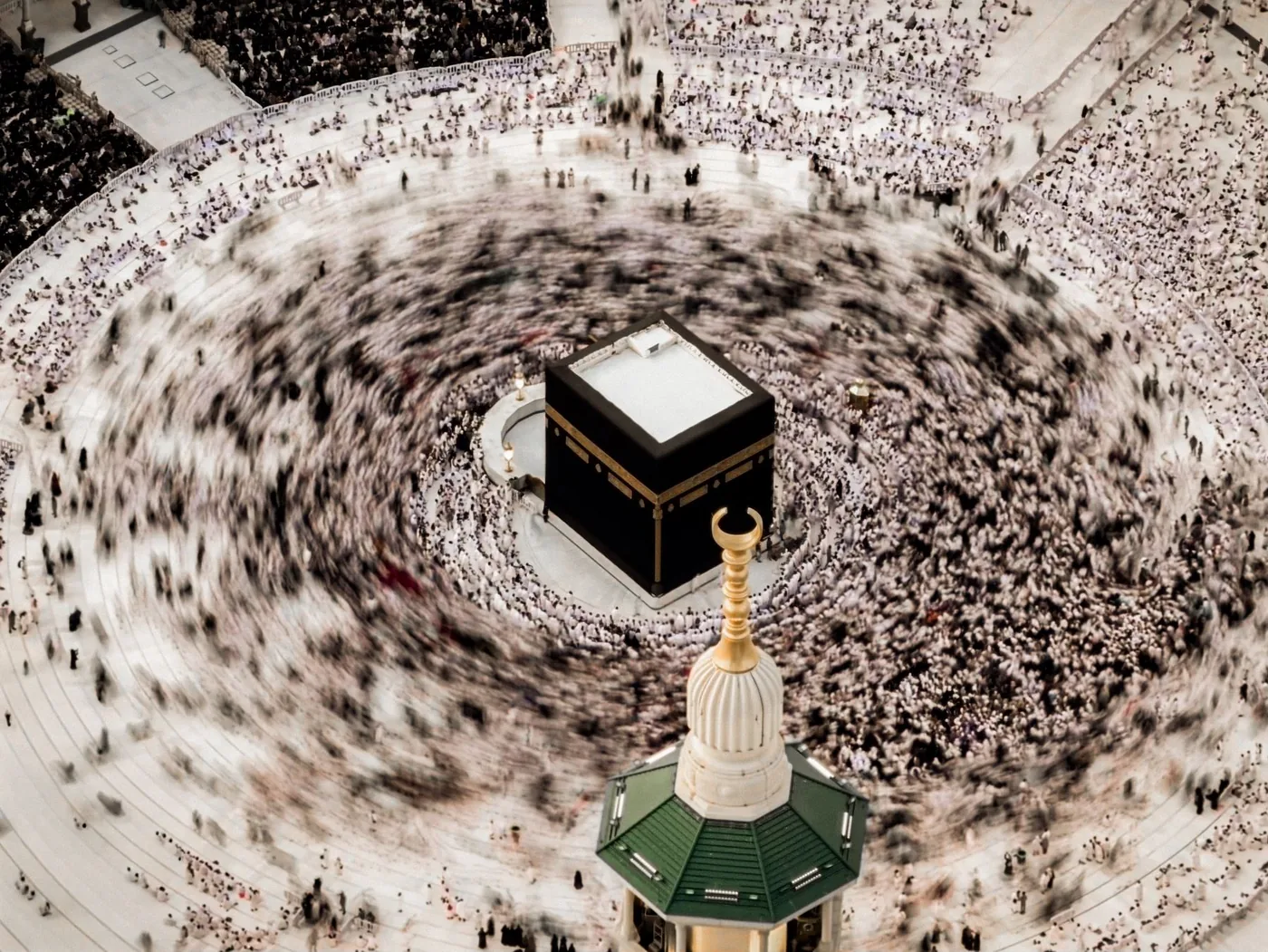
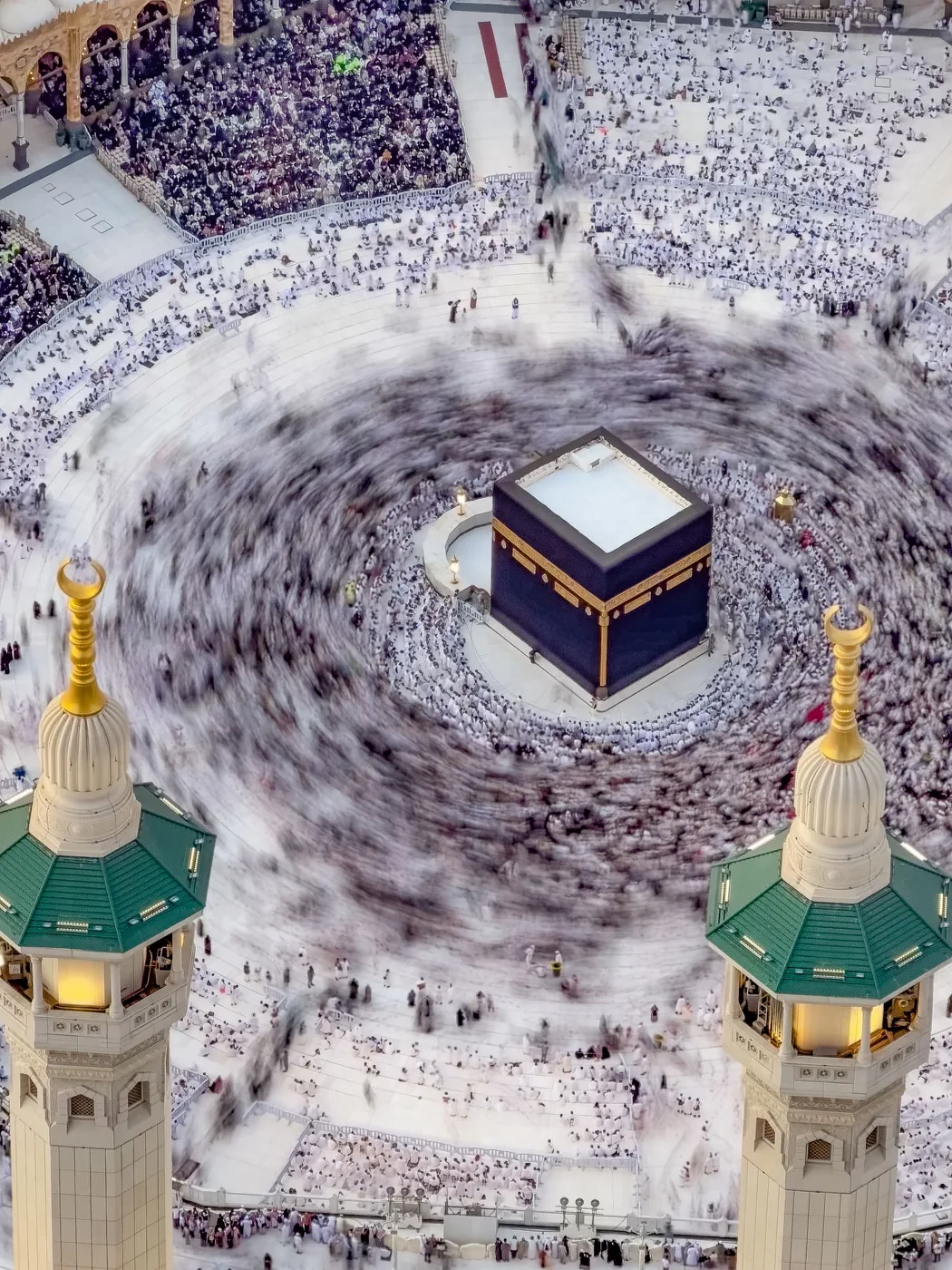
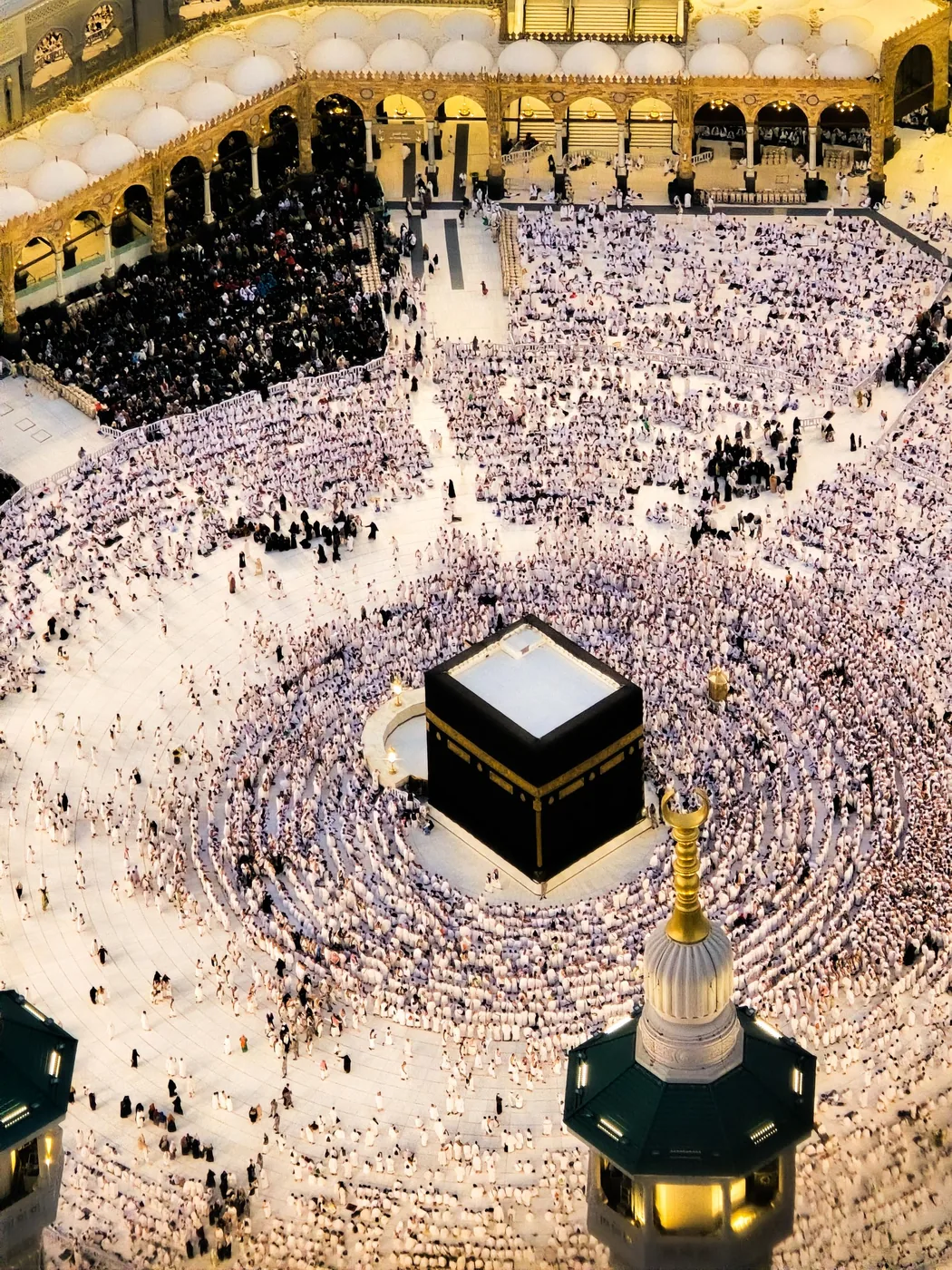
Around the Kaaba, people circle. Seven times, always in the same direction. Millions perform that circuit every year, in a ring that can neither move nor change its centre.
The whole engineering problem of the sanctuary lies in a single question: how many people can circle at once. It is a question of throughput, and it has a mathematical answer that is not the one people expect.
A circuit is not the same length everywhere
The first point is simple, and it can be worked out. The circumference of a circle is two pi times its radius, and the rite calls for seven of them.
Twelve metres from the centre, seven circuits therefore come to about five hundred and twenty-eight metres. At forty-five metres, the same seven circuits come to close to two kilometres, precisely one thousand nine hundred and seventy-nine metres.
At the pace a dense crowd allows, say three kilometres an hour, that is some ten minutes on one side and close to forty minutes on the other. The same rite, at the same moment, takes four times as long depending on where it is performed.
One might conclude that the outer edge is useless
The conclusion seems obvious: if a circuit out wide takes four times as long, then the outer rings must be inefficient, and the sanctuary would do better to concentrate people near the centre.
That is wrong, and the arithmetic shows it.
A ring far from the centre is longer, so it holds more people at any given moment: the number it can accommodate is proportional to its radius. But each of those people takes proportionally longer to complete their seven circuits: the duration is likewise proportional to the radius.
The two effects cancel exactly. Twice as far means twice as many people, and twice as slowly. The ratio between the two does not change.
The real law: throughput depends on width, not radius
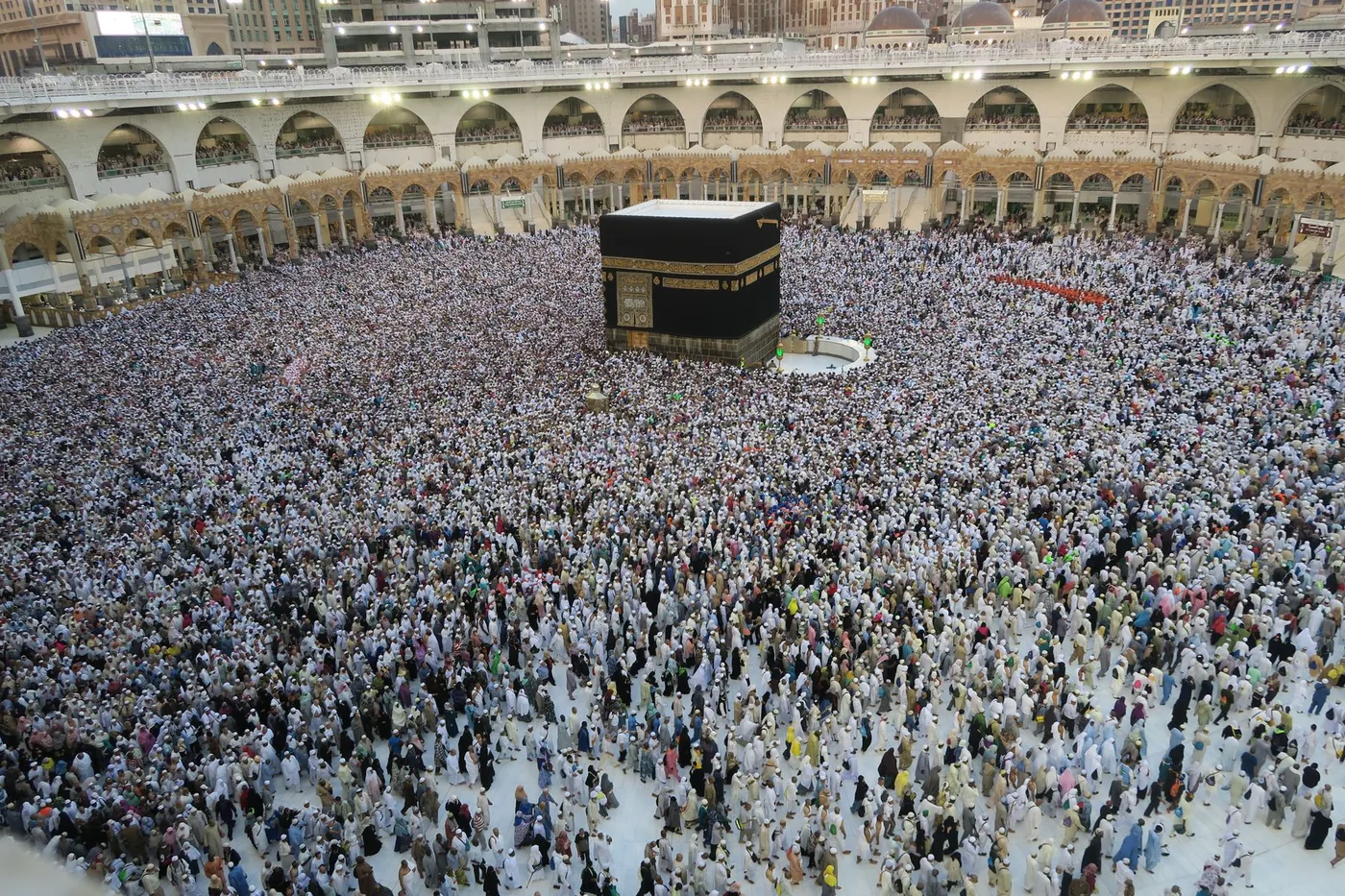
So the result can be stated properly. The number of people a ring passes per hour does not depend on its distance from the centre. It depends only on its width.
A ring ten metres wide passes as many people whether it lies twenty metres or a hundred metres from the centre. What changes is the time each person spends in it, not the throughput of the whole.
That precision matters, because the common formulation, that "it is the perimeter that governs", leads to a misleading conclusion. The perimeter is not the useful parameter. The width is.
The trap: the area does not follow
If throughput depends on width, then doubling throughput requires doubling the width of the ring. That is where the building takes its revenge.
The area of a ring between an inner and an outer radius is pi times the difference of the squares of those two radii. Let us work through two concrete cases.
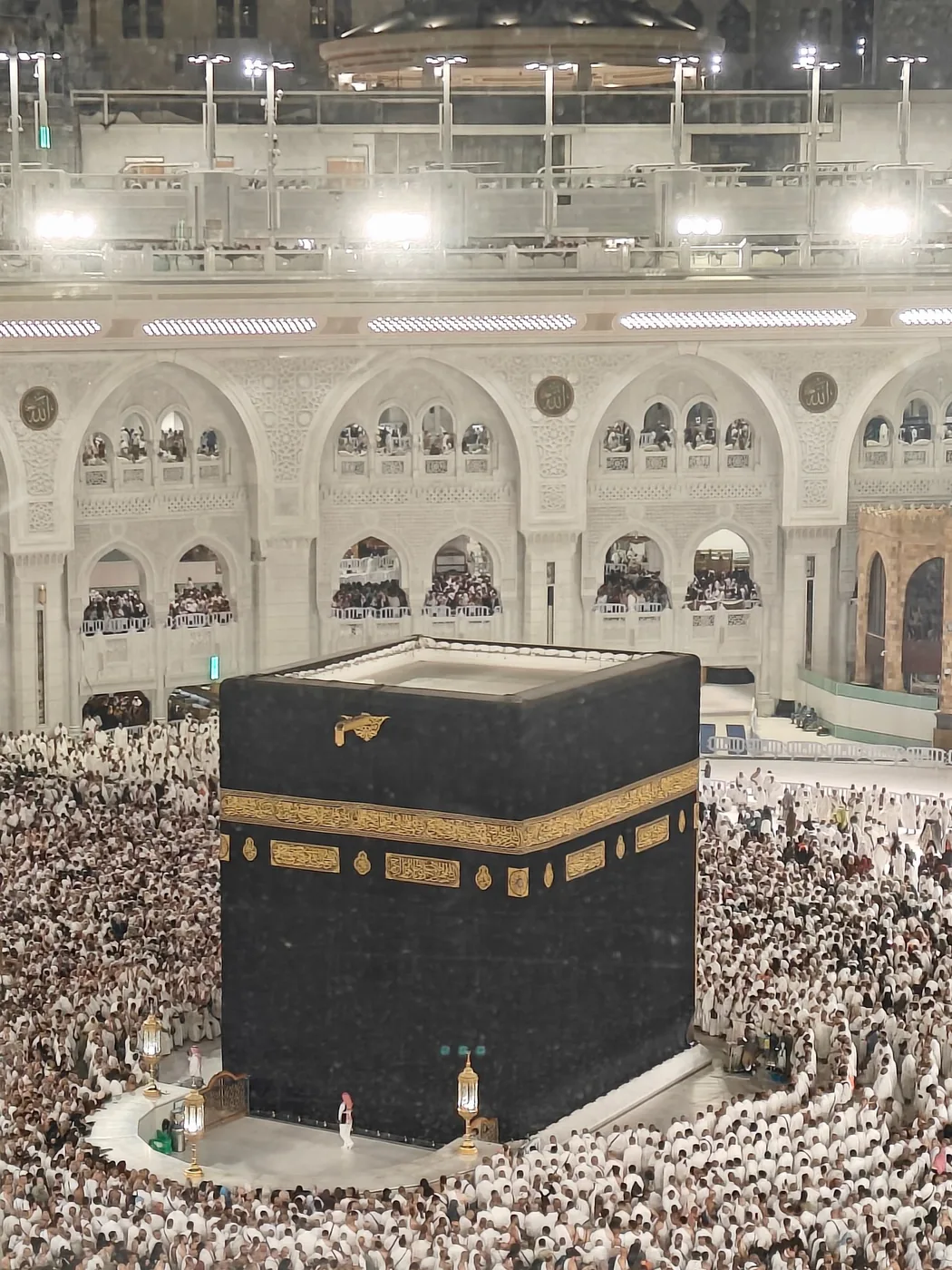
A ring running from twelve to forty-five metres is thirty-three metres wide and covers about five thousand nine hundred square metres. To double its width, its outer edge has to be taken to seventy-eight metres. The width then becomes sixty-six metres, and the area about eighteen thousand seven hundred square metres.
The width has doubled. The area has tripled.
What tripling an area means
That factor of three is not an abstract figure, and the first item of expenditure is not even the construction.
The surface has to be taken from the mosque itself first
The first instinct is to think that this surface is taken from the city. That is true of the enlargement of the mosque as a whole, which has always meant buying houses and pulling them down, and it is the subject of the first chapter of this series. But it is not what happens when the circling ring is widened.
The ring lies at the centre of the mosque, not at its edge. What borders it is not the city: it is the porticoes and galleries of the building itself. To widen it, the mosque has to be demolished before anything else is.
That is exactly what was done in the works launched in 2011. The structure behind the Ottoman portico was pulled down, then rebuilt with a basement, three floors and a roof, entirely free of pillars and reserved for circling alone. The width of the mataf's covering went from about twenty metres to about fifty. The dismantled pieces of the Ottoman portico, which belongs to the oldest parts still standing, were entrusted to a restoration firm with a view to reinstallation.
The figure that sums the operation up is the one for supports. The number of pillars in the mosque was reduced by about forty-four per cent: by thirty per cent on the ground floor and in the basement, and by seventy-five per cent on the first floor. Widening the ring, here, means first removing what stands inside it.
Then it has to be built, and paved
Then comes the construction itself, and the ground, which is not just any ground.
The mataf is open to the sky. Nothing there is air-conditioned, and people walk on it barefoot through summers well above forty degrees. The problem is therefore pushed onto the floor itself. The paving used in the Two Holy Mosques is a white Thassos marble, imported from Greece since the late 1970s. This dolomitic marble has a very high solar reflectance, so that it returns light rather than absorbing it, and a high thermal conductivity, so that it carries downwards whatever heat it does take up. The slabs, about five centimetres thick, are laid over insulating layers and ventilated voids, so that heat stored in the ground does not rise back to the surface. The arrangement has been the subject of published thermophysical studies.
In other words, every square metre added to the circuit is a square metre of that stone, laid on that assembly.
Above all it has to be drained. Chapter three of this series showed that Mecca is built in a valley with the sanctuary at its low point, and that a flood brought down walls of the Kaaba there in 1630. Every additional square metre is one more surface on which water falls and from which it must be carried away.
And it has to be reached. A wider concourse means longer approaches, more stairs, more gates, and a crowd that takes longer to enter and to leave.
The cost is therefore not linear but accelerating, and it accelerates in the one direction the sanctuary is most tempted to take.
Why the sanctuary does not simply spread
The conclusion is a constraint, not a solution. Every metre of width gained costs more than the one before, since the area to be added is proportional to the radius at which it is added. Widening an already wide ring is the worst possible ratio between what is spent and what is gained.
In other words, the only solution is to build rings stacked on rings. The sanctuary cannot solve its throughput problem by spreading, because the cost grows faster than the benefit, and because doing so would mean demolishing ever more of its own structure, before even touching the city.
The next chapter will deal with the only remaining way out, and with what it entails: stacking the levels. A second level set on the same radii adds exactly the same throughput as a doubling of width, without taking up a single extra square metre of ground.
Our sources
- The lengths and areas in this article are calculated, not borrowed: seven circuits at a radius r come to 7 x 2πr, and the area of a ring is π(R² - r²). The radii of 12, 45 and 78 metres correspond to the orders of magnitude of the mataf and its successive extensions.
- On the valley, the low point and the flood of 1630, see chapter 3 of this series.
- On the demolition required by each enlargement, see chapter 1.
- On Thassos marble and its thermal behaviour, the published work on the paving of the Two Holy Mosques, notably Cool white marble pavement thermophysical assessment at Al Masjid Al-Haram.
- Photographs: Pexels, free licence.