
Home › Masjid al-Haram › It was not the stone that was in the way
Masjid al-Haram, chapter 10 · Mecca · 9 min read
It was not the stone that was in the way
At the centre of Mecca, in the space where tens of thousands of people circle at the same time, there is a stone that nobody can move.
It measures about fifty centimetres on a side and carries two hollows on its surface, two footprints. This is the Maqam of Ibrahim (peace be upon him), his station, the place where he stood to build the Kaaba. The hollows were measured in the twentieth century: roughly twenty-seven centimetres long, fourteen wide, and nine to ten centimetres deep. The stone is soft, and that is precisely why its history is a history of wrappings.
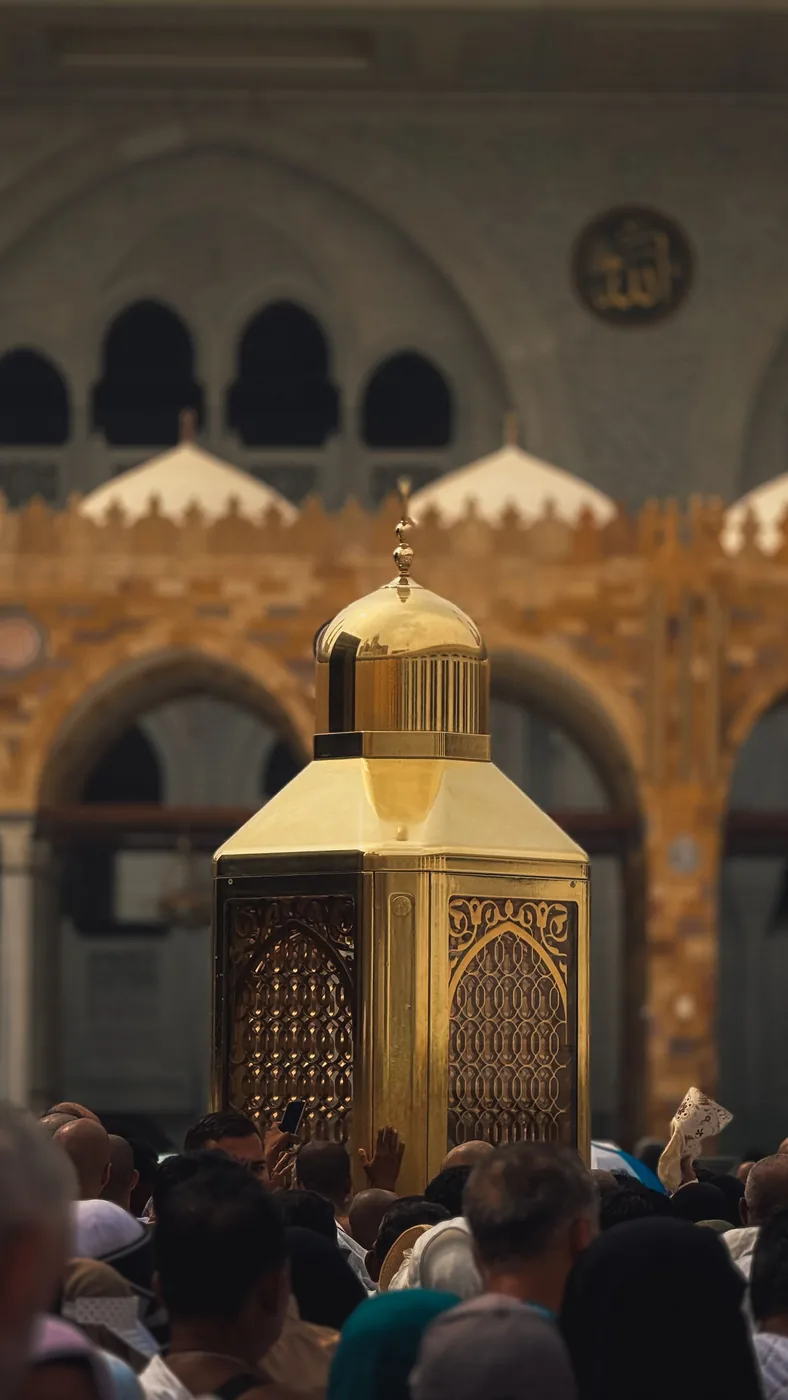
A stone inside the ring
The Maqam stands about ten metres from the eastern wall of the Kaaba, in front of its door. In other words, right inside the narrowest and densest band of the mataf, the space where circling takes place.
This series has described, chapter after chapter, how everything that stood in that band was taken out of it. Pillars, by the hundred. Staircases. Whole buildings, including the one that covered the Zamzam well. The rule is constant and admits no exception: nothing can stand inside the ring.
The Maqam is the exception that is not one. It cannot be removed, and for two reasons that have nothing to do with architecture. It is named in the Qur'an. And it is behind it that two units of prayer are performed after circling. An object that is both cited in the text and built into the rite is not moved to free up space.
The only time it moved
It did move once, and the episode is worth telling because it contains a mechanism.
The early sources report that the stone originally stood against the Kaaba, flush with its wall. Under the caliphate of Umar, a violent flood, the one the chronicles call sayl umm nahshal, swept through Mecca and carried the Maqam out of its place.
What follows is the important part. It was not put back where anyone believed it had been. Someone went to fetch, from the treasury of the Kaaba, a cord whose length recorded the exact distance between the stone and a fixed point of the building. Before the flood, that distance had been measured and the measurement stored. The stone was set back on the mark the cord indicated, slightly further out than before, clear of the path of those circling, so that it would not be trampled by a crowd that was already growing.
This account must be taken for what it is: a chroniclers' account, discussed by some classical scholars, particularly on the question of whether Umar really moved the stone or merely restored an earlier position. The mechanism, however, explains everything that follows. From that moment, the position of the Maqam is no longer a habit, it is a measurement. And a measurement is not negotiable.
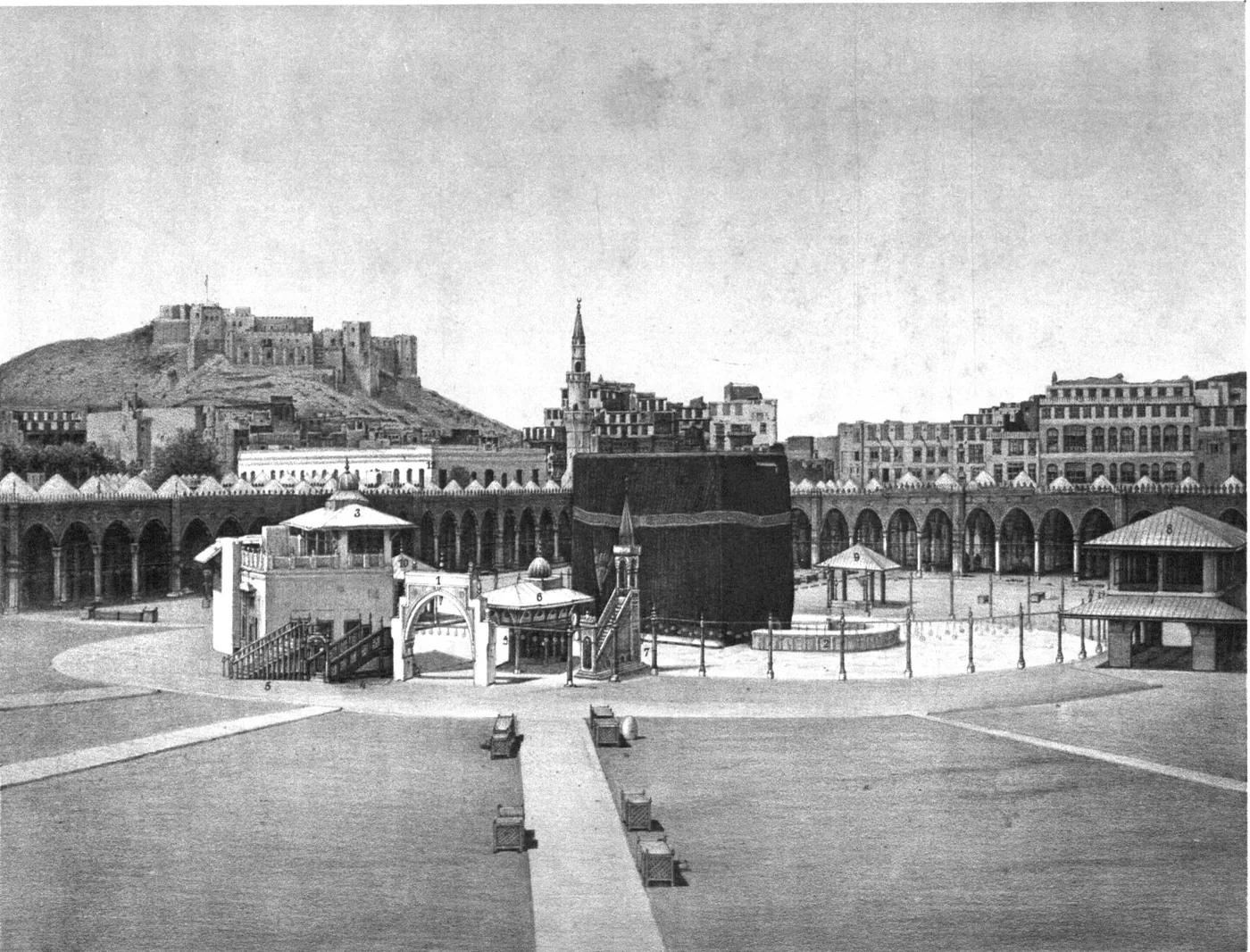
A thousand years of wrappings
With the stone fixed and untouchable, what changed around it was everything that protected it.
The movement starts early. Around 156 of the hijra, the Abbasid caliph al-Mahdi had the stone plated in gold, its soft material being subject to wear. Al-Mutawakkil renewed the decoration in 236. Then came the shelters. In the ninth century, a wooden dome carried on four columns, closed by four iron windows. In 810 of the hijra, an enclosed structure. Under the Ottomans, a domed kiosk, rebuilt again and again from the fifteenth to the eighteenth century.
Each generation protected the stone by taking a little more room. None of those decisions is absurd taken on its own. Their sum eventually became a problem.
By the twentieth century, what stood in the middle of the mataf was no longer a shelter but a timber structure three metres by six. Eighteen square metres, planted in the busiest band of the sanctuary, around an object occupying a quarter of a square metre. The wrapping had become seventy-two times the surface of what it wrapped.
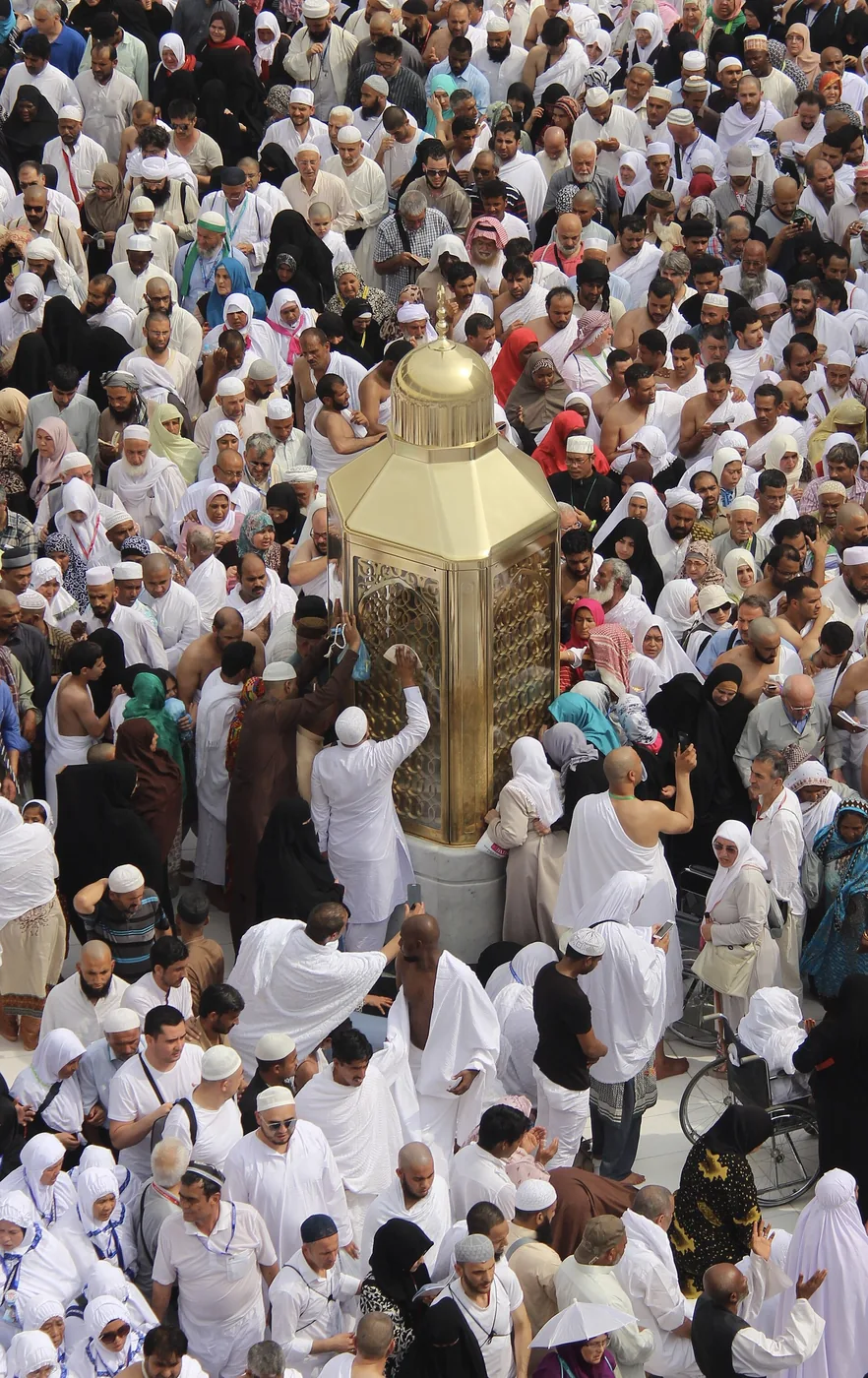
1967, the dismantling
The decision did not come from an engineering office. The constituent council of the Muslim World League took it at its eleventh session, on the twenty-fifth day of the twelfth month of the year 1384 of the hijra, and the reason is stated plainly: to remove the danger of crushing during the pilgrimage season.
It was carried out in Rajab 1387, that is October 1967, and as part of a wider programme. King Faisal had ordered the widening of the mataf and the removal of everything among the buildings that obstructed those circling. The Maqam fell under that general rule, exactly like the rest.
The structure was dismantled. The stone did not move a centimetre. It went under a thick crystal cover, protected by a metal grille, set on a marble base whose dimensions were explicitly capped: one metre eighty by one metre thirty, seventy-five centimetres high. The whole was unveiled by the king himself. In 1996 it was reworked with an inner gold-plated grille, copper, white Carrara marble and green granite.
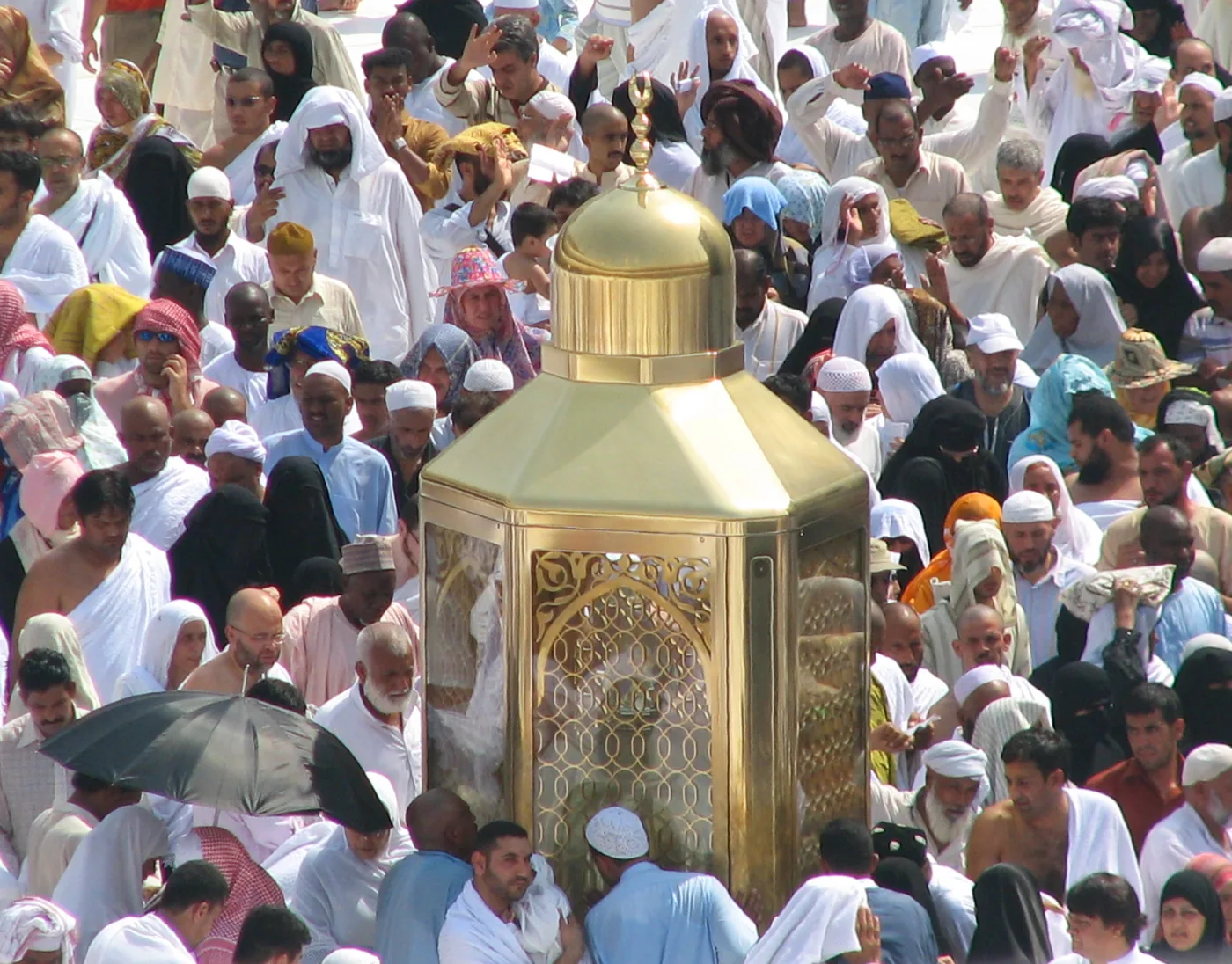
Checking it by arithmetic
Two figures circulate separately in the sources, and neither cites the other. The first describes the pre-1967 structure as three metres by six. The second announces that the operation returned fifteen point six square metres to the mataf.
It is enough to do the sum. Three times six is eighteen. One metre eighty by one metre thirty is two point three four. The difference is fifteen point six six. The two statements, sharing no source, land on the same number: they validate each other.
One point of honesty about the size of the stone. Two measurements coexist. About fifty centimetres on a side in modern descriptions, and among the early authors a block twenty centimetres high whose upper face measures thirty-six centimetres on three of its sides and thirty-eight on the fourth. We have used the larger one, that is, the one that makes the contrast least spectacular. With the early measurement, the ratio would not be seventy-two but more than a hundred and thirty.
Four objects, one law
This chapter closes the series, and states its formula.
Chapter six removes structure: forty-four per cent of the mosque's supports were suppressed, and the rebuilding was done without putting a single one back inside the ring. Chapter seven removes site works: a temporary bridge cost eleven thousand circuits an hour at ground level for as long as its feet were planted there. Chapter nine removes a use: since the Zamzam well could neither be moved nor replaced, its access was suppressed and its function displaced five kilometres away.
This one removes nothing at all, because there was nothing to remove. The object was not in the way, and never had been: it occupies a quarter of a square metre. What was in the way was the accumulation of a thousand years of well-meant protection around it.
It was not the stone that was in the way. It was what had been built around it.
Our sources
On the dimensions of the stone and its hollows, the early records of Ibn Rusta and those of Muhammad Tahir al-Kurdi, together with the descriptions published by the Saudi authorities.
On the gold plating by al-Mahdi and al-Mutawakkil, on the successive domes and on the Ottoman kiosk, the chronologies of the sanctuary.
On the decision of 1384 of the hijra and its execution in Rajab 1387, the records of the Muslim World League and the Saudi reference press.
On the flood and the treasury cord, the early chronicles of Mecca, reported with the usual reservations.
Photographs: Pexels and Wikimedia Commons.