
Home › Masjid al-Haram › Zamzam, erased from the ring
Masjid al-Haram, chapter 9 · Mecca · 9 min read
Nothing can stand in the ring, not even Zamzam
Mecca is built in a dry valley. There is no river, and in such a place a water point is not an amenity: it is what allows a settlement to hold.
Twenty-one metres east of the Kaaba lies a well some thirty metres deep, the well of Zamzam, whose water is drunk by everyone who comes to the sanctuary.
But twenty-one metres is squarely inside the ring where the circling is done. And in this building, anything standing in the ring eventually leaves it.
1964: the building goes
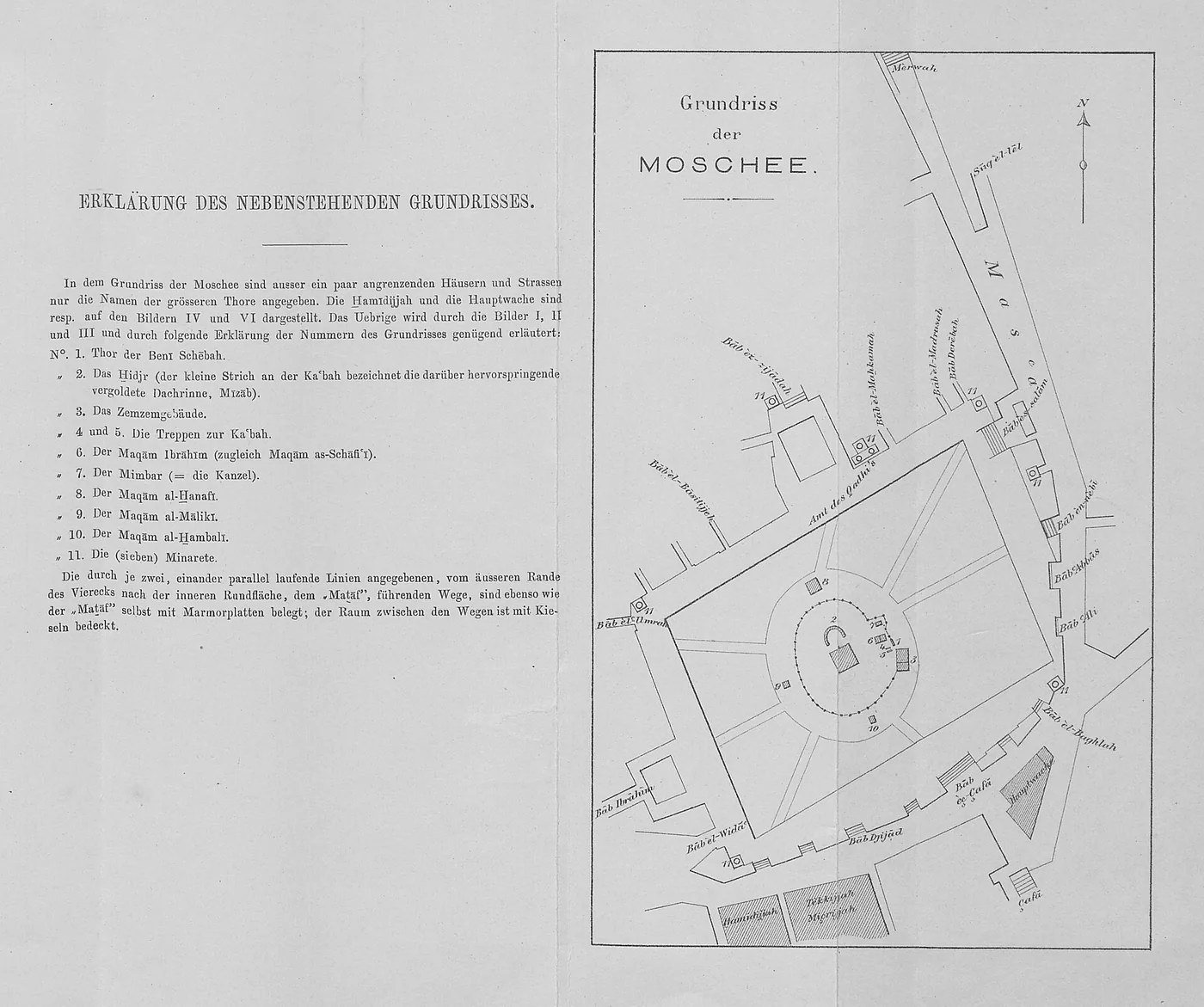
For centuries a structure covered the well, in the middle of the courtyard. It appears on the old plans of the sanctuary and on photographs from the nineteenth and early twentieth centuries: a free-standing building, with its wellhead protected, planted in the very middle of the space where people circle.
In 1964 it was demolished. The reason is no mystery: the mataf had to be widened to absorb a number of pilgrims rising year on year, and this building occupied a significant share of the useful band.
The well itself cannot move. The solution adopted was therefore to take it down: its mouth was lowered into a basement dug less than three metres below the paving, reached by a staircase.
2003: the staircase goes in its turn
The problem had only been displaced, and it took forty years to pose itself again in the same terms.
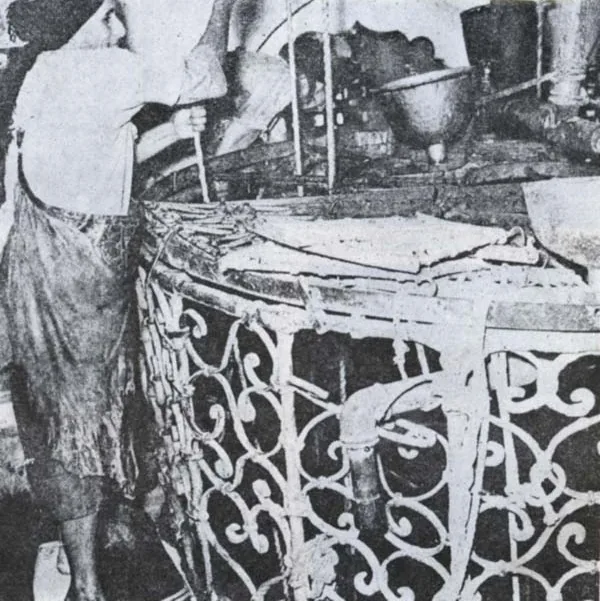
The staircase down to the basement also came out in the ring. An open shaft in the middle of a space where tens of thousands of people are circling at once is both a loss of surface and a point of friction in the flow.
In 1424 of the Hijri calendar, that is 2003, the basement was closed and sealed, the entrances removed, and the fountains moved to the sides of the mataf to allow a further widening.
Today the well is still twenty-one metres from the Kaaba, and no one can reach it. Pilgrims walk over the paving that covers it without seeing anything of it. There is no marking on the ground.
The water still comes out
That is the second half of the story, and it is purely logistical.
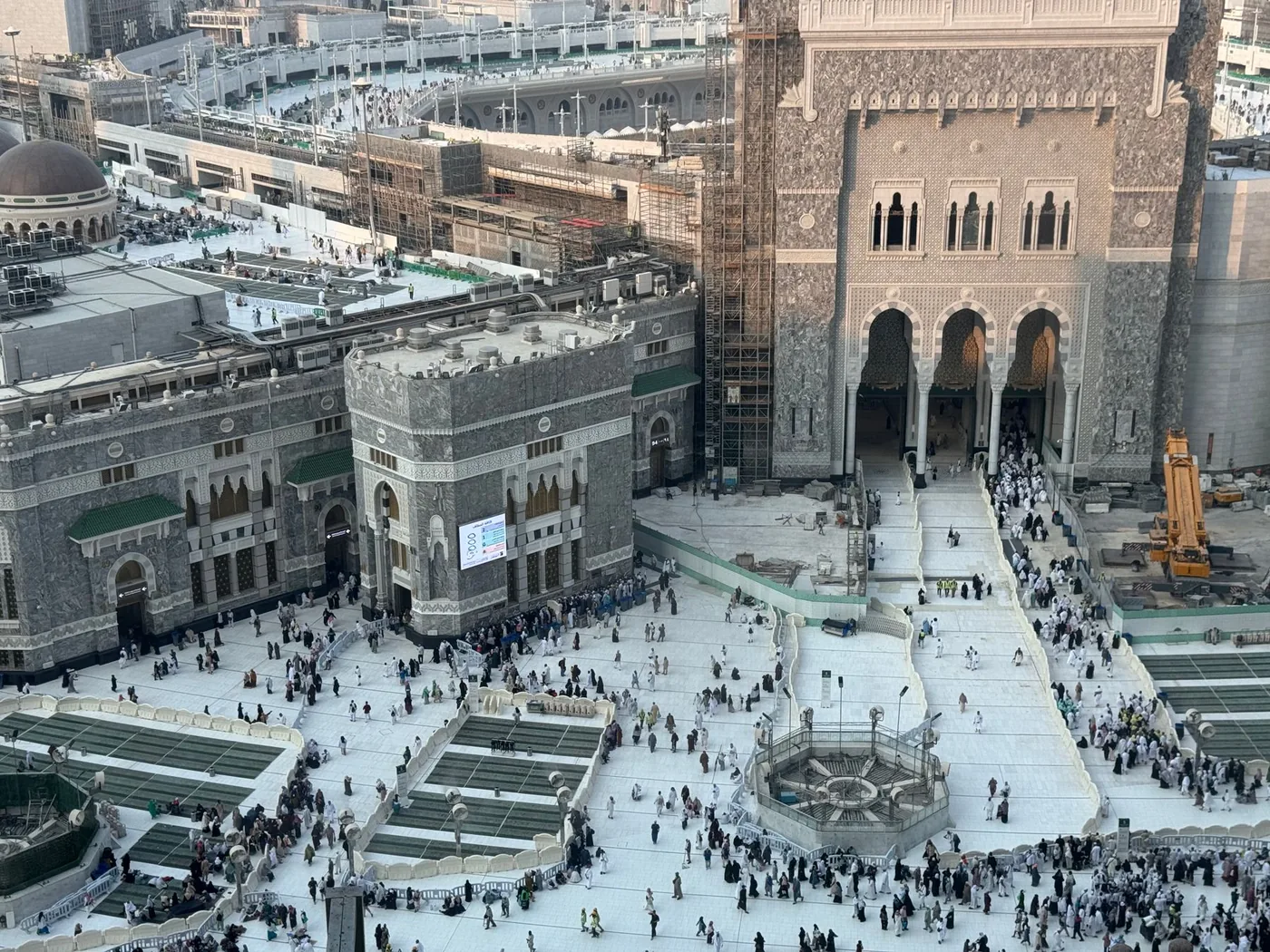
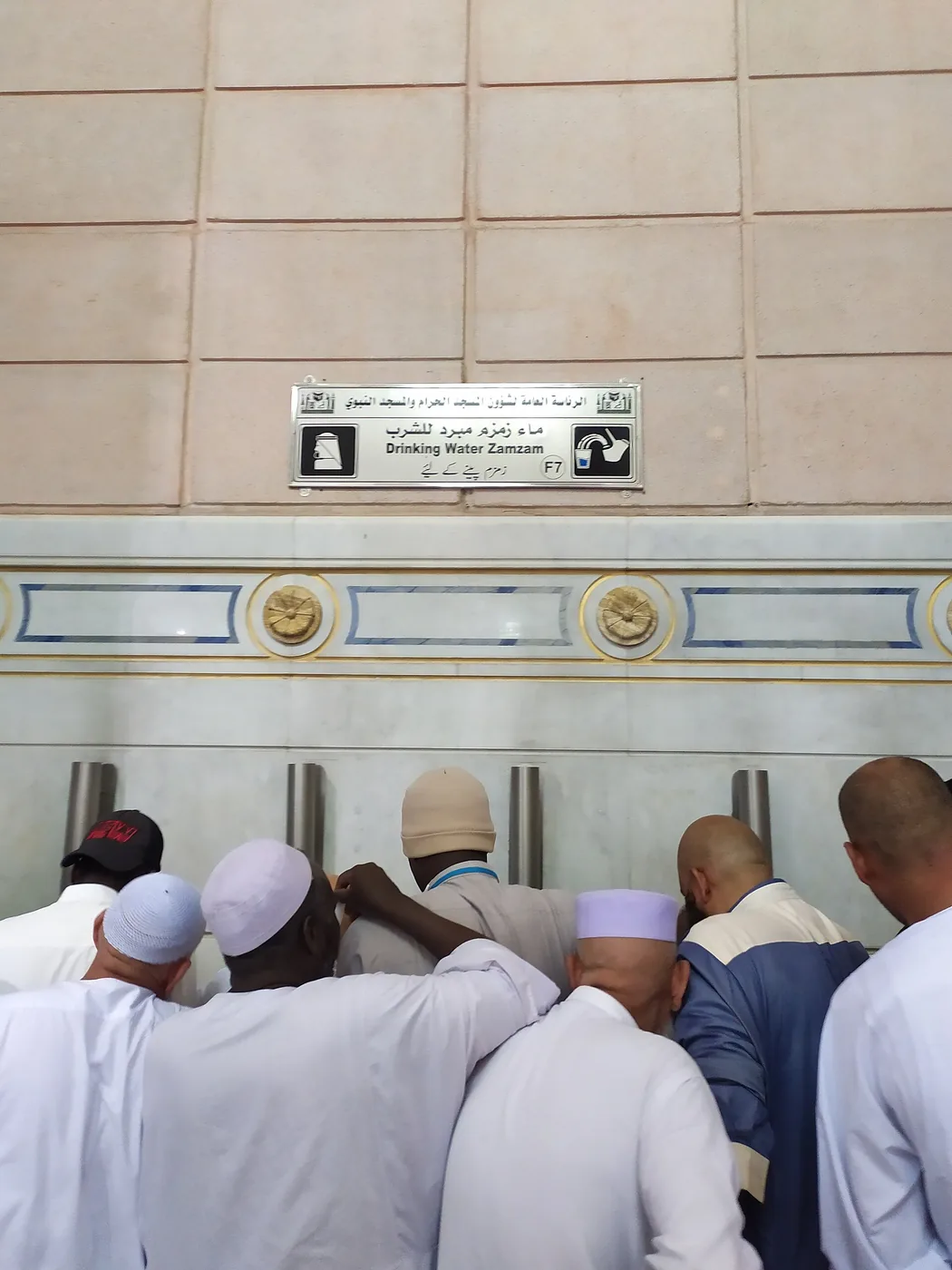
The water is pumped from the sealed well, then carried five kilometres south, where it is filtered, treated and bottled before returning to the sanctuary. There it is distributed by fountains and dispensers throughout the building, and by chilled containers placed in the halls and galleries.
The volumes give the measure of the operation: of the order of nine hundred and fifty thousand litres a day in normal times, and up to one million six hundred thousand litres a day at peak periods.
In other words, the use was not suppressed, it was relocated. What occupied the centre now occupies the periphery, and the water's journey has been lengthened by five kilometres so that the circling could gain a few square metres.
A well that does not suffice alone, and does not have to
One last point deserves setting out, because it explains why the treatment plant and the reservoirs exist at all.
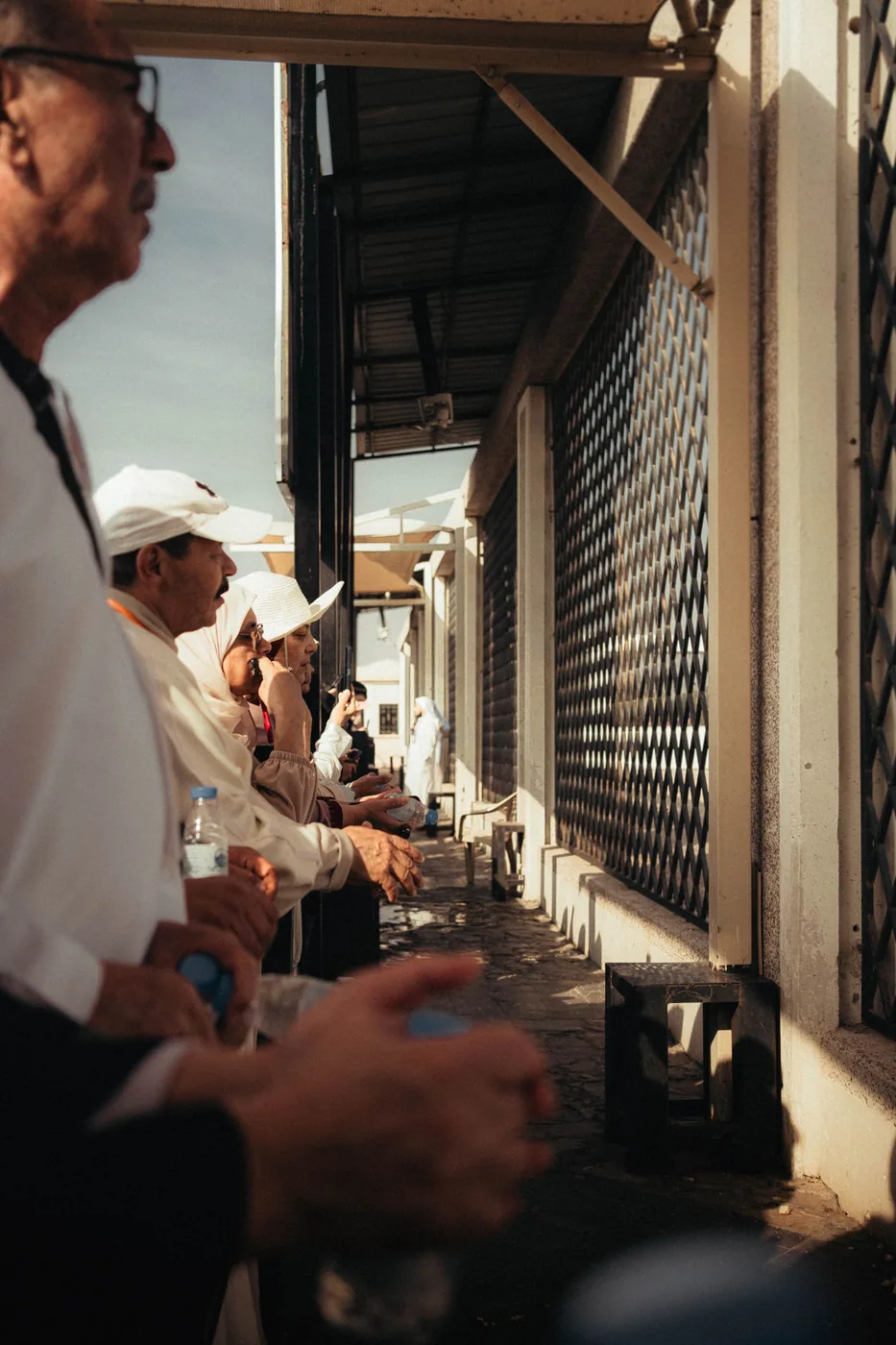
In normal times the well supplies about nine hundred and fifty thousand litres a day, against a consumption of the order of seven hundred thousand. The surplus is some two hundred and fifty thousand litres daily. At peak periods the ratio reverses: supply rises to one million six hundred thousand litres, but consumption can reach two million. Close to four hundred thousand litres a day are then missing.
The system therefore does not hold by the well's flow, it holds by storage. The treatment site south of the city has a reservoir of ten thousand cubic metres, that is ten million litres. At four hundred thousand litres of daily shortfall, that reserve alone covers a peak of several weeks.
In other words, the surplus of ordinary days is accumulated to pay for the peak days. That is exactly the logic of a buffer, and it is the same as the rest of the sanctuary's: you do not size for the peak, you absorb it.
Twenty-five days of shortfall, on that reserve alone. The buffer is not a convenience: it is what allows a single well, of fixed and modest yield, to serve a gathering whose size varies by a factor of three across the year.
Three objects, one law
This chapter is the third in a run that shows the same mechanism applied to objects of different natures.
Chapter six removes pillars, that is structure: forty-four per cent of the mosque's supports were taken out, and the rebuilding was done without putting a single one back in the ring. Chapter seven removes temporary supports, that is construction: a two-level bridge cost eleven thousand circuits an hour on the ground for as long as its legs stood there.
This one removes a use. The well could neither move nor be replaced, so it was the access that was suppressed, and the function carried five kilometres away.
In all three cases the rule is the same, and it admits no exception: nothing can stand in the ring.
The next chapter, and the last, applies the same law to an object that could neither be moved nor replaced: the Maqam of Ibrahim (peace be upon him), of which only the wrapping shrank.
Our sources
- On the position and depth of the well, on the flow rates and on the treatment circuit, data published by the Saudi authorities and its coverage in the press.
- On the demolition of 1964 and the closure of 2003, chronologies of the sanctuary and photographic archives.
- On the old plans of the sanctuary showing the structure in the middle of the courtyard, nineteenth-century surveys.
- On the two chapters cited, see the throughput problem and stacking the levels.
- Photographs: Pexels and Wikimedia Commons.