
The series
Masjid an-Nabawi, what grew around a fixed point
The Prophet's Mosque began at a thousand and fifty square metres, in mud brick and palm trunks. It now passes a million. Six chapters on what changed, on what never moved, and on what the sources do not allow us to claim.
What this series is about
It follows a building that cannot be moved. Everything else follows from that: growth in rings, the asymmetry of the present plan, the replacement of the original materials, and even the contemporary devices that manufacture usable area where the sun was taking it away.
Three chapters can be photographed and three rest on reconstruction, because their subject has disappeared or was never photographed. In those cases the figure is announced as a reconstruction throughout, and we say what the sources do not establish.
Where our series on Masjid al-Haram follows the same constraint on another site, this one attends to material: what the building is made of, and what has been replaced.
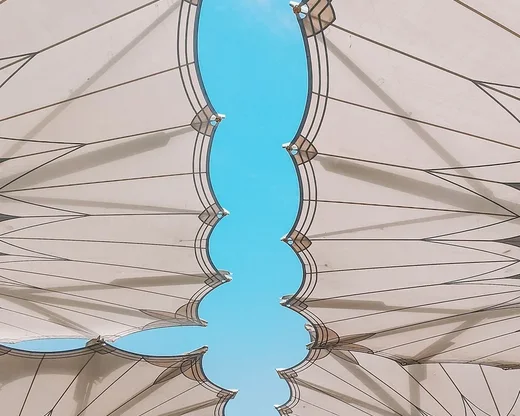
Forty tonnes, and it opens in three minutes
One courtyard umbrella weighs forty tonnes and takes a hundred and eighty seconds to open. And it goes down as it opens. Every figure comes from the designer, including the one it does not give.
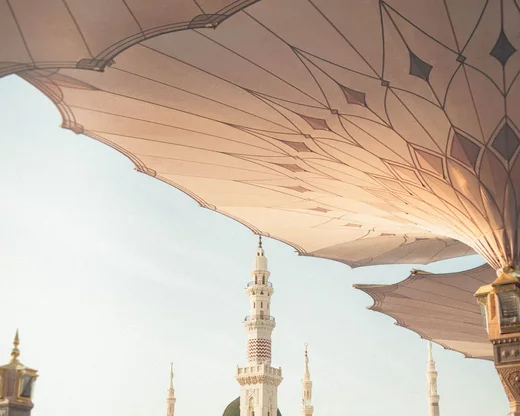
A huge building, and a centre that has not moved since 622
A thousand and fifty square metres at the start, over a million today. At every enlargement they add all around, because there is one point that does not move.
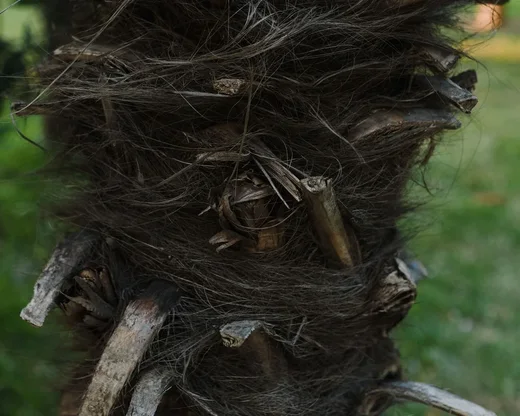
The first version was palm trunks
In 622 the mosque fits in a thirty-metre square: mud brick on a stone base, a frond roof carried on trunks, three metres sixty above the ground.
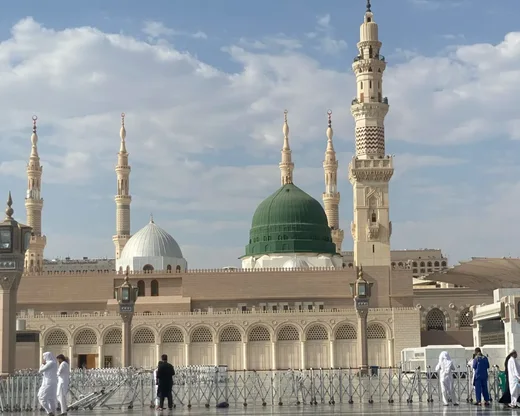
The dome has only been green since 1837
The dome turned green two years before photography was invented. That is exactly why no image of the earlier state exists.
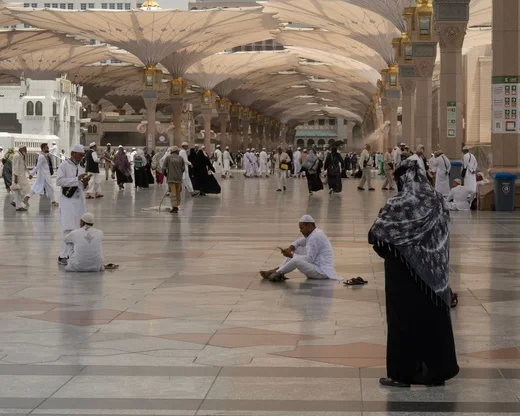
The ground does not burn, and it is not a miracle
Thassos marble reflects 85 % of the radiation and conducts downwards twice as well as ordinary marble. Two measured properties, and a widespread explanation we set aside.
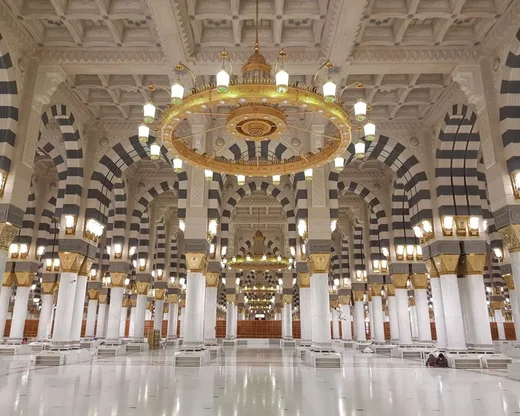
A mosque was not only for prayer
People prayed there, but they also slept there, were taught there, received delegations there and settled disputes there. One enclosure, because there was nothing else. Then each function left.
A note on method
Each chapter states its sources and, where relevant, what it declines to claim: an explanation set aside for want of technical literature, a number that is a witness account rather than a census, an orientation the sources do not allow us to settle. These reservations are not footnote caution, they are part of the subject.