
Home › Masjid an-Nabawi › Forty tonnes, and it opens in three minutes
Masjid an-Nabawi, chapter 1 · Medina · 8 min read
Forty tonnes, and it opens in three minutes
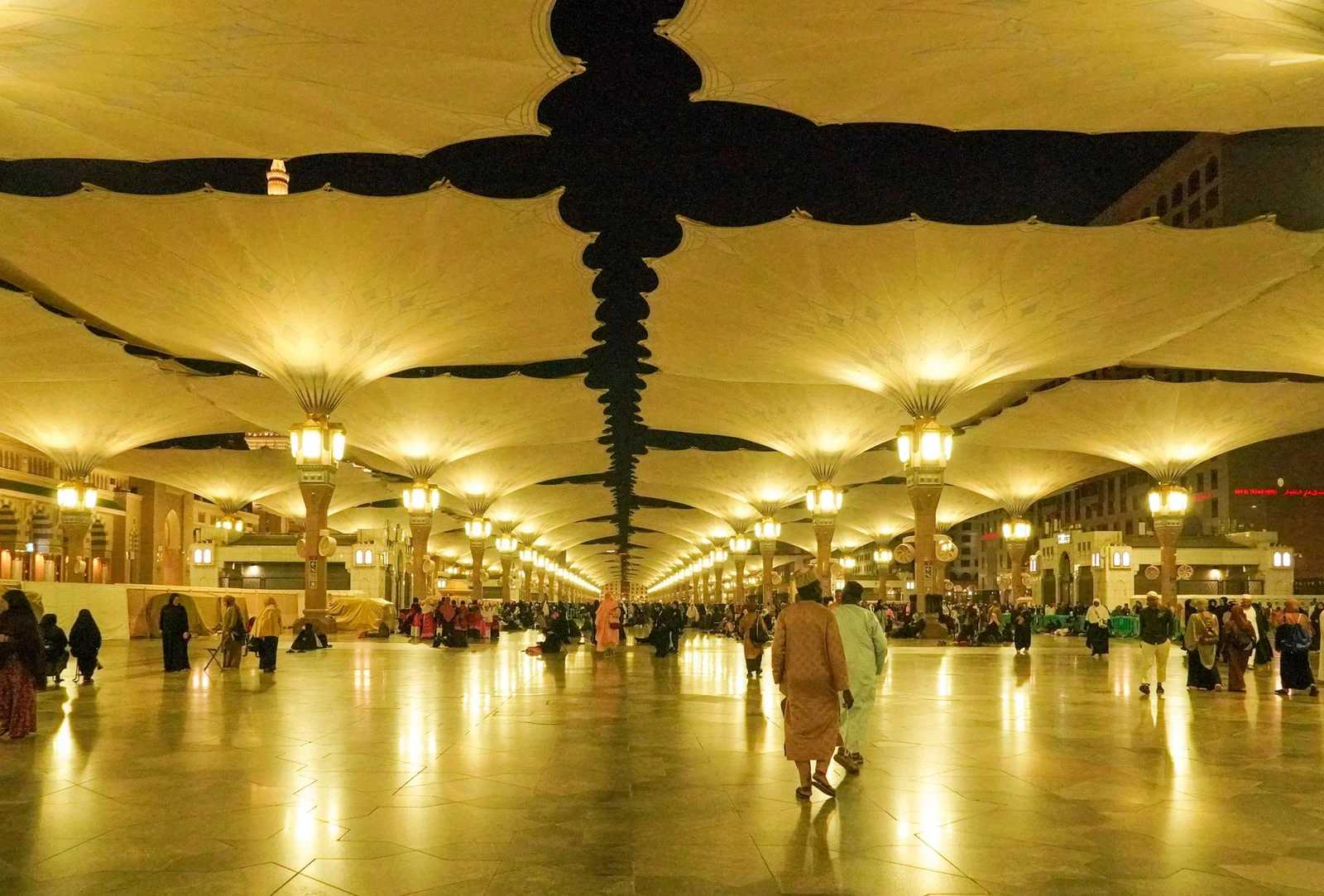
On the courtyards of the Prophet's Mosque at Medina, giant umbrellas open every morning. One of them weighs forty tonnes and takes a hundred and eighty seconds to deploy. And as it opens, it goes down. That is the first counter-intuitive fact in this series, and it is not a detail: it explains the rest.
What you see, and what you do not
The first thing an early visitor sees on the courtyard is a row of white trunks. Those are the folded umbrellas. At that point they resemble nothing familiar: not trees, not columns, not masts. They are narrow spindles, very tall, their ribs gathered along a central mast.
Then they open. The fabric unfolds together with the frame, and the silhouette changes completely in three minutes. What was a vertical object becomes a horizontal one.
The thing you do not see is that the whole assembly has come down.
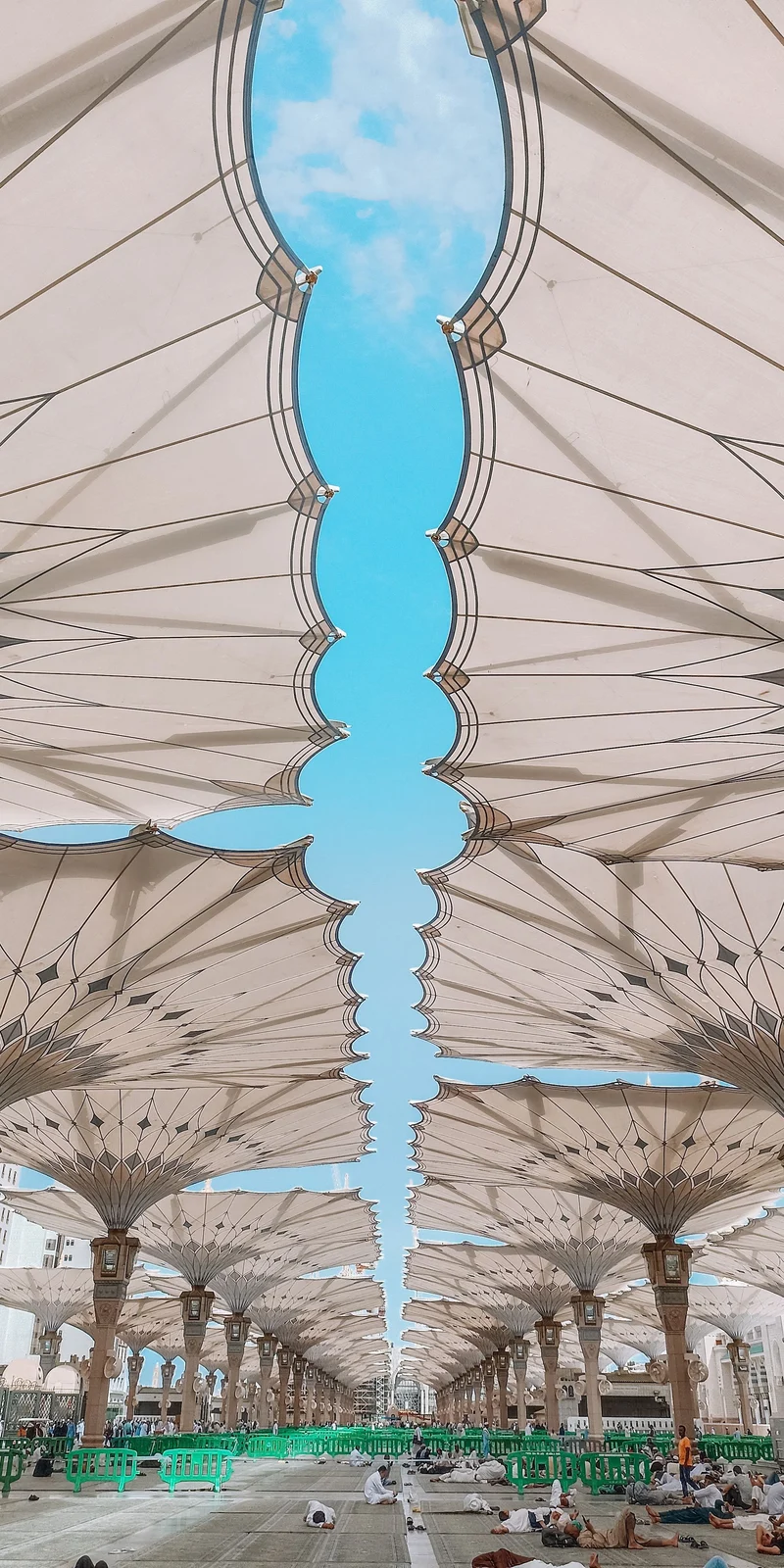
An umbrella that opens goes down
The figures come from the designer's own project sheet: the German practice SL Rasch, specialists in lightweight structures, under the name Madinah Piazza Shading Project. No figure in this article is second-hand.
Folded, an umbrella stands 21.7 metres tall. Deployed, it comes back down to 14.4 metres, or 15.3 depending on the model.
This is worth pausing on, because it is the opposite of what intuition suggests. An ordinary umbrella does not change height when you open it, it widens. Here the object loses seven metres by opening.
The reason lies in the mechanism. The fabric does not cover a fixed frame. It is carried by folding arms, and those arms, as they unfold outwards, draw the top downwards. When the umbrella closes, the reverse happens: the arms travel back up the mast, and the fabric stows inside the spindle rather than hanging around it.
That last point is what matters for the life of the structure. A membrane left permanently exposed ages fast. A membrane that retreats into its own mast is shielded from the sun for every hour it is not in use.
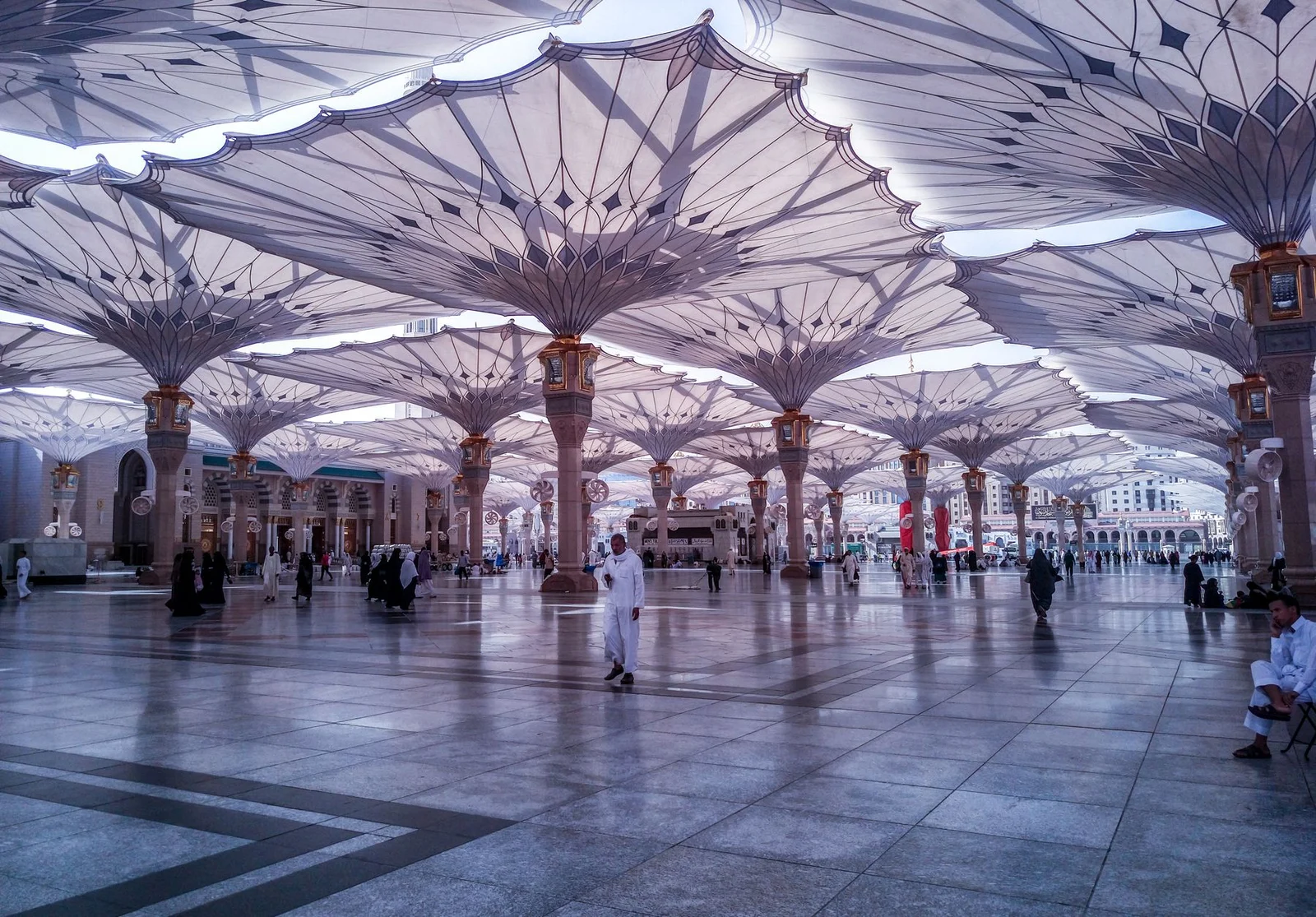
What shade actually makes
Each umbrella casts six hundred square metres of shade. The scheme as a whole covers a hundred and fifty thousand, under which the courtyard can hold up to two hundred and fifty thousand people. It was completed in 2011.
You could read those numbers as comfort. That would miss the point.
At Medina in summer the air runs well past forty degrees, and the courtyard is crossed barefoot. Bare ground in full sun becomes impossible to walk on. Not unpleasant: impossible. A courtyard without shade is therefore a courtyard nobody can occupy during the hot hours.
In other words, these forty tonnes are not making decoration. They are making room. Shade here is usable floor area, in the same sense as paving or a staircase, and that is why it belongs to engineering rather than to ornament.
It also explains why the subject returns elsewhere in this series. The choice of stone for the ground answers the same problem by another means, and has a chapter of its own.
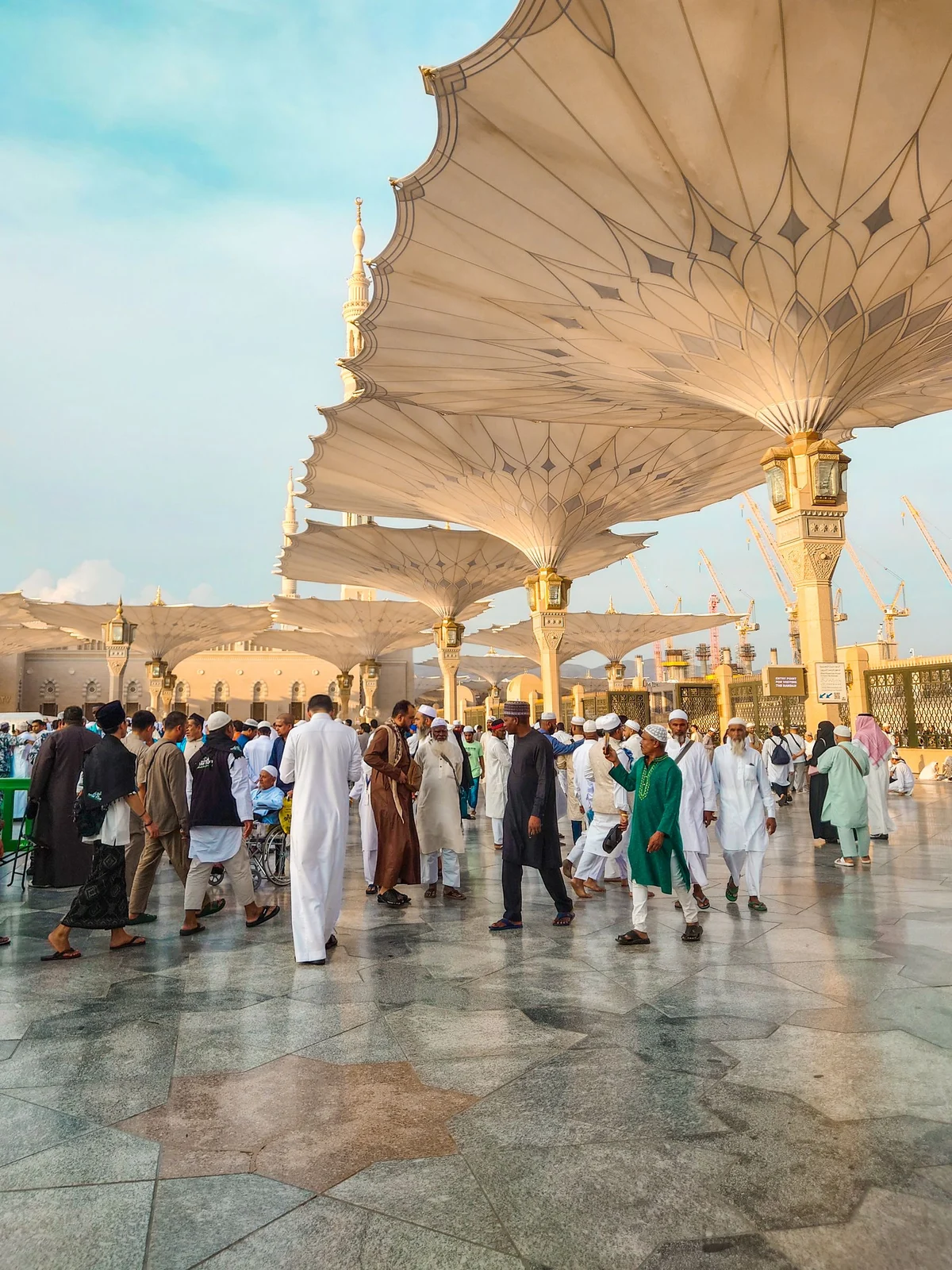
How many are there? The designer does not say
Here is the point where honesty is instructive.
The figure of 250 umbrellas is very widely repeated. It is consistent: a hundred and fifty thousand divided by six hundred does give two hundred and fifty. But that is exactly the problem. It is not an observed figure, it is a division, performed by third parties from two published numbers and then republished as though it came from the source.
The designer gives no total. It gives something else: the umbrellas are installed in groups of two to fifteen units, according to the geometry of the space being covered.
So we stay with what the source says. Saying what a source does not say is information, and often the most useful kind: it marks where the verified part stops.
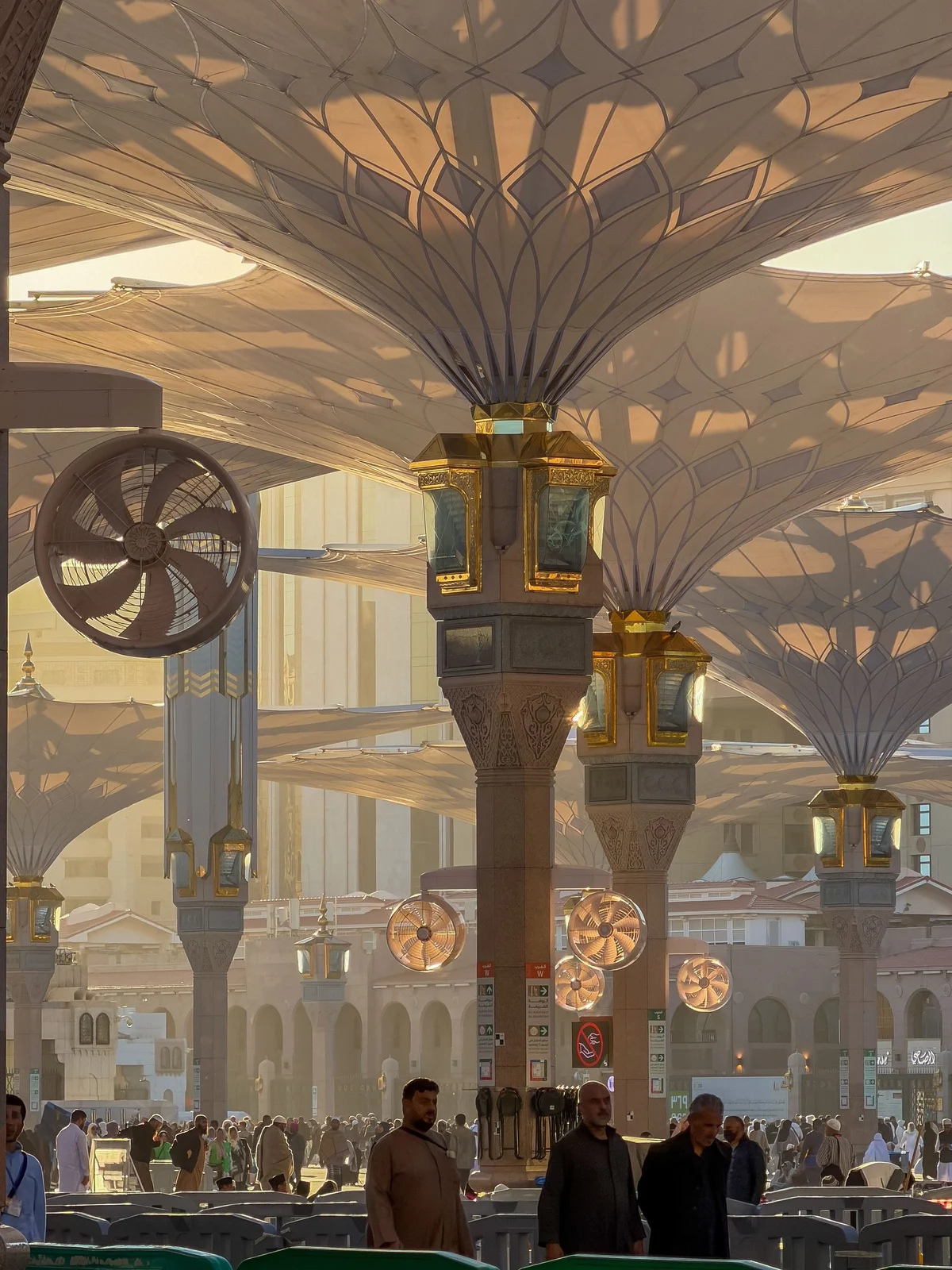
Why this rather than a roof
The question is fair: why not cover the space once and for all?
Because a permanently covered courtyard is no longer a courtyard. It becomes a hall. These surfaces serve both prayer and circulation; they have to be emptied, washed, crossed, and they have to stay open to the sky once the heat drops. A movable device allows both states, which no fixed roof does.
There is a second, more prosaic reason. A fixed cover of a hundred and fifty thousand square metres is a permanent sail, and a heat trap. An umbrella folds when the wind rises.
A note on the figures
Two values circulate for the deployed height, fourteen metres forty and fifteen metres thirty. That is not a contradiction: the scheme uses several models, and the courtyards do not all share the same geometry. We give both rather than pick one.
Likewise, the opening time of a hundred and eighty seconds is the designer's. Observed times may vary with wind and maintenance, and we found no published independent measurement.
Where they stand
The umbrellas are not distributed evenly. They follow the courtyards, which are themselves the result of successive enlargements, and that is why the groups vary from two units to fifteen. A regular grid would have been simpler to build and would have fitted nothing: the ground it has to cover was never designed as a single surface.
That irregularity is worth noticing, because it is the visible trace of the history told in the next chapter.
Our sources
The designer's project sheet, SL Rasch, Madinah Piazza Shading Project, for every figure quoted: shaded area per unit, folded and deployed heights, weight, opening time, total shaded area, capacity, year of completion and group sizes.
We have used no second-hand figure, and we flag explicitly the one number the designer does not publish, the total.
The rest of the series
Chapter 2 shows why the whole complex has this geometry: the mosque grew in rings around a point that has never been moved. Chapter 5 returns to heat, but through the ground: the marble chosen for the courtyards reflects most of the radiation and conducts downwards the little it absorbs.
Discover
Mosques mentioned in this article
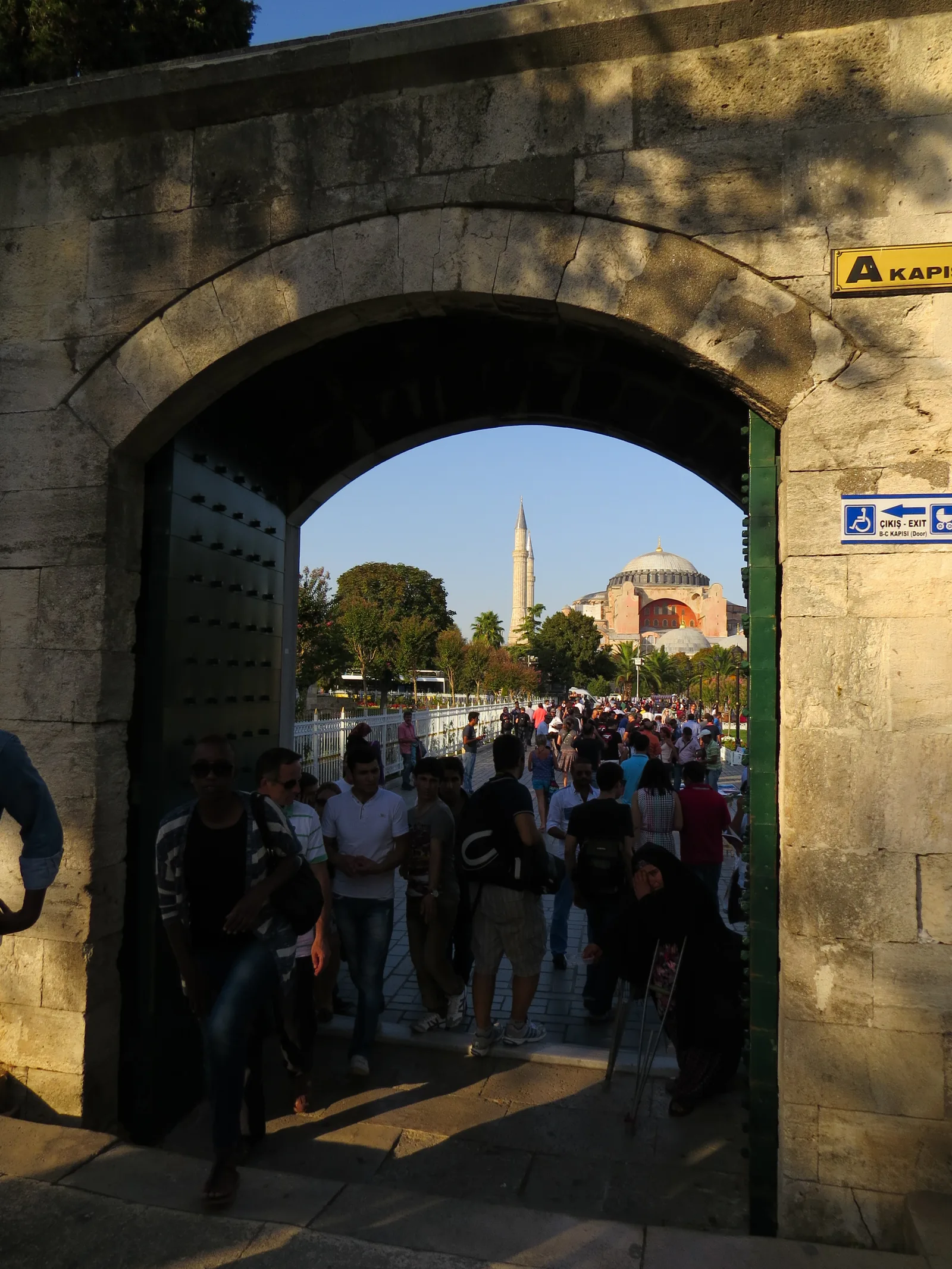
Blue Mosque (Sultan Ahmed)
Six minarets, a cascade of domes and over 20,000 Iznik tiles: the icon of Istanbul.
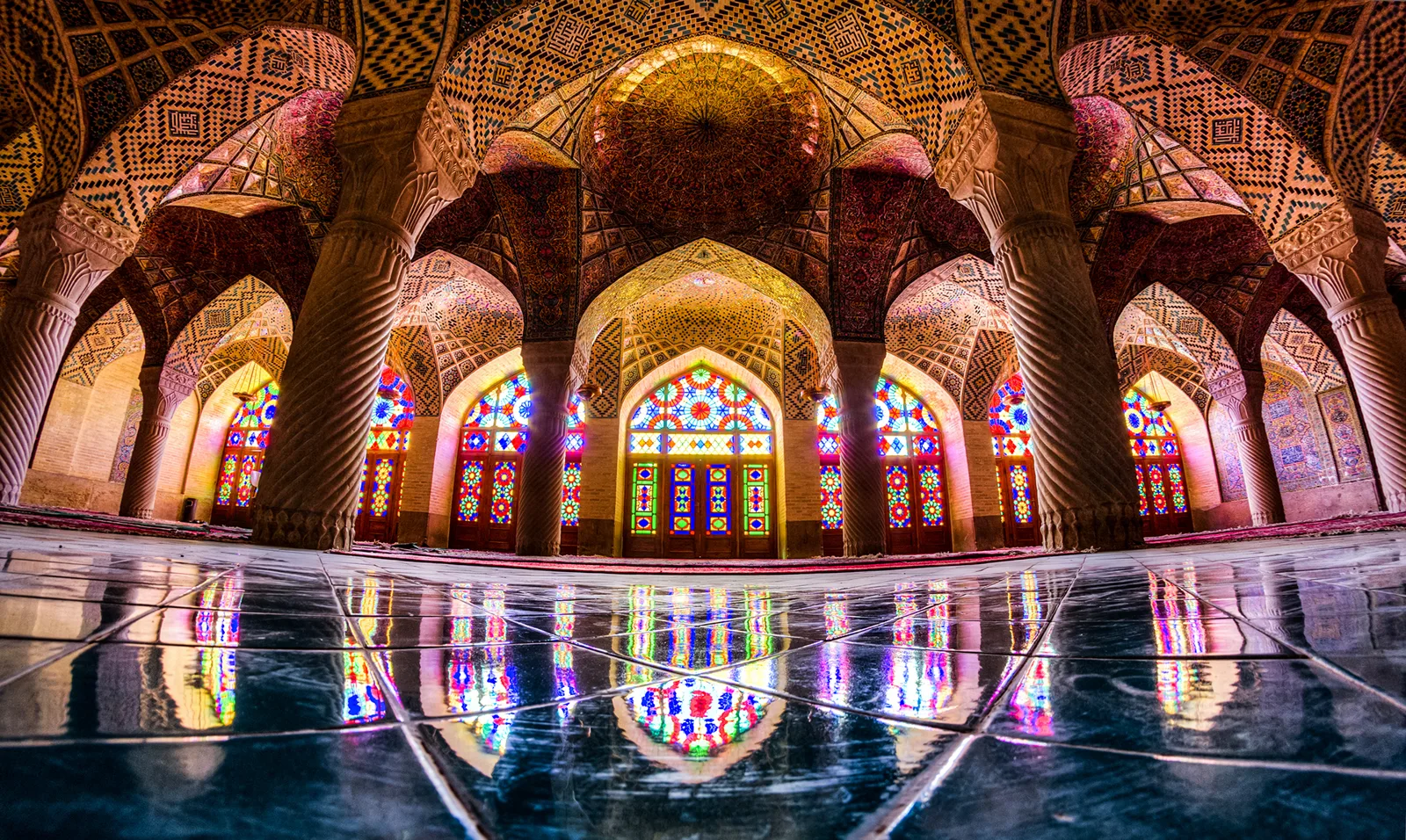
Nasir al-Mulk Mosque
Shiraz's "Pink Mosque", whose stained-glass windows turn every morning prayer into a kaleidoscope.
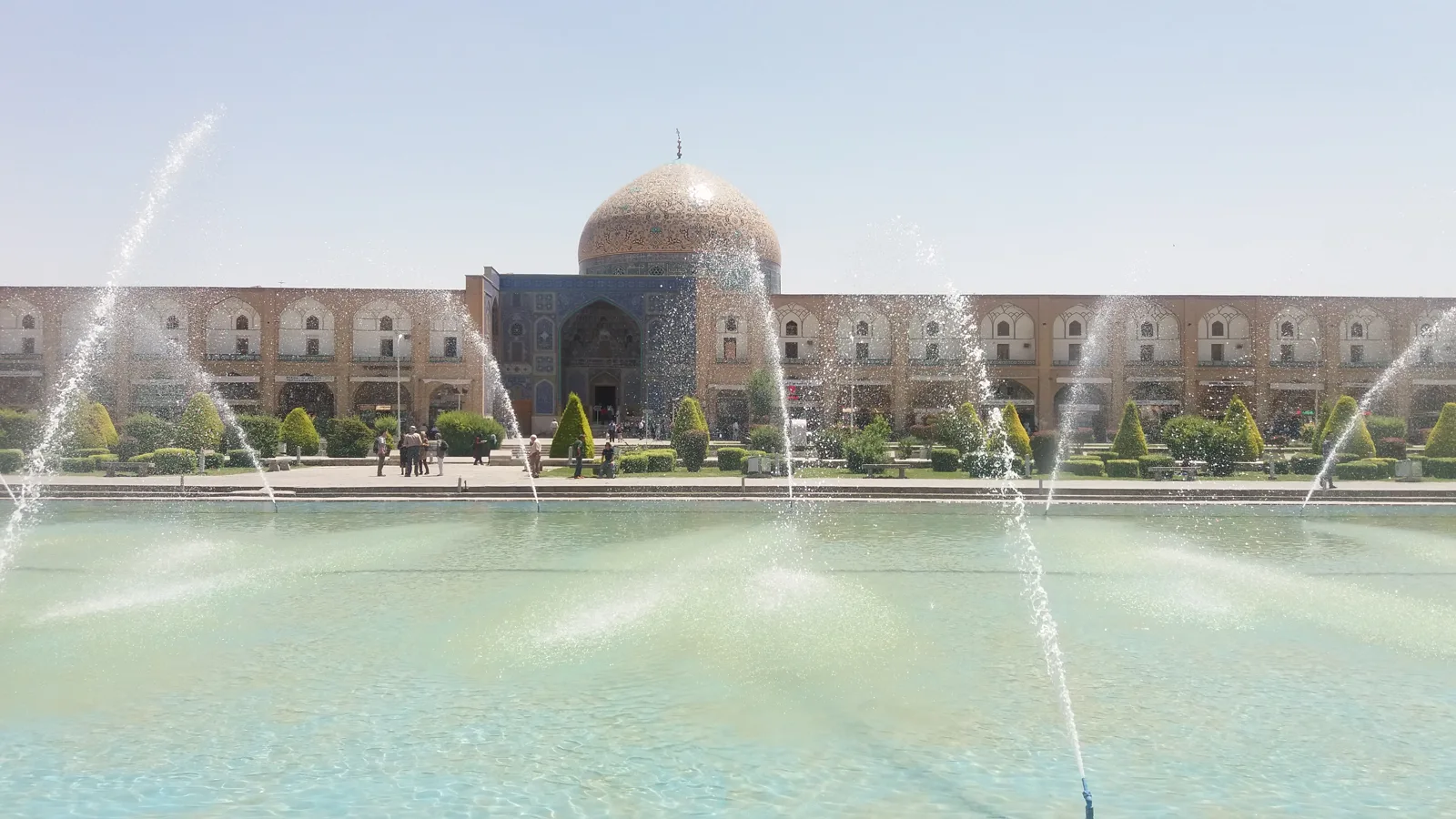
Sheikh Lotfollah Mosque
The Safavid jewel of Naqsh-e Jahan Square: no minaret, no courtyard, but Iran's most beautiful dome.
About this page's content: this site offers editorial and cultural content written with care and respect for the religious traditions concerned; it does not constitute a theological opinion or a source of religious authority. Despite our checks, errors, inaccuracies or approximations may remain. If you spot one, please let us know via the Contact page or by email at qibla.mosk@gmail.com, and we will correct it gratefully.